ABB and NVIDIA Promise Factory Robots Deployed Twice as Fast with Physical AI
ABB integrates NVIDIA Omniverse into RobotStudio to create ultra-realistic digital twins. Target: 99% sim-to-real correlation, -40% costs and -50% time-to-market. Foxconn is already piloting.
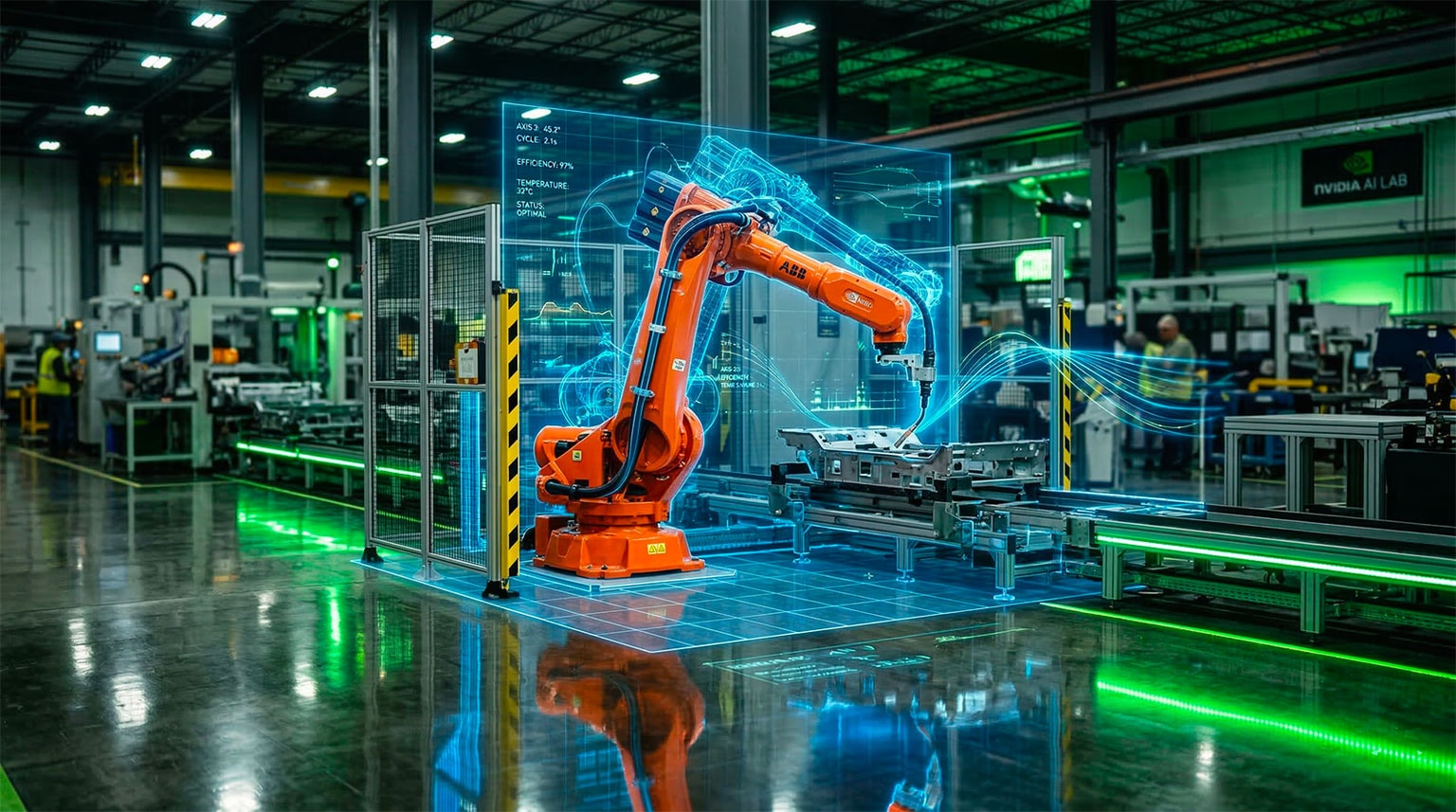
The partnership between ABB Robotics and NVIDIA has just taken a concrete industrial dimension. By integrating NVIDIA Omniverse libraries into its RobotStudio suite, ABB promises to drastically reduce the gap between simulation and reality — and with it, the costs and timelines for deploying factory robots.
The "Sim-to-Real Gap": Industrial Robotics' Nightmare
Anyone who has worked with industrial robots knows the problem: a perfectly calibrated robot in simulation behaves differently in the real world. Vibrations from a nearby press, changing lighting, a slightly deformed part — all variables that traditional simulators struggle to reproduce.
The result: weeks of on-site adjustments, halted production lines, and skyrocketing costs.
Physical AI promises to solve this problem by creating simulations so faithful to reality that the robot can be deployed almost directly.
RobotStudio + Omniverse: The Technical Solution
High-Fidelity Digital Twins
ABB integrates Omniverse into RobotStudio to create ultra-realistic digital replicas of complete robotic cells: robots, sensors, lighting, kinematics, parts to handle. Material physics, light reflections, collisions — everything is simulated with industrial precision.
Same Firmware, Virtual and Real
The key differentiator: the ABB virtual controller uses exactly the same firmware as the physical robot. This isn't a software approximation — it's the real software running in a simulated environment. Announced result: 99% correlation between simulated and real behavior.
Synthetic Data for Training
Omniverse also enables the generation of synthetic data (images, scenarios, edge cases) to train robot vision and decision models. No more need for thousands of hours of real-world data — simulation produces it on demand.
Concrete Business Benefits
ABB announces ambitious figures for RobotStudio HyperReality, scheduled for the second half of 2026:
| Metric | Improvement |
|---|---|
| Deployment costs | Up to -40% |
| Time-to-market | -50% |
| Sim-to-real correlation | 99% |
| Physical prototypes needed | Drastic reduction |
The Foxconn Case
Pilots are already underway at Foxconn, the electronics assembly giant. On a consumer component assembly line, ABB and Foxconn are testing deploying robots reconfigured entirely in simulation, without stopping production.
Imagine the scenario: Foxconn needs to adapt a line for a new smartphone model. Instead of 3 weeks of downtime and recalibration, the engineer reconfigures the robots in the digital twin in 3 days, validates the movements, and loads the program onto the physical robots on a Sunday evening. Monday morning, the line is producing.
What About Industrial SMBs?
One of the major challenges for physical AI is democratization. Today, only large corporations like Foxconn or BMW can afford sophisticated digital twins.
But ABB explicitly targets SMBs and mid-sized companies:
- RobotStudio is already used by thousands of integrators
- Omniverse integration could be offered in cloud mode, without heavy hardware investment
- Standardized robotic cell templates reduce configuration time
For an SMB automating its first welding or packaging line, this could mean the difference between a 6-month project and 6 weeks.
Competition Intensifies
ABB and NVIDIA aren't alone in the physical AI race:
- Google/Intrinsic (Alphabet subsidiary) is developing its own AI robotics platform
- Hyundai/Boston Dynamics bets on intelligent mobile robots
- Fanuc and KUKA are accelerating their simulation investments
- Tesla (via Optimus) is attacking the industrial humanoid robot market
The convergence of robotics + generative AI + high-fidelity simulation is redefining what a factory can accomplish — and how quickly it can adapt. This dynamic is part of the major tech trends transforming development in 2026.
Physical AI may be the AI domain with the most tangible short-term economic impact. Less hype than chatbots, but billions of dollars in industrial savings at stake. To understand how AI is also transforming software development, read our guide on AI-native applications.