Mistral AI Targets €1B Revenue in 2026: Arthur Mensch's Race Against Time
With €300M ARR, the Koyeb acquisition and 10,000 public agents equipped, Mistral AI wants to triple its revenue in 15 months. But competition from AMI, OpenAI and Google complicates the equation.
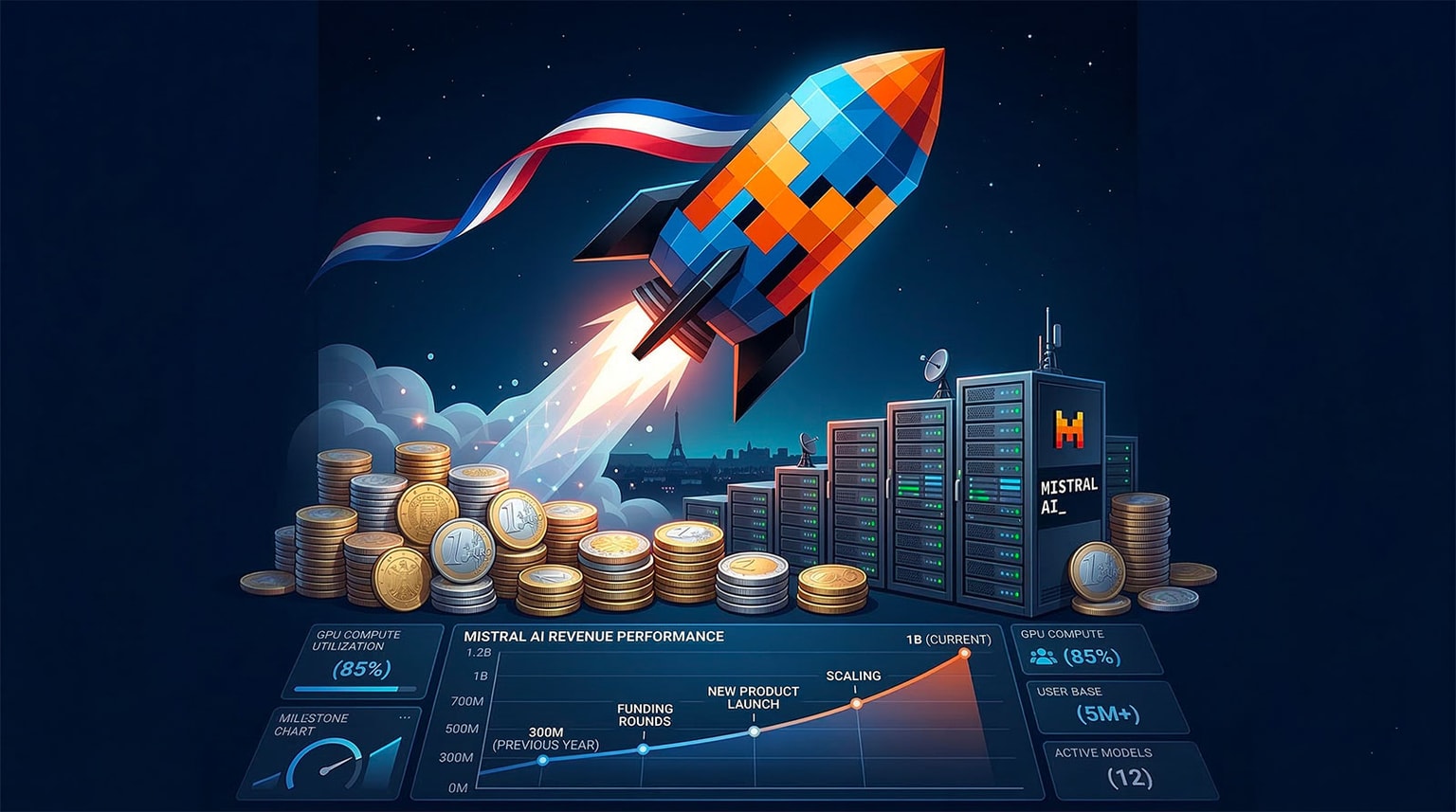
At Davos in January 2026, Arthur Mensch set an ambitious milestone: Mistral AI will exceed €1 billion in revenue by the end of 2026. A promise that, if fulfilled, would make the French sovereign AI champion one of the rare European startups to reach this threshold in under three years of existence. The challenge is colossal — and the window of opportunity, narrow.
From €300 Million to One Billion: The Growth Bet
In September 2025, Mistral posted an ARR of €300 million, driven by a historic €1.7 billion raise with ASML as a strategic shareholder, pushing the valuation to €11.7 billion. Going from €300M to over one billion in 15 months requires a 3.3x multiplication — a pace that even the most aggressive SaaS hypergrowth stories struggle to maintain.
Mistral relies on three revenue levers:
1. The pay-per-token API. The historical core of the business: developers and companies consuming Mistral models on a usage basis. A fast-growing market, but ultra-competitive against the aggressive pricing of OpenAI and Anthropic.
2. Private and sovereign licenses. This is the key differentiator. Banks, insurance, healthcare, defense — sectors that require their data to remain on controlled infrastructure. Mistral offers on-premise deployments and sovereign clouds, a niche where Big Tech is structurally disadvantaged in Europe.
3. The full-stack offering post-Koyeb. The most recent lever, and potentially the most transformative.
"Our ambition is not to sell models. It's to become the trusted AI infrastructure for businesses and governments that refuse to depend on American platforms." — Arthur Mensch, Davos, January 2026
Koyeb and Sovereign Infrastructure: The Strategic Pivot
The acquisition of Koyeb, a French cloud hosting platform, marks a major strategic shift. Until now, Mistral was a model provider — dependent on AWS, Azure, or GCP for execution. With Koyeb, Mistral becomes full-stack: models + infrastructure.
The logic is clear. When a European bank or government ministry deploys generative AI, the question is no longer just "which model?" but "where does my data run?". By controlling the infrastructure layer, Mistral can offer an integrated solution — sovereign model on sovereign cloud — that neither OpenAI nor Google can easily replicate on European soil.
It's also a margin question. Selling compute on top of the model means capturing a larger share of the value chain. To reach the billion, Mistral needs significantly higher revenue per customer than simple pay-per-token.
10,000 Public Agents Equipped: The State as First Customer
The deployment of Mistral tools to 10,000 French civil servants is a powerful signal. In Q1 2026, government employees are using Mistral AI assistants for drafting, document analysis, and administrative request processing.
The stakes go beyond the commercial. It's an act of digital sovereignty: France explicitly chooses a European alternative to American solutions. A precedent that could inspire other European administrations — and open a massive public sector market.
For startups building AI-native applications, this signal is also an opportunity: the French government validates that generative AI is ready for large-scale use, including in sensitive environments.
The Risks: AMI, OpenAI and Giant Pressure
The road to the billion is riddled with obstacles.
AMI Labs enters the arena. The announcement of Yann LeCun's €890M raise creates a new French competitor of real weight. Even though AMI targets world models rather than LLMs, the battle for talent, GPUs, and European investor attention intensifies. Two French champions is good for the ecosystem — but it also fragments resources.
The model race accelerates. GPT-5 from OpenAI, Gemini Ultra from Google, Claude 4 from Anthropic — every quarter brings a new model that pushes the benchmarks. Mistral must prove its open-weight models remain competitive against rivals spending 10 to 50x more on R&D. The open source vs proprietary AI debate is at the heart of this battle.
The burn rate is concerning. With a CAPEX commitment of roughly €2.8 billion for 2026, Mistral is spending heavily — on GPUs, infrastructure (Koyeb), hiring. If the trajectory toward the billion derails, the financial pressure will be immense. The €1.7B raise provides a runway, but not an infinite one.
European market dependency. The sovereign positioning is an asset in Europe, but a handicap internationally. In the US and Asia, companies don't face the same regulatory constraints — and Big Tech is on home turf. Mistral will need to prove its technology is competitive independently of the sovereignty argument.
Mistral AI is playing the most critical movement of its young history in 2026. The billion in revenue isn't just a financial target — it's proof that Europe can produce a world-class AI player. The coming quarters will tell whether Arthur Mensch's bet is vision or hubris.