Nyne: The AI Agent That Remembers You and Understands Your Human Context
Nyne is a UC Berkeley spinout giving AI agents persistent memory and human context. No more amnesiac chatbots. Full breakdown of the technology.
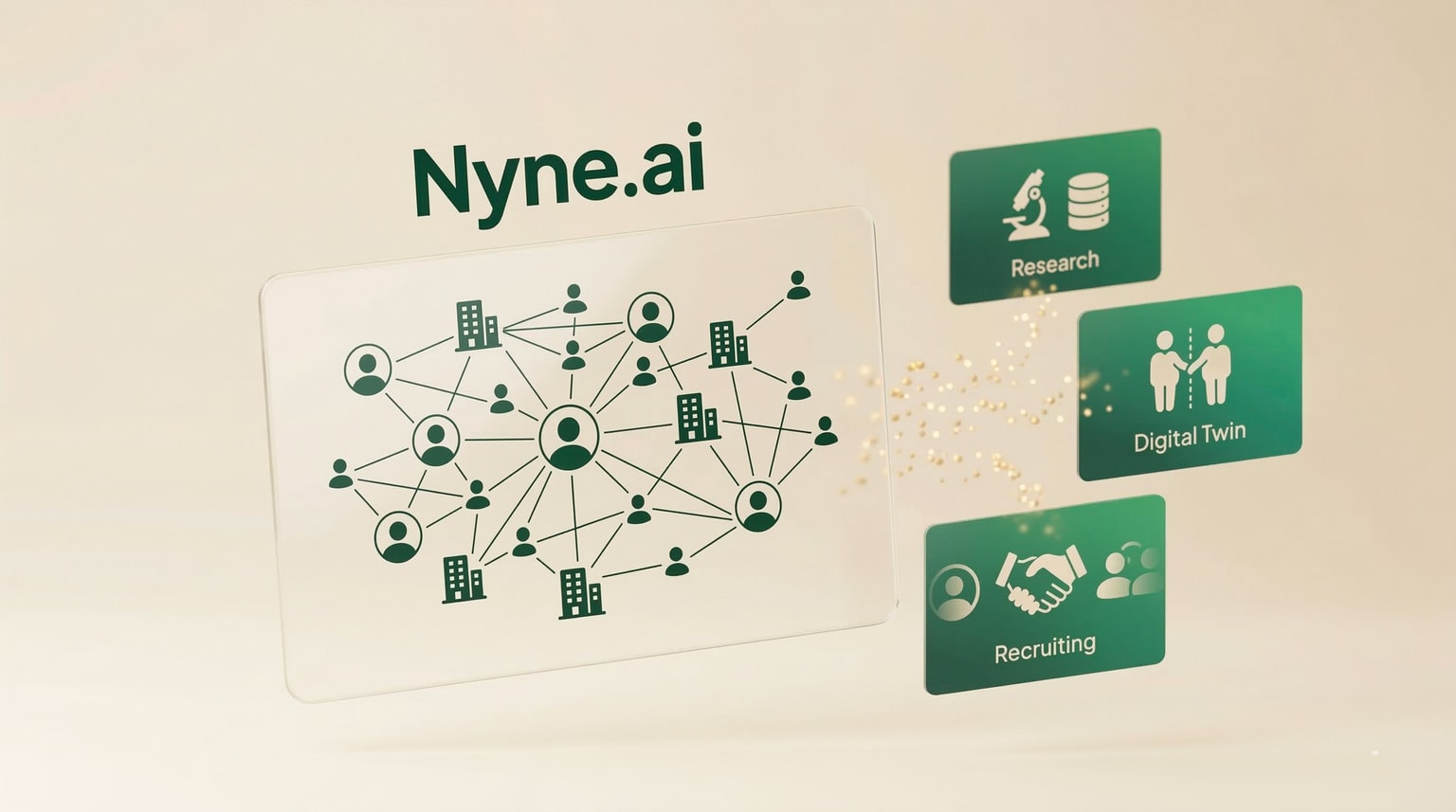
On March 16, 2026, a startup born out of UC Berkeley emerges from stealth. Nyne is building a persistent human context layer for AI agents. The goal: turn amnesiac chatbots into assistants that truly know you — your habits, your relationships, your current priorities. It's the missing link for builders creating INTERNAL LINK: autonomous AI agents | AI agents in enterprise article.
The Problem: AI Agents Are Amnesiac
Open a new conversation with ChatGPT, Claude or Gemini. The agent knows nothing about you. It doesn't remember you have an investor call tomorrow morning. It ignores your preference for Tailwind over raw CSS. It forgot your co-founder's name is Thomas.
This problem is structural. LLMs (large language models) work session by session. Each new window starts from scratch. Solutions exist — RAG (Retrieval-Augmented Generation) lets you plug in documents, and OpenAI offers a "Memory" feature in ChatGPT — but these approaches store raw facts. They don't understand context.
The difference between an assistant and a true collaborator is this understanding of human context. Not just what you said, but why you said it, to whom, and in what state of mind.
What Nyne Actually Does
Nyne, today, builds what the team calls a human graph. It's a structured model of your personal universe: your close relationships, active projects, routines, preferences and even emotional dynamics.
In practice, Nyne learns that your manager prefers short messages in the morning. That you're in the middle of a sprint before a launch. That your co-founder handles the front-end. This information persists across sessions and across devices — this is cross-session, cross-device memory.
The approach goes far beyond classic RAG. RAG retrieves relevant documents. Nyne models relationships, priorities and social dynamics. The agent no longer just searches for answers. It understands your situation.
The technology comes from BAIR (Berkeley AI Research), UC Berkeley's AI research lab — one of the most influential AI research centers in the world.
Nyne vs Existing Solutions
The memory market for AI agents isn't empty. But the approaches differ fundamentally.
| Solution | Memory type | Social context | Cross-session | Integration |
|---|---|---|---|---|
| Nyne | Human graph | ✅ | ✅ | Universal API |
| Mem0 | Vector-based | ❌ | ✅ | API |
| Letta (MemGPT) | Hierarchical | ❌ | ✅ | Open source |
| OpenAI Memory | Raw facts | ❌ | ✅ | ChatGPT only |
| Project Astra | Multimodal | Partial | ✅ | Google only |
Mem0 offers efficient vector-based memory. But it stores isolated facts without understanding the links between them. Letta (formerly MemGPT) uses hierarchical memory inspired by operating systems — innovative, but without social modeling. OpenAI Memory retains what you tell it, but stays locked within the ChatGPT ecosystem. Google's Project Astra integrates a multimodal component, but doesn't model emotional context.
Nyne positions itself above these solutions. Its API is compatible with the major agents on the market: Claude, GPT and Gemini.
What This Changes for Builders and Devs
For developers building agent workflows, Nyne solves a concrete problem. A INTERNAL LINK: vibe coding agent integrated into Cursor | vibe coding article that knows your code conventions, your stack and your naming preferences will be more effective from the first interaction.
An automation agent plugged into INTERNAL LINK: n8n or Make | automation agents article that knows you're preparing a product launch this week will prioritize the right tasks. A messaging assistant that understands your professional relationships will adapt the tone of each email.
Nyne integrates via a universal API. Builders can plug it into any existing INTERNAL LINK: RAG pipeline or LLM tool | LLM tools article without changing the base model. It's an additional layer, not a replacement.
The most immediate use case: personal AI agents. These assistants manage your calendar, emails, projects — and thanks to Nyne, no longer ask you to re-explain everything at each session.
The Vision: Toward an Agent That Truly Knows You
Nyne's ambition goes beyond the personal assistant. The team from INTERNAL LINK: UC Berkeley and BAIR | new AI labs article is working on a dynamic user representation that evolves in real time. Not a static profile, but a living model that captures changing priorities, context and emotional state.
Within 12 months, Nyne wants every AI agent — whether for code, sales, support or personal use — to natively have a deep understanding of its user. Persistent memory would no longer be an optional feature, but a standard.
The bet is ambitious. But the team starts with an edge: BAIR's research on multi-agent systems and human interaction modeling.
Key Takeaways
- Nyne is a UC Berkeley (BAIR) spinout building a persistent human context layer for AI agents, revealed on March 16, 2026.
- Nyne's human graph models relationships, preferences, habits and emotional dynamics — far beyond classic RAG.
- Memory is cross-session and cross-device: the agent remembers everything, regardless of platform or conversation.
- Nyne is compatible with Claude, GPT, Gemini and integrates via a universal API into Cursor, n8n, Make and Zapier workflows.
- Competitors (Mem0, Letta, OpenAI Memory, Project Astra) store raw facts but don't model the user's social and emotional context.
If an AI agent knows your habits, relationships and emotional state, it becomes a remarkably effective collaborator. But the open question remains: where do you draw the line between an assistant that understands you and a surveillance system that knows everything about you?