Vibecoding: Why the Best Developers Are Starting to Flee Companies That Abuse It
Vibecoding attracts 84% of devs but creates a silent crisis: seniors fleeing, explosive technical debt, juniors nowhere to be found. Forbes raises the alarm on March 9, 2026.
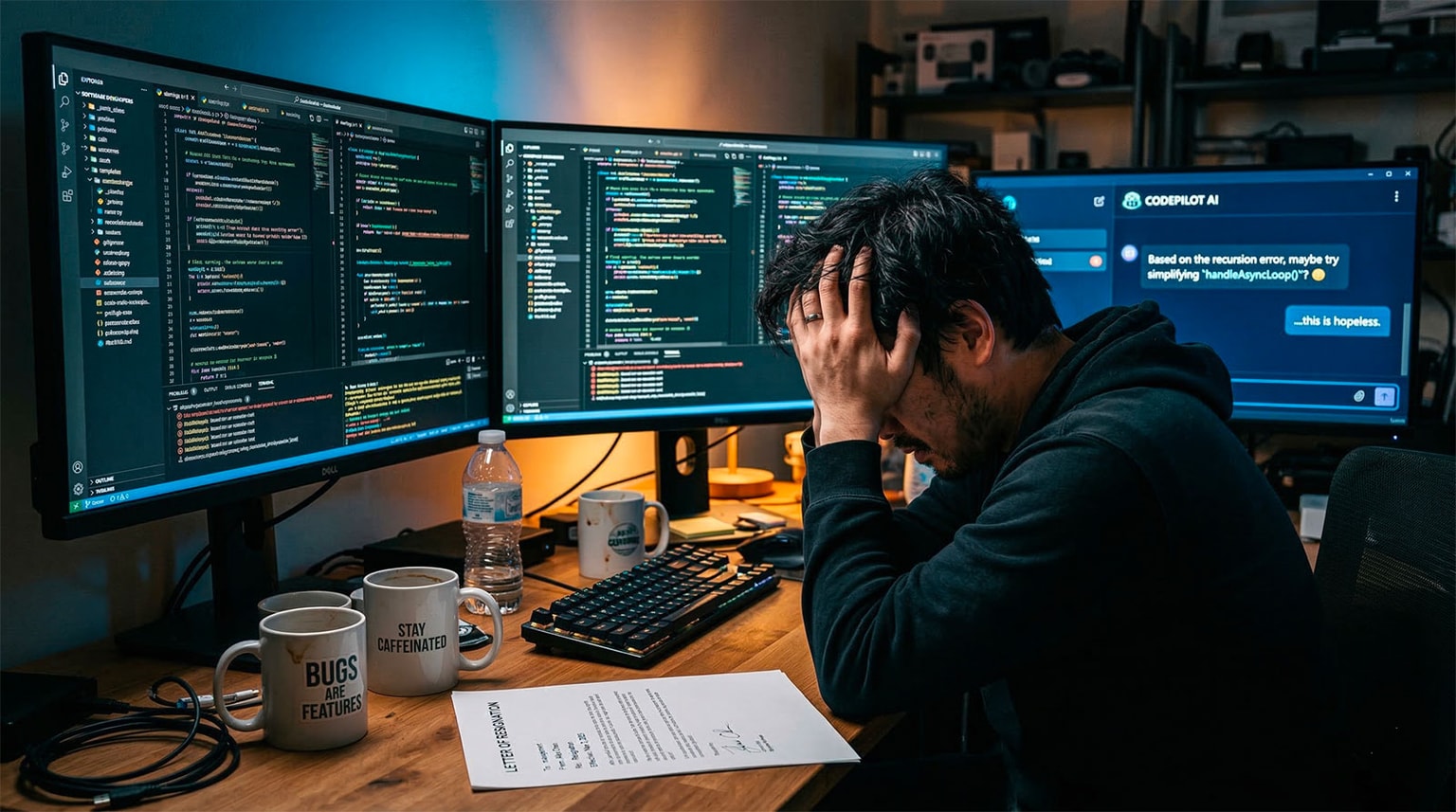
Vibecoding was supposed to liberate developers. In 2026, 84% of them use AI code generation tools — but only 29% trust them (PixelMojo 2026). The reversal is brutal: senior developers are walking out of companies that impose these tools without discernment, AI technical debt is exploding in production, and juniors are no longer being hired. On March 9, 2026, a Forbes Tech Council article put words to this malaise: engineer retention has become the number one challenge for teams that adopted vibecoding without guardrails. The problem isn't AI — it's how it's being deployed.
From $20 to $200 Per Month: When the Demo Becomes a Money Pit
Vibecoding's initial appeal rests on an irresistible economic argument: $20 a month for a copilot that generates code in real time. But Forbes describes a reality that teams discover in production: costs climb to $200 per month per developer as soon as the application moves beyond the prototype stage.
The reason is mechanical. AI-generated code is "token-heavy" — verbose, redundant, difficult to optimize. Every bug fix triggers a new paid API call. Every feature added weighs down a codebase that nobody actually wrote, and therefore nobody fully masters. For a SaaS app with a thousand users and fifty AI-powered features, the infrastructure and maintenance bill quickly exceeds initial savings.
The most telling signal: GitHub introduced a "kill switch" allowing automatic blocking of AI-generated pull requests after identifying systematic vulnerability patterns in submitted code. When the platform hosting the world's code deems a circuit breaker necessary, the message is clear.
Spaghetti Code and Technical Debt: Vibecoding's Dirty Secret
Imagine building a house with cardboard. It's fast, it looks impressive in photos — but the first rain reveals the problem. AI-generated code works the same way: it passes unit tests, produces a convincing demo, then collapses when faced with edge cases, load scaling, and security requirements.
The numbers are eye-opening. According to Aikido Security (survey of 450 developers and CISOs), 45% of AI-generated code contains vulnerabilities. Developer trust in AI code dropped from 77% in 2023 to 60% in 2026 (Hashnode State of Vibe Coding 2026) — and only 33% trust it for accuracy. Even more alarming: 40% of junior developers deploy AI code they don't understand.
The great vibecoding paradox boils down to two numbers: 84% adoption, 29% trust. The industry is massively using a tool it only half believes in.
Seniors Walking Out: The Real Human Cost
On Reddit, a senior engineer sums up the prevailing sentiment: "Being forced to use AI makes me want to leave the industry." CyberNews and multiple testimonies converge: experienced developers forced to use AI tools they didn't choose are leaving their companies — sometimes the profession entirely.
Those who stay suffer a phenomenon the community calls AI fatigue. Siddhant Khare, an engineer, describes his transformation: he now feels like a "reviewer" rather than an engineer — more productive on paper, but more exhausted than ever. Seniors absorb a disproportionate workload: reviewing AI code, perpetual refactoring, managing the technical debt the tools created. Burnout is accelerating.
And the outlook isn't reassuring. Steve Yegge, former Amazon and Google, author of the book Vibe Coding, predicted in Business Insider on February 10, 2026 that 50% of Big Tech engineers will be laid off: "You're going to have to get rid of half of them to make the other half maximally productive." Mark Zuckerberg doubled down by claiming an engineer could do the work of an entire team — a controversial quote fueling fears of massive layoffs.
No Juniors Today, No Seniors in 2027: The Ticking Time Bomb
On March 4, 2026, Forbes headlined: "No Juniors Today, No Seniors Tomorrow: The Cost Of Replacing Developers With AI." The figures are damning: 54% of engineering leaders plan to hire fewer junior developers thanks to AI (LeadDev survey 2025). Most startups now require a minimum of two years' experience.
The mechanical consequence is predictable but ignored: the seniors of 2028 — those who would today have 2 to 4 years of experience — don't exist. They weren't hired, weren't trained, weren't exposed to production code. The industry is sawing off the branch it's sitting on.
Maturity Phase: What Good Teams Do Differently
Forbes concludes aptly: "The vibe coding predicament is not indicative of a failure of AI — it represents a maturation phase. The next wave will prioritize reliable code capable of sustaining a business, not just demos."
Companies that successfully integrate vibecoding don't "vibe" blindly. They apply three rules:
- Vibecoding doesn't replace code review: every AI-generated PR goes through a senior who understands the business context, security, and scalability
- Tools are chosen, never imposed: teams collectively decide which workflows benefit from AI — the rest stays artisanal
- Juniors are trained with AI, not replaced by it: human-AI pair programming becomes a skill-building tool, not a substitute for learning
The next wave of vibecoding won't be about the fastest code. It'll be about the most reliable.
And you — in your team, is vibecoding a chosen tool or a mandated imposition?