
Cloudflare Launches EmDash: The Open-Source WordPress Successor Built for AI Agents — Native MCP, Sandboxed Plugins, TypeScript
EmDash v0.1.0 beta: open-source TypeScript CMS by Cloudflare, the spiritual successor to WordPress. Native MCP Server, V8 Isolates sandboxed plugins, Astro 6.0, MIT license.
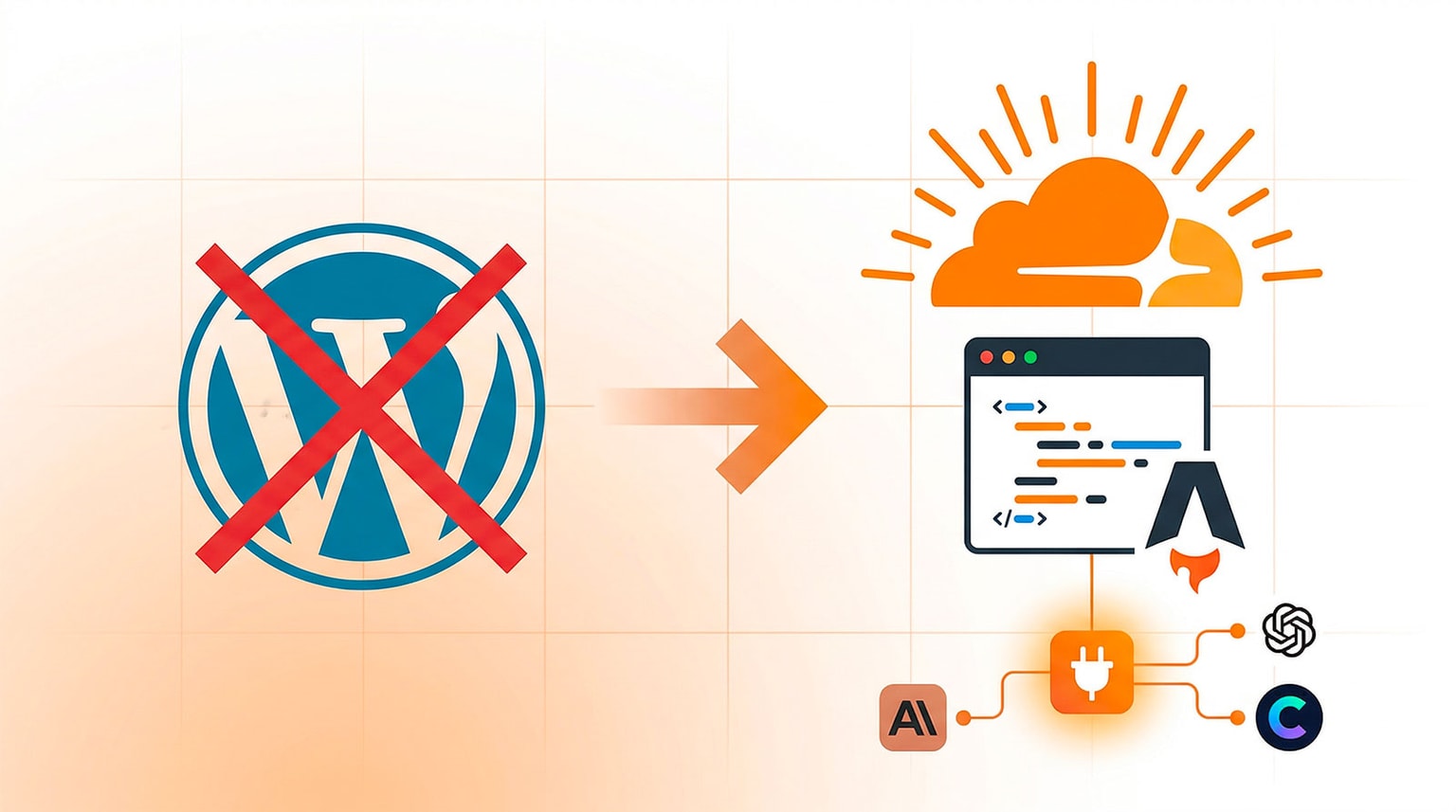
WordPress powers 43% of the web and has since 2003. Cloudflare just published its spiritual successor as open-source — built from scratch for AI agents. EmDash: TypeScript, Astro 6.0, sandboxed plugins, and a native MCP server that lets Claude manage your site directly. v0.1.0 beta, MIT, EmDash GitHub repository. The timing is perfect and the launch is real — despite April 1st.
WordPress is 23 years old. It shows.
WordPress was created in 2003. Back then, "publishing on the web" meant writing PHP, configuring an Apache server and hoping updates wouldn't break everything. Twenty-three years later, the architecture hasn't fundamentally changed.
Three structural problems pushed Cloudflare to act.
Plugin security is a disaster. In 2025, over 11,300 new WordPress plugin vulnerabilities were reported. Not because developers are incompetent. Because WordPress's PHP architecture gives every plugin full access to the site — database, files, configuration. A single compromised plugin takes the entire site down.
The PHP architecture is frozen. Serverless — running code without a dedicated server — didn't exist in 2003. Neither did AI agents. WordPress has no native mechanism to interact with an agent. You need to stack plugins to simulate what the architecture should handle natively.
Scaling is manual. More traffic? Buy a bigger server. Traffic spike? Hope for the best. Edge computing — distributed processing close to the user — is incompatible with WordPress's monolithic model.
Cloudflare's summary: "the spiritual successor to WordPress that solves plugin security." WordPress is brilliant for 2003. EmDash is built for 2026.
V8 Isolates: the end of dangerous plugins
V8 Isolates are the same technology Chrome uses to isolate browser tabs from each other. Each tab runs in its own secure environment. If a malicious site compromises one tab, the others remain intact.
EmDash applies this principle to CMS plugins. Each plugin runs in its own isolated bubble. It cannot read another plugin's data. It cannot modify the CMS core. It cannot access the server's file system.
If a plugin is compromised: it's compromised alone. The rest of the site keeps running normally.
This is architecturally impossible in WordPress. All plugins share the same memory space, the same MySQL database, the same files. A vulnerable plugin compromises everything. EmDash eliminates this entire class of vulnerabilities by design.
The native MCP Server: the real breakthrough
This is EmDash's killer feature. Every instance exposes an MCP server — Model Context Protocol — natively. No third-party plugin required. It's built into the CMS core.
MCP is the standard protocol that lets AI agents communicate with external tools. Claude, ChatGPT, Cursor — any MCP-compatible agent can connect directly to your EmDash site.
In practice: "Claude, create an article about the EmDash launch with this image, this SEO schema and this category." Claude executes. The site updates. No copy-paste. No graphical interface. No integration plugin.
This is exactly what Linear Agent does for product management — the agent works within the product's context, not beside it. And what Figma Canvas Agents does for design. EmDash applies the same logic to CMS.
Joost de Valk, founder of Yoast SEO, confirms: "I can point Claude at it and say 'build me a theme' — the MCP server makes it actually work." His full review details the developer experience.
EmDash provides three tools for AI agents:
| Tool | Function | Compatible agent |
|---|---|---|
| EmDash CLI | Upload media, schemas, programmatic content | Any CLI agent |
| Native MCP Server | Full site management via remote MCP | Claude, ChatGPT, Cursor |
| Typed TypeScript API | Structured documentation, zero hallucination | Any LLM |
Portable Text: content becomes an API
WordPress stores content as HTML blobs in a MySQL database. Raw HTML mixed with proprietary shortcodes. For an AI agent, parsing this content is like reading a 90s Word document — doable but fragile and unpredictable.
EmDash uses Portable Text. It's structured JSON. Every content block — title, paragraph, image, quote — is a typed object with clear properties. Any agent, any frontend, any AI can read and modify content without parsing HTML.
It's the same principle Figma applied to design. Everything is JSON. Everything is structured. Everything is programmatically manipulable. Applied to editorial content, it changes the game for vibe coding and agentic workflows.
The full technical stack:
| Criteria | WordPress | EmDash v0.1.0 |
|---|---|---|
| Language | PHP (2003) | TypeScript (2026) |
| Architecture | Traditional server | Serverless / Edge |
| Plugin security | Global access | V8 Isolates sandboxed |
| Authentication | Login/password | Native Passkey |
| MCP Server | Third-party plugin | Native built-in |
| Native AI agents | No | CLI + MCP + Typed API |
| Content storage | HTML blob (MySQL) | Portable Text (JSON) |
| Agent monetization | No | Native |
| License | GPL | MIT |
| Plugin ecosystem | 60,000+ | Nearly nonexistent (beta) |
| Maturity | 20+ years | v0.1.0 beta |
EmDash also integrates native monetization for the AI era. Publishers can charge classic human subscribers, but also AI agents and crawlers accessing their content. This is the first native implementation of this logic in a CMS — a direct answer to the question every publisher asks: how do you monetize when AI scrapes your content?
Honest limitations: v0.1.0 is not WordPress
No overselling. Ben Ryan, independent reviewer, said it clearly: "Zero ecosystem. For 99% of WordPress sites: keep what you have. For greenfield projects: keep watching."
The ecosystem is nearly nonexistent. Zero third-party plugins. Few themes. Migrating complex WordPress sites — those with hundreds of custom plugins — isn't documented in detail. On Reddit r/BigSEO, the community asks the hard question: "How do you migrate sites with hundreds of custom plugins?"
But for 2026 greenfield projects — new sites, modern stacks, teams already working with autonomous web agents — EmDash is the only CMS built for this world. And Cloudflare, which already hosts 20%+ of the web via its DNS, CDN, Workers and Pages services, has the infrastructure to make it the next standard within 12 to 18 months.
The code is on the EmDash GitHub repository and the Cloudflare official announcement details the long-term vision. The competition — Ghost, Sanity, Contentful, Strapi — has been put on notice.
Key takeaways
- Cloudflare launches EmDash v0.1.0 beta on March 31, 2026: open-source TypeScript CMS described as the "spiritual successor to WordPress", MIT license, public GitHub
- Stack: Astro 6.0, Cloudflare Workers + D1 (edge SQLite) + R2 (object storage), V8 Isolates sandboxed plugins, native Passkey, Portable Text (structured JSON)
- Killer feature: native built-in MCP Server — Claude, ChatGPT, Cursor can manage the site directly without third-party plugins
- Native AI agent monetization: publishers can charge crawlers and agents accessing their content — first implementation in a CMS
- Main limitation: v0.1.0 beta, nearly nonexistent ecosystem — ideal for greenfield projects, not yet for complex WordPress migrations
WordPress was built when "publishing on the web" meant writing PHP and managing an Apache server. EmDash was built for a world where "publishing on the web" means telling Claude what you want and letting it build. The migration won't be instant — WordPress's ecosystem has 20 years and 60,000 plugins. But the architecture has shifted. And Cloudflare, which already hosts 20% of the web, just gave vibe coding its first native CMS.


