
Emergent Launches Wingman — The Messaging-First AI Agent That Turns an Indian Vibe Coding Startup Into a Direct Rival to Claude and OpenClaw
Emergent, the Indian vibe-coding unicorn valued at $300M with $100M raised in total, launched Wingman on April 15, 2026 — an autonomous AI agent that lives in WhatsApp and Telegram. 8 million builders, 1.5 million MAU, and a clear repositioning: from no-code to autonomous background execution.
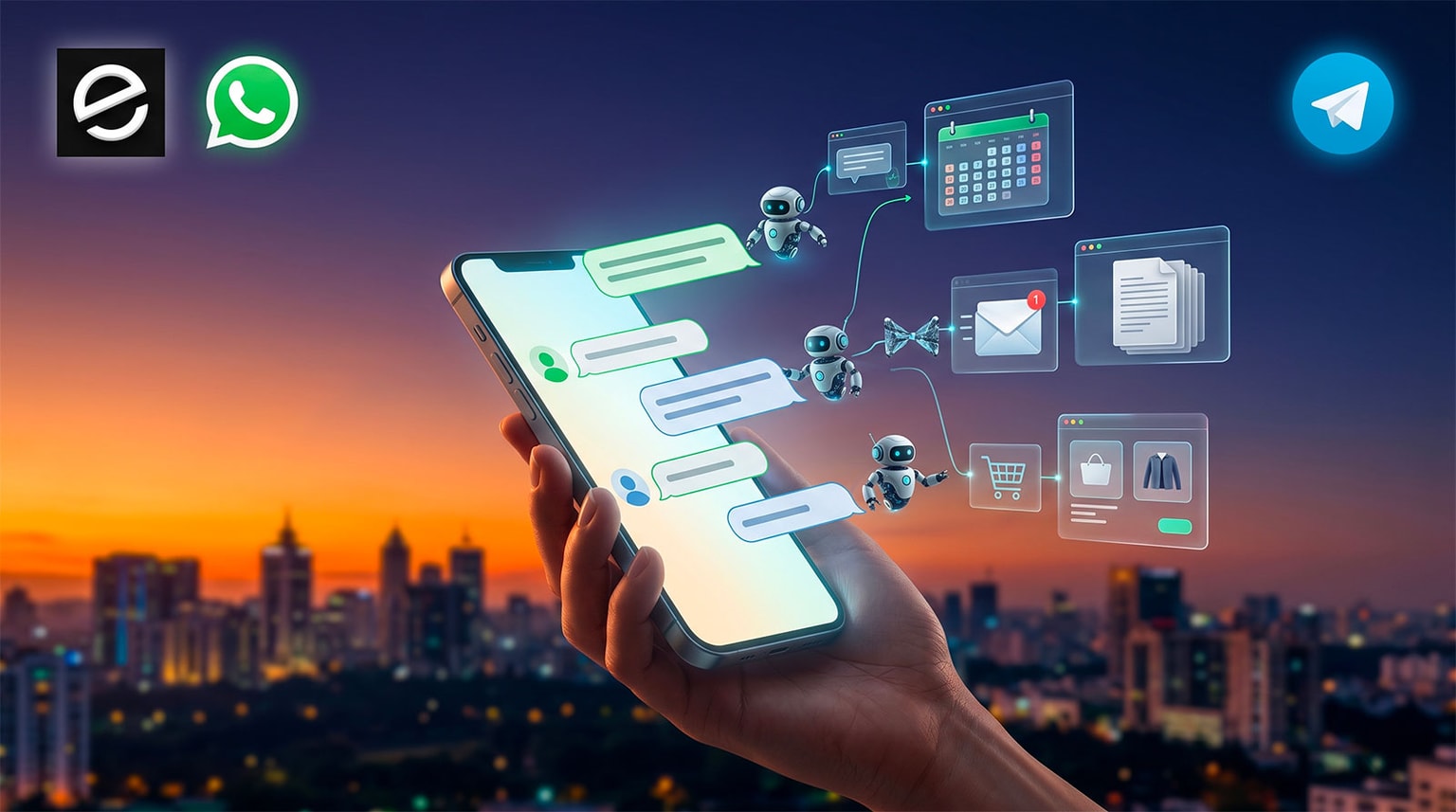
Indian vibe coding goes on offense. On April 15, 2026, Emergent — the Bangalore startup that lets anyone build full-stack apps with natural language — launched Wingman, its first persistent autonomous AI agent. The positioning is crystal clear: Wingman doesn't live in a browser or an IDE, it lives in WhatsApp and Telegram. Users chat with their agent like a colleague, and Wingman runs in the background across email, calendar, SaaS tools. In seven months, Emergent has raised $100 million total, hit 8 million builders and 1.5 million MAU, and now positions itself as a direct rival to Claude (Anthropic) and OpenClaw (OpenAI) — from Bangalore, not San Francisco.
Emergent Before Wingman: The Vibe Coding Unicorn Nobody Watched
Founded in 2025 by Kabeer Biswas (co-founder of Dunzo, the famous Indian delivery unicorn acquired by Reliance), Emergent is the South Asian answer to Lovable, Bolt, and v0. Its platform lets you build a full-stack app (frontend + backend + database) from a prompt in English or Hindi. 8 million builders generated and deployed code on Emergent in less than a year. 1.5 million monthly active users. Free-to-paid conversion rate of 12%, per figures shared with TechCrunch.
Funding rounds have been fast:
| Date | Round | Amount | Valuation |
|---|---|---|---|
| June 2025 | Seed | $30M | $100M |
| January 2026 | Series B | $70M | $300M |
| Total raised | $100M |
Investors: SoftBank (lead Series B), Khosla Ventures, Lightspeed Venture Partners India, Accel India. The pace is comparable to Lovable's in 2025: first building consumer product-market fit, then pivoting to the platform. Except Emergent targets non-developers from day one — "builders without a technical background" — while Lovable initially targeted devs.
Wingman: The Messaging-First Play
Wingman is a counter-intuitive bet. While Claude walls its desktop interface and Perplexity Computer lives in a browser, Emergent picks WhatsApp and Telegram as its main surface. Reason Biswas gave in the Emergent blog: "In India, Southeast Asia, Brazil, Africa, the browser isn't the productive surface. WhatsApp is."
Wingman architecture:
1. Conversational interface — Wingman lives as a WhatsApp contact or a Telegram bot. The user gives instructions in natural language: "Summarize this week's unread emails", "Book me a Paris-Singapore economy flight under €800", "Publish yesterday's drafted LinkedIn post at 2pm". No clicks, no dashboard. One conversational thread.
2. Background workers — Wingman deploys workers on connected tools (Gmail, Outlook, Google Calendar, Notion, Slack, HubSpot, Shopify). Workers run 24/7, triggered by calendar, event, or one-shot instruction.
3. Trust boundaries — Central concept: Wingman distinguishes three permission levels.
- Autonomous: routine tasks executed without confirmation (inbox cleanup, classification, note-taking)
- Confirm: consequential tasks requiring approval (external email, payment, public publishing)
- Pause: ambiguous tasks where the agent halts and asks for clarification
The system is designed to solve the "liability gap" that killed many agents in 2025 (agents sending embarrassing emails, buying the wrong ticket, publishing something awkward).
4. Persistence — Wingman holds long-term context. The agent remembers preferences, deadlines, important contacts, internal processes. Emergent showcased an internal benchmark: on a "6-week personal assistant onboarding" scenario, Wingman hits 94% of human performance by week 3.
OpenClaw, Claude, Wingman: The Autonomous Agent War Takes Shape
Wingman enters a market until now dominated by two players:
| Player | Surface | Positioning | Price |
|---|---|---|---|
| Claude (Anthropic) | Desktop + Cowork + API | Enterprise, deep reasoning | $100-400/user/mo |
| OpenClaw | Browser + open-source SDK | Developers, extensible | Free + compute |
| Wingman (Emergent) | WhatsApp + Telegram | Consumer, emerging markets | $15/mo consumer, $45 pro |
The price positioning is aggressive. At $15/month for the consumer plan, Wingman is 6x cheaper than Claude Pro ($100) and targets a market no one else looks at: mobile-first users who don't own a primary laptop. In India, Brazil, and Indonesia, the phone is the computer for 80% of knowledge workers. WhatsApp has 500 million active users in India, 120 million in Brazil, 90 million in Indonesia.
What This Changes for Vibe Coding
Wingman marks the convergence of two categories that were separate until now:
- Vibe coding: building apps with natural language (Cursor, Lovable, Emergent, Replit)
- Autonomous agents: executing tasks in the background (Claude, OpenClaw, Perplexity Computer, Manus)
They were separate. Cursor doesn't run your calendar. Claude doesn't build your app. Emergent fuses them: you build the app with Emergent, then deploy Wingman inside your app to manage your end users. It's the first vibe coder to ship an agent runtime on top of the code runtime.
The pattern echoes what Vercel did with the chat SDK agents — directly embedding agents into conversational channels (Slack, Discord, WhatsApp). Vercel and Emergent are now aligned on the same thesis: the agentic future doesn't come through new interfaces, but through injecting agents into existing surfaces.
3 Headwinds to Watch
1. Meta / WhatsApp Business API dependency. Wingman lives in WhatsApp, which is controlled by Meta. Any restriction on the WhatsApp Business API could kill the product overnight. Emergent announced work on a Telegram + Discord + Signal fallback, but WhatsApp stays the primary surface in India.
2. Competition with foundation models. If Anthropic or OpenAI launch native WhatsApp integrations (Claude WhatsApp rumors have been circulating since March), Wingman loses its surface advantage. Emergent's moat is technological (trust boundaries, memory system), not distributional.
3. Economics at $15/month. To hit profitability, Emergent must maintain LTV / CAC > 3 on a hyper-price-sensitive market. Indians and Brazilians pay less than Americans for SaaS. Unit economics at $15/month stays fragile, especially if Claude / GPT inference costs don't drop 30% this year.
TL;DR:
- Emergent launches Wingman on April 15, 2026 — first messaging-first AI agent in vibe coding
- Interface: WhatsApp + Telegram (no browser, no desktop) — mobile-first bet for emerging markets
- $100M raised in total, $300M valuation (SoftBank, Khosla, Lightspeed, Accel)
- 8 million builders on the vibe coding platform, 1.5M MAU
- Trust boundaries: 3 permission levels (autonomous, confirm, pause) to solve the "liability gap"
- Pricing: $15/mo consumer, $45/mo pro — 6x cheaper than Claude Pro
- Direct rival to Claude (Anthropic) and OpenClaw (OpenAI) on the consumer autonomous-agent market
Emergent made the bet that in 2026, the AI-agent war isn't won with the best model — it's won with the best deployment surface. Claude has intelligence, OpenClaw has open source, Wingman has WhatsApp. In a world where 3 billion people use WhatsApp every day and only 10% of them own a laptop, that might be the most underestimated advantage of the current generation. The question now is whether Meta lets an agentic competitor thrive on its infrastructure — or whether Zuckerberg decides to embed Llama inside WhatsApp by end of 2026.
Sources: TechCrunch — Emergent enters OpenClaw-like space, Techloy — Wingman paid AI agent, Startup News — Wingman launch, Laffaz — Persistent AI agent, TechBuzz — Wingman WhatsApp.


