
GTC 2026 Recap: Vera Rubin, Physical AI, Open-Weight Models and a $1 Trillion Opportunity
Full recap of Nvidia GTC 2026: Vera Rubin NVL72, Physical AI, $26B open-weight push, Groq deal, and Jensen Huang's $1 trillion AI factory opportunity.
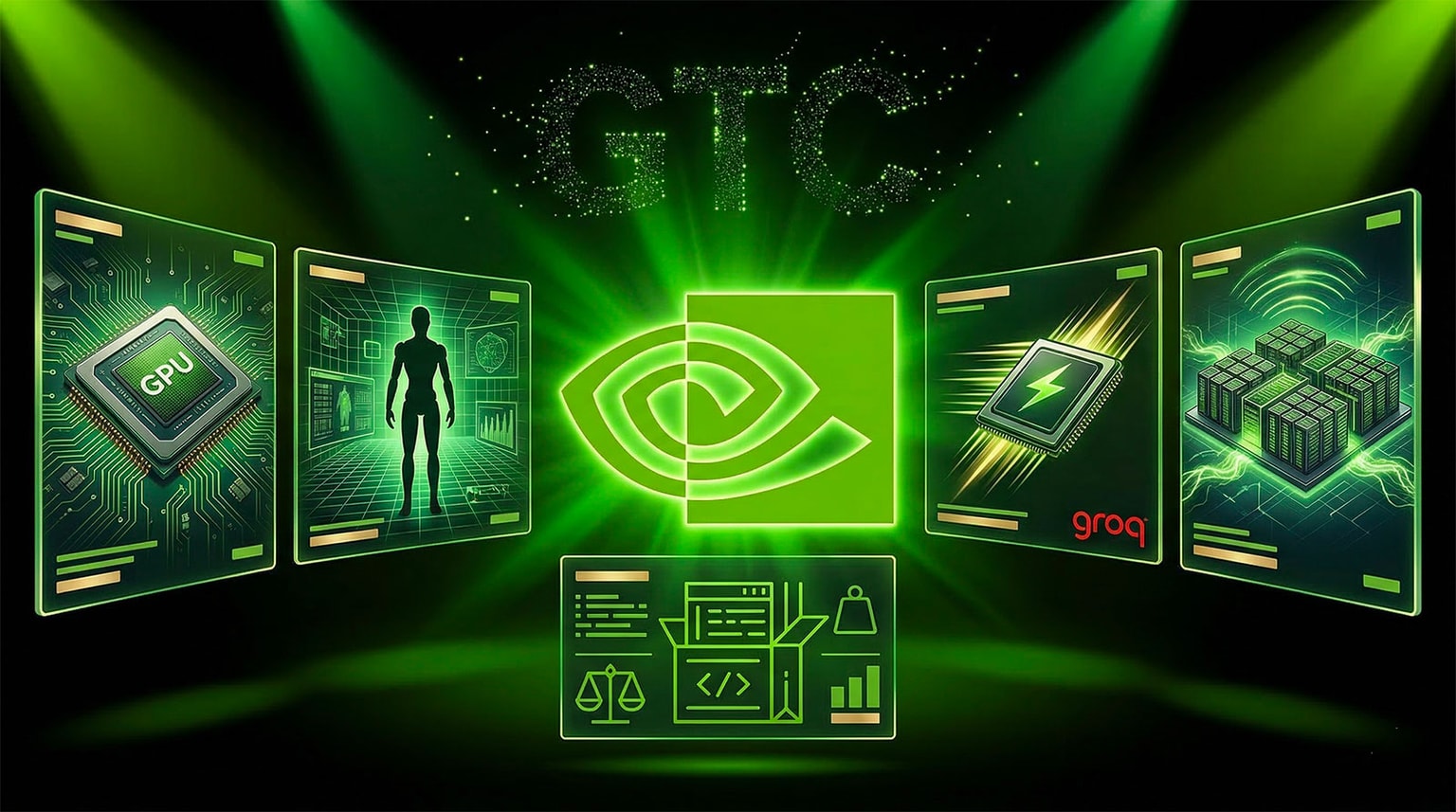
Nvidia GTC 2026 wrapped up today, March 19 — four days of announcements that map the next three years of AI. Jensen Huang didn't just unveil GPUs. He announced that Nvidia is becoming an AI lab, a robot builder, and the financier of open source. Here are the five announcements that actually matter.
Vera Rubin: Blackwell Is Already Old News
In the auto industry, a new model ships every three to four years. Nvidia ships a new GPU generation every twelve to eighteen months. Vera Rubin NVL72 is proof of that pace.
Announced during Jensen Huang's keynote at GTC 2026 (GPU Technology Conference, Nvidia's annual event in San Jose), Vera Rubin succeeds Blackwell — which shipped in late 2025. Expected availability: second half of 2026.
The numbers: 3.3x more powerful than Blackwell on inference (the phase where an AI model generates responses, as opposed to training where it learns). The architecture packs 72 GPUs per rack, interconnected via NVLink, Nvidia's ultra-fast linking technology.
The price? Several million dollars per system. This isn't a consumer product. It's the infrastructure of AI factories — data centers entirely dedicated to AI.
Physical AI: Robots Are Coming, Trained in Simulation
Jensen Huang said it plainly: Physical AI is "the next big wave after LLMs" (large language models like ChatGPT or Claude).
Physical AI is AI that controls physical objects — robots, autonomous vehicles, industrial arms. And Nvidia wants to provide the entire training platform.
Isaac Sim is the centerpiece. It's a robot simulator: you train a robot in a virtual environment before letting it touch the real world. Jensen Huang's metaphor: "crash-testing a car virtually before building the real thing."
Omniverse, Nvidia's physics simulation platform, was updated to support these use cases. The partnerships announced at GTC 2026 are telling: Boston Dynamics, Figure, and Tesla Optimus. The three leaders in humanoid robotics are building on Nvidia infrastructure.
Jensen Huang's quote: "Every robot, every autonomous vehicle, every factory will be trained in simulation before touching the real world."
$26 Billion in Open-Weight: Nvidia Becomes an OpenAI Competitor
This is the most structurally significant announcement long-term. An SEC filing confirmed the figure: Nvidia is investing $26 billion over five years to build its own open-weight AI models (models whose weights are published — anyone can download and use them).
First concrete result: Nemotron 3 Super. The model has 120 billion total parameters, with 12 billion active simultaneously. It's already deployed at Perplexity, Siemens, Palantir, and Cadence.
The signal is massive. Nvidia no longer just sells GPUs. It's building the entire AI stack — from silicon to models. If Nvidia makes the GPUs and the models, the question becomes: who still needs OpenAI or Anthropic for foundation models? The model race just took a new turn.
It's also a strong signal for sector investment. As the AI funding explosion in 2026 shows, capital is shifting toward infrastructure.
The Groq × Nvidia Deal: Inference Becomes the New Battleground
$20 billion. That's the size of the deal between Nvidia and Groq, announced at GTC 2026. Groq 3, the new ultra-fast inference chip, was unveiled on stage.
Why so much money on inference? Because the market is shifting. Training an AI model happens once. Inference — every time a user asks a question — happens billions of times a day.
Jensen Huang summed it up: "Inference will be as big as training within the next two years." Groq 3 positions itself as an Intel competitor on dedicated AI compute processors. The bet: making inference as fast as human thought.
Nvidia also invested in Thinking Machines Lab, Mira Murati's new lab — another signal that the AI ecosystem is restructuring around Nvidia.
$1 Trillion — and Wasted Watts
The quote that sums up all of GTC 2026:
"There is so much power squandered in these AI factories. Every unused watt is revenue lost." — Jensen Huang
Nvidia's projection: the total AI factory market will reach $1 trillion. AI data centers are the new critical global infrastructure — bigger than roads, cables, or telecom towers.
But Jensen Huang points to a problem: a massive share of that power is wasted. GPUs throttled to avoid electrical spikes. Unused compute cycles. Watts that produce nothing.
This is exactly what startups like Niv-AI are trying to solve — optimizing every watt, every cycle, every GPU inside data centers. The $1 trillion opportunity isn't captured by adding more GPUs. It's captured by eliminating waste.
In summary:
- Nvidia GTC 2026 (March 16-19, San Jose) unveiled Vera Rubin NVL72, Blackwell's successor, available H2 2026 — 3.3x more powerful on inference.
- Jensen Huang declared Physical AI the "next big wave" and showcased robot simulations via Isaac Sim and Omniverse, with Boston Dynamics, Figure, and Tesla Optimus.
- Nvidia is investing $26 billion over 5 years in open-weight models — Nemotron 3 Super is already deployed at Perplexity, Siemens, Palantir, and Cadence.
- The Groq × Nvidia $20 billion deal positions inference as equally strategic as training — Groq 3 was unveiled on stage.
- Jensen Huang estimates the total AI factory opportunity at $1 trillion — "every unused watt is revenue lost."
| Announcement | Detail | Impact |
|---|---|---|
| Vera Rubin NVL72 | 3.3x Blackwell, H2 2026 | New AI GPU standard |
| Physical AI + Omniverse | Robots trained in simulation | Robotics revolution |
| $26B open-weight | Nemotron 3 Super already live | Nvidia becomes an AI lab |
| Groq × Nvidia deal | $20B, Groq 3 unveiled | Inference = new battleground |
| $1 trillion opportunity | "Every unused watt is revenue lost" | AI factories = critical infra |
GTC 2026 isn't a GPU conference. It's a conference about eliminating idle resources at every scale — from wasted watts in data centers to throttled GPUs avoiding electrical spikes, to robots that don't exist yet but are already training in simulation before touching the real world. Jensen Huang sees a world where nothing sits idle. Every watt produces. Every GPU computes. Every robot trains, even when it doesn't physically exist yet. That's exactly the Idlen philosophy.


