
Meta Spends $135B on AI and May Have to Call Google for Help
Meta delays its flagship AI model Avocado to May 2026 after disappointing benchmarks against Gemini 3 and GPT-4o. The company is now considering licensing Gemini.
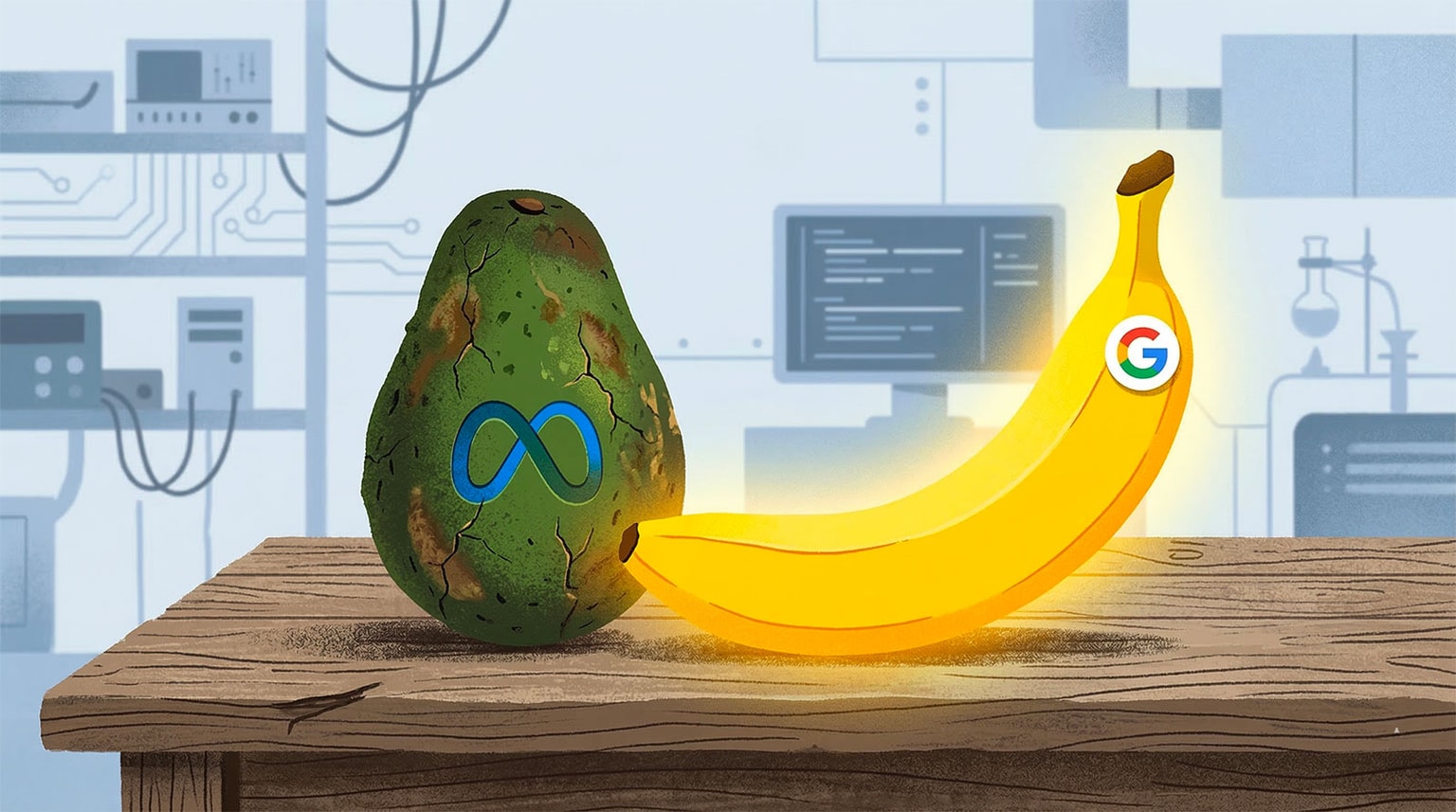
Meta is investing between $115 and $135 billion in AI infrastructure in 2026 — the largest capex (capital expenditure) budget ever announced by a tech company. Yet its flagship model Avocado isn't ready. Worse: its executives are seriously considering paying Google to use Gemini in the meantime.
Avocado was supposed to change everything — it didn't
In 2026, Meta restructured its entire AI strategy around two new models. Mango, focused on image and video generation, competes with Sora (OpenAI). Avocado, focused on text, reasoning, and code, is meant to replace the Llama family and rival INTERNAL LINK: GPT-4o | GPT-5.4 OpenAI article and Gemini 3.
Avocado's development is led by the TBD Lab, an elite unit of roughly 100 researchers inside Meta. At its helm: Alexandr Wang, 29, former founder of Scale AI — acquired by Meta for $14.3 billion in June 2025.
The initial goal was clear: launch Avocado by mid-March 2026. Pre-training (the initial phase of training a model on a large dataset) wrapped up in late 2025. Post-training (the fine-tuning phase that improves model responses) began in January 2026. But the results didn't follow.
According to the New York Times, the launch has been pushed to May 2026 at the earliest. The reason: benchmarks (standardized tests measuring model performance) fell short on reasoning, code, and writing.
The numbers that hurt: where Avocado actually stands
Avocado outperforms Meta's previous models. It also beats Gemini 2.5, Google's mid-2025 model. But the problem lies elsewhere: the ground shifted faster than expected.
| Model | vs Avocado | Status |
|---|---|---|
| Llama (Meta's previous) | ✅ Avocado better | Surpassed |
| Gemini 2.5 (Google) | ✅ Avocado better | Surpassed |
| Gemini 3.0 (Google) | ❌ Avocado behind | Better |
| GPT-4o (OpenAI) | ❌ Avocado behind | Better |
| Claude Sonnet (Anthropic) | ❌ Avocado behind | Better |
Beating Gemini 2.5 doesn't matter when Gemini 3.0 shipped in November 2025. The window closed. Meta finds itself chasing a pack that keeps accelerating.
The unthinkable option: licensing Gemini
Facing this delay, Meta's AI leadership is considering a Gemini license from Google. The goal: keep Facebook, Instagram, and WhatsApp at the cutting edge of conversational AI while Avocado continues development.
No final decision has been announced. But the mere existence of this discussion is telling. This isn't a humiliating failure — it's a rational business decision. A company spending $135 billion on AI capex can't afford to let its products fall behind for six months.
The symbolism is heavy. Meta built part of its tech identity on independence and open source. Paying a direct competitor to fill a gap — even temporarily — wasn't part of the script.
The end of the open-source myth?
This may be the most consequential issue. Meta built its AI reputation on Llama, an open-source model used by thousands of developers and startups. But that openness backfired.
Labs like INTERNAL LINK: DeepSeek | DeepSeek V4 article leveraged Llama's open architecture to build competing models — at a fraction of the cost. Open source fed the competition instead of widening the moat.
The result: as early as summer 2025, Mark Zuckerberg and Alexandr Wang leaned toward making Avocado closed-source (code and weights not publicly accessible). The final decision hasn't been announced yet. But the internal debate is intense.
It's a genuine strategic dilemma. Closing Avocado protects the technological advantage. But it breaks the promise that rallied an entire community around Meta. And in the AI race, ecosystem matters as much as the model.
$135 billion and internal tensions
Money isn't the issue. Meta raised its AI capex budget from $107 billion (announced December 2025) to INTERNAL LINK: $115–135 billion | AI capex infrastructure article in late January 2026. It's the largest AI investment announced by any big tech company.
But money doesn't solve everything. Internally, three visions coexist uneasily. Alexandr Wang (TBD Lab) pushes fundamental research. Chris Cox (CPO) wants AI integrated into consumer products. Andrew Bosworth (CTO) created a parallel AI team outside the TBD Lab to accelerate advertising integration.
These frictions generate rumors. An alleged clash between Zuckerberg and Wang was denied through an Instagram selfie posted by Zuckerberg himself. But the signal is clear: when the CEO has to post a selfie to reassure people, the tensions are real.
The lesson extends beyond Meta. Even with $135 billion, 100 elite researchers, and the best GPUs in the world, building a frontier AI model remains incredibly hard. AI isn't a money problem. It's a problem of alignment, talent, and timing.
In summary:
- Meta has delayed the launch of its AI model Avocado to May 2026 due to insufficient performance against competitors.
- Avocado outperforms Gemini 2.5 but trails Gemini 3, GPT-4o, and Claude Sonnet.
- Meta is considering temporarily licensing Gemini from Google to keep its products competitive during development.
- Avocado is developed inside the TBD Lab, led by Alexandr Wang (29), former founder of Scale AI acquired for $14.3B.
- Meta is investing between $115 and $135 billion in AI capex in 2026 — the largest AI budget announced by any big tech company.


