
Nvidia Groq 3 LPX: 35x Faster Per Megawatt — The $20 Billion Chip Reinventing AI Inference in 2026
Nvidia unveils the Groq 3 LPX, first LPU from the $20B Groq acquisition. 256 LPUs, 40 PB/s bandwidth, 35x throughput per MW combined with Vera Rubin NVL72. Shipping Q3 2026.
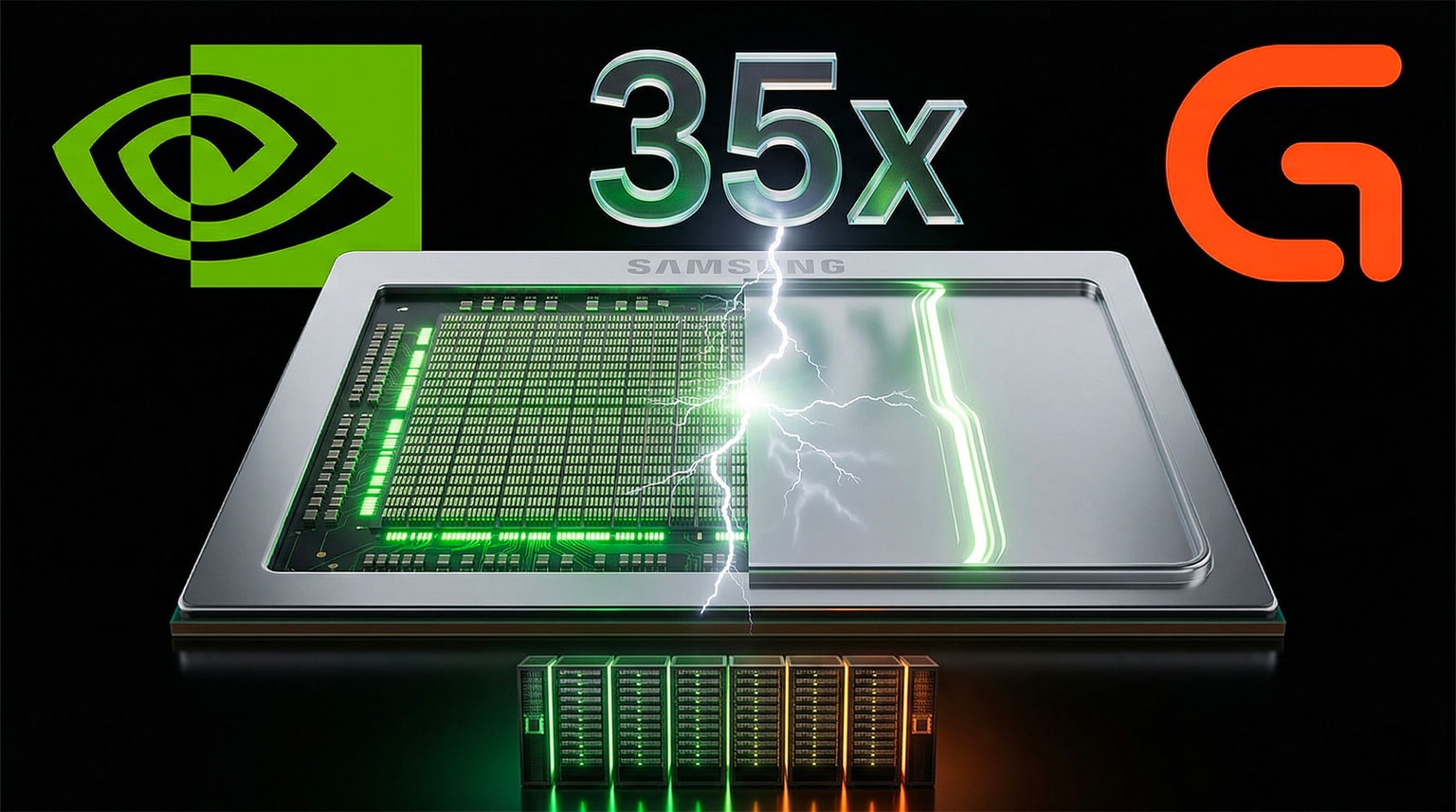
$20 billion invested on December 24, 2025. The result today: a chip that runs 35x more LLM requests for the same power consumption. The Groq 3 LPX is not a GPU. It's an LPU — a Language Processing Unit built exclusively for the decoding phase of AI inference. And it just replaced a Nvidia in-house chip on the Vera Rubin roadmap.
GPU vs LPU: Why They're Not the Same Thing
A GPU — Graphics Processing Unit — contains thousands of cores working in parallel. This architecture is ideal for model training: millions of simultaneous matrix computations. But for inference — the phase where the model generates a response — the work is sequential. One token after another. The GPU waits between each step.
An LPU — Language Processing Unit — is the opposite. It's a sequential pipeline optimized to generate one token at a time, as fast as possible. Zero unnecessary parallelism. Zero idle cycles.
The analogy: a GPU is an 80,000-seat stadium. Perfect for concerts. Inefficient for a conversation between two people. An LPU is a direct corridor — zero latency, zero overhead.
This is precisely what Groq understood before anyone else. And that's why Nvidia signed a $20 billion check.
40 Petabytes/s: The Number That Says It All
Memory bandwidth is THE bottleneck of inference. To generate each token, the model must read all its weights from memory. The faster the memory, the faster tokens come out.
Nvidia's H100 delivers about 3.35 terabytes per second. The Groq 3 LPX: 40 petabytes per second. That's 12,000 times more memory bandwidth. The SRAM — static memory embedded directly on the chip — eliminates round trips to external memory.
| Spec | Value |
|---|---|
| Number of LPUs | 256 |
| SRAM memory | 128 GB |
| Memory bandwidth | 40 petabytes/s |
| Latency | Sub-millisecond |
| Manufacturing process | Samsung 4nm |
| Shipping | Q3 2026 |
| Combined Vera Rubin gain | 35x throughput/MW |
Combined with Nvidia's Vera Rubin NVL72 rack: 35x more throughput per megawatt vs GPU-only inference. A datacenter spending 1 megawatt for X LLM requests per second now spends 1 megawatt for 35X. Same infrastructure, 35 times more capacity. Technical details on the Nvidia Developer official blog.
Why Nvidia Paid $20 Billion for a Chip
Groq wasn't a research lab. It was the only manufacturer in the world that had industrialized LPUs at datacenter scale. Founded by Jonathan Ross — one of the creators of Google's TPU — Groq had proven its chips could serve LLMs in real time, with latencies that even the best GPUs couldn't match.
Nvidia saw that the inference war was coming. And that its GPU architecture had a physical limit on sequential decoding. An H100 GPU during the decoding phase runs at about 30% of its capacity — the rest is idle time institutionalized in silicon.
Rather than invest five years in internal R&D: $20 billion to buy the solution. Same logic as the Mellanox acquisition for $7 billion in 2020, which gave birth to NVLink — the interconnect technology that made GPU clusters possible. Mellanox result: NVLink. Groq result: the Groq 3 LPX integrated directly into Vera Rubin.
Inference: The New Chip Battleground
In 2023-2024, the AI arms race came down to one question: who has the most H100s to train GPT-4? In 2026, the question has shifted: who can infer 1 billion tokens per second at the lowest cost?
Models are trained once. But they're inferred 24/7, for billions of users. Every ChatGPT request, every Claude API call, every Gemini search consumes inference cycles. It's become the number one cost center for AI labs.
Three announcements in 72 hours on the same topic:
| Date | Announcement | Company | Approach |
|---|---|---|---|
| Mar 24 | ARM AGI CPU | ARM | Datacenter inference silicon |
| Mar 25 | TurboQuant | Google Research | Software KV cache compression |
| Mar 26 | Groq 3 LPX | Nvidia × Groq | Dedicated decoding LPU |
This isn't a coincidence. It's the entire industry converging on the only problem that matters: inference efficiency. Google attacked the problem through software with TurboQuant — 6x memory compression, 8x speedup. Nvidia attacks through hardware with a dedicated chip.
Vera Rubin NVL72 + Groq 3 LPX: The 2026 Reference Rack
The combined configuration is the new standard. The Vera Rubin NVL72 rack — Nvidia's latest-generation GPUs — handles training and the prefill phase of inference. The Groq 3 LPX — 256 LPUs as a co-processor — takes over for sequential decoding.
This is the first rack-scale Nvidia chip built around non-GPU silicon. It replaced a Nvidia in-house chip on the roadmap. The fact that an acquired chip beat an internal one speaks volumes about the LPU's architectural superiority for decoding.
Shipping: Q3 2026. Expected customers: OpenAI, Google, Anthropic, every hyperscaler. The question: when these racks are in production, what will the cost per token be for GPT-5 or Claude 5? The answer will reshape pricing across the entire AI industry — and everything that was too expensive for agentic AI will suddenly become viable.
Key Takeaways
- The Groq 3 LPX is the first product from Nvidia's acquisition of Groq ($20 billion, December 2025) — an LPU dedicated to the decoding phase of LLM inference
- Specs: 256 LPUs, 128 GB SRAM, 40 petabytes/s bandwidth, Samsung 4nm, shipping Q3 2026
- Combined with Nvidia's Vera Rubin NVL72 rack: 35x more throughput per megawatt vs GPU-only inference
- First rack-scale non-GPU Nvidia chip — replaced a Nvidia in-house chip on the Vera Rubin roadmap
- Part of the industry's convergence toward inference efficiency: ARM AGI CPU, Google TurboQuant, and Groq 3 LPX in 72 hours
The AI chip war has moved to new ground. It's no longer about who can train the biggest model. It's about who can run it fastest, cheapest, with the fewest watts. Nvidia paid $20 billion not to lose that war. The Groq 3 LPX is the answer. In Q3 2026, when these racks are in production, the cost per token will collapse. And everything that was too expensive to be viable in agentic AI will suddenly become possible.


