
Nvidia GTC 2026: All of Jensen Huang's Announcements — Vera Rubin, Feynman, Robotaxis and DLSS 5
Nvidia GTC 2026 keynote: Jensen Huang reveals Vera Rubin, Feynman, BYD/Hyundai/Nissan robotaxis, DLSS 5, OpenClaw and the Isaac robotics platform.
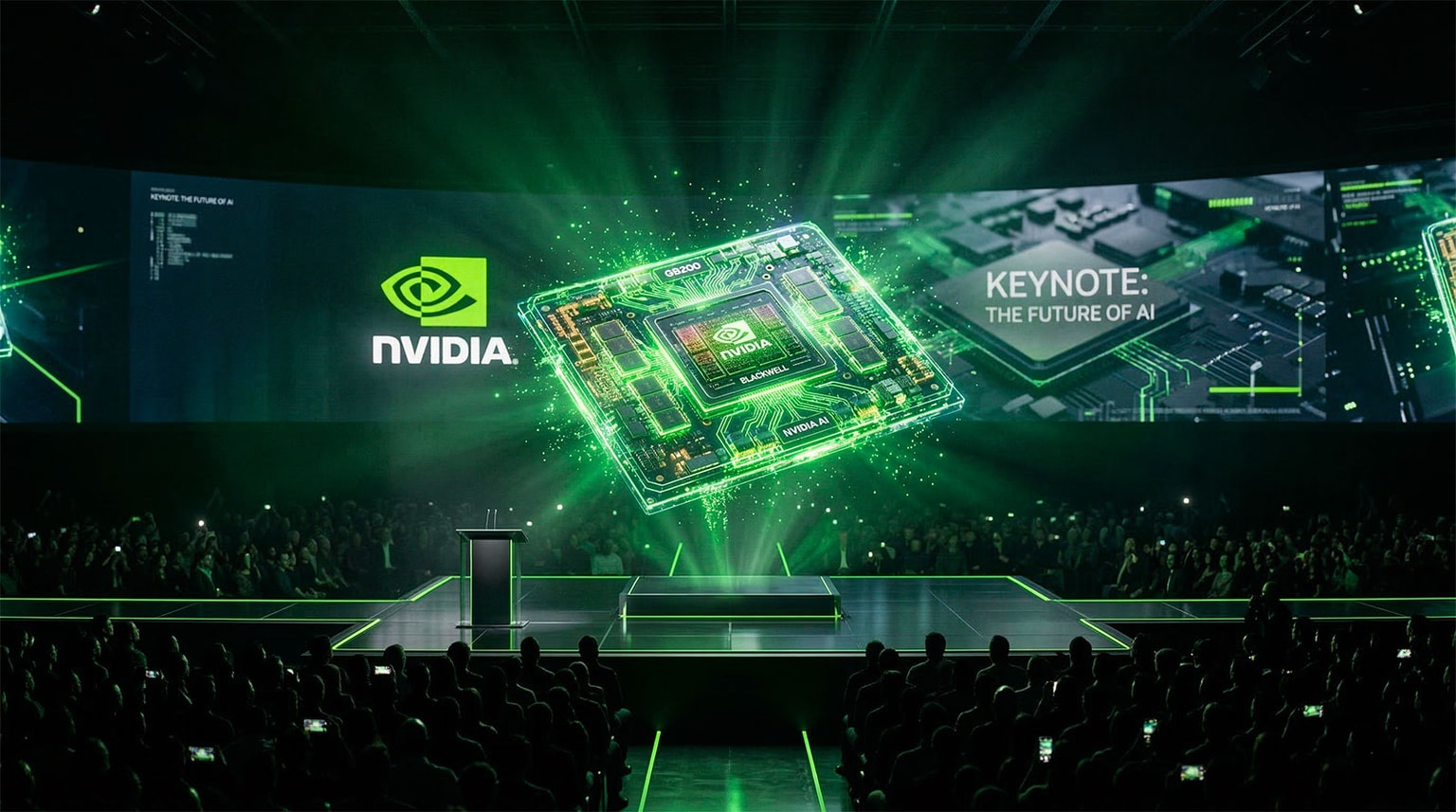
On March 16, 2026, Jensen Huang takes the stage for the main Nvidia GTC 2026 keynote. Nvidia's co-founder and CEO unveils Vera Rubin, the new GPU architecture succeeding Blackwell, alongside H300 accelerators and the Isaac robotics platform. He also surprises the audience by revealing Feynman, the architecture planned for 2028, robotaxis with BYD, Hyundai and Nissan, and DLSS 5, neural rendering for gaming. Here's the full recap of the official announcements from the keynote. Updated March 17, 2026 with all confirmed announcements.
What Is GTC and Why It Matters
GTC (GPU Technology Conference) is Nvidia's flagship annual event, running since 2009. Each edition sets the pace for the accelerated computing industry. In 2026, Nvidia's market cap sits at roughly $3.5 trillion. Big Tech is set to spend $650 billion on AI infrastructure this year. What Jensen Huang announces tonight at GTC directly shapes the roadmaps of OpenAI, Anthropic, Mistral, and every lab that depends on Nvidia chips.
Vera Rubin: The Blackwell Successor
Vera Rubin is Nvidia's new GPU architecture, built to train and run models with 1 trillion parameters and beyond. It succeeds Blackwell, which already pushed the boundaries of AI compute in 2024-2025.
The Official Numbers Confirmed Tonight
The NVL72 rack (a server chassis housing 72 Vera Rubin GPUs and 36 Vera CPUs) packs 220 trillion transistors. It's a compute behemoth. Jensen Huang stated on stage that this single rack's internal bandwidth exceeds the total bandwidth of the entire global internet.
The performance speaks for itself. Vera Rubin NVL72 delivers 3.3x the inference performance of the Blackwell GB300 NVL72. The cost per token is 10x lower than Blackwell. HBM4 memory bandwidth exceeds 3 TB/s.
Nvidia positions Vera Rubin as the reference chip for frontier models — those powering ChatGPT, Claude, Gemini, and future autonomous AI agents. The GPUs are already in production at TSMC and will be available on AWS, Google Cloud, Azure, Oracle and CoreWeave in the second half of 2026.
Jensen Huang also revealed Vera Rubin Space One — a version of the architecture specifically designed for satellites and space. First customers include space agencies and satellite constellation operators. It's the first time Nvidia directly targets low Earth orbit as a market for its AI GPUs.
The H300 accelerators, also announced tonight, target a complementary use case: ultra-fast inference. Where Vera Rubin trains, the H300 serves. Together, they cover the entire generative AI value chain.
Feynman: The 2028 Architecture Nobody Saw Coming
Jensen Huang didn't just present Vera Rubin. He revealed the architecture that will succeed it: Feynman, planned for 2028.
Feynman will be built on the TSMC A16 process (1.6 nm) — the most advanced manufacturing node ever announced commercially. Nvidia would be the first and only customer to use TSMC A16 in mass production.
The most striking innovation: silicon photonics — a technology that uses light to transmit data inside chips. Data travels via optical signals rather than electrical ones. Light replaces copper wires. The gains in transmission speed and energy efficiency are potentially revolutionary.
Another key announcement: 6th-generation NVLink with co-packaged optics. Optical signals replace electrical signals inside rack systems themselves. In practice, GPUs communicate at the speed of light, without the losses inherent to copper.
By announcing Feynman two years ahead, Jensen Huang is planting a flag. The message to AMD, Intel and Google TPUs is clear: Nvidia has already designed the generation after Vera Rubin. The AI chip race is being fought two generations ahead.
AI Robotics at the Core of Nvidia's Vision
Jensen Huang is no longer talking just about GPUs for data centers. His 2026 vision is the physical AI factory: humanoid robots driven by world models trained on Nvidia chips.
Isaac and World Models
The Isaac platform provides the software foundation for this ambition. It gives developers the tools to build autonomous robots that understand and interact with the physical world. World models — AI models that simulate real-world environments — let robots learn without millions of hours of physical trial and error.
This is a paradigm shift. Nvidia is no longer just selling chips. The company is building the complete software infrastructure for autonomous robotics.
Robotaxis: BYD, Hyundai and Nissan Join the Nvidia Platform
Nvidia announces four new partners for its robotaxi platform: BYD, Hyundai, Nissan and a fourth unnamed manufacturer. Deployment is coupled with Uber: Nvidia-powered robotaxis will be bookable directly through the Uber app.
These vehicles use Isaac world models to navigate in real time. The signal is clear: traditional automakers are relying on Nvidia infrastructure rather than building their own AI stack. Autonomous driving is moving from prototype to mainstream service.
The Big Winners: Who Already Signed With Nvidia
The GTC 2026 announcements come with major partnerships. Thinking Machines Lab, the laboratory founded by Mira Murati (former OpenAI CTO), officially confirmed tonight a "gigawatt-scale" deal — an AI infrastructure the size of a power plant, valued at $50 billion in Vera Rubin chips. It's the largest GPU supply contract ever announced by an AI startup.
Groq signs a $20 billion deal with Nvidia. The LP30 chip, specialized for ultra-fast inference, is planned for Q3 2026. This partnership confirms the rise of inference chips as an alternative to traditional GPUs. Groq, which specializes in LPUs (Language Processing Units), is leveraging Nvidia to scale its infrastructure.
xAI, Elon Musk's lab, is also among the first Vera Rubin customers. Databricks is deepening its Nvidia partnership to accelerate its data and training pipelines.
IBM officially expands its Nvidia partnership at GTC: GPU-native data analytics, unstructured document extraction and enterprise AI consulting. Use case presented on stage: accelerating Nestlé's supply chain decisions with Nvidia chips.
Nvidia also co-founds the Optical Compute Interconnect Consortium with AWS, Google, Microsoft and Meta. The goal: define an open standard for AI optical infrastructure. It's the first time these five giants have aligned on a common interconnect standard.
These deals confirm a trend: Nvidia is no longer content to just sell hardware. The Santa Clara giant is taking strategic stakes in the most promising AI labs, locking in customers and influence.
DLSS 5: Neural Rendering Reinvents Gaming
Jensen Huang introduced DLSS 5 (Deep Learning Super Sampling), the fifth generation of Nvidia's AI-assisted rendering technology. This time, Nvidia moves to 3D-guided neural rendering.
The difference from DLSS 4 is fundamental. The neural engine no longer just upscales images: it generates entire frames. The result: photorealistic 4K performance in real time on consumer hardware, with unprecedented visual quality.
The impact extends beyond gaming. Independent studios gain access to cinematic rendering without cloud render farms. Architecture, film and industrial visualization also benefit. Nvidia is extending its AI empire far beyond data centers — all the way to every gamer's and creator's screen.
What This Means for Developers and Builders
For developers, the GTC 2026 announcements have direct consequences. More powerful chips mean lower inference costs. The APIs from OpenAI, Anthropic, and Mistral — those powering Cursor, Replit, GitHub Copilot, and AI-powered IDEs — will run on more performant hardware.
OpenClaw and NemoClaw: Open-Source AI Agents
Jensen Huang announced tonight OpenClaw, Nvidia's open-source AI agent platform. He described it as the fastest-growing open-source project in history. OpenClaw provides the building blocks to create, train and deploy autonomous agents.
NemoClaw is its enterprise version, developed in partnership with OpenAI. It enables deploying autonomous agents on private infrastructure. GTC attendees built agents live on DGX Spark, Nvidia's AI development workstations.
In practical terms, frontier models become more accessible. Vibe coding — the practice of coding in natural language through an AI agent — directly benefits from the added power. The better the hardware, the longer models can reason, and the more reliable AI-assisted development tools become.
Jensen Huang also hosted an unprecedented roundtable featuring Cursor, A16Z, AI2, AMP Coalition, Black Forest Labs, Reflection AI and Thinking Machines Lab on the state of the art in frontier open-source models. That Cursor — the vibe coders' favorite AI IDE — sat at the same table as Mira Murati and Andreessen Horowitz sends a clear signal: AI development tools are now strategic players on par with research labs.
Falling inference costs also open the door to new use cases: autonomous agents in production, AI embedded in mobile apps, and fine-tuned specialized models like DeepSeek V4 accessible to small and mid-size businesses.
Key Takeaways
- The Vera Rubin NVL72 rack (72 GPUs + 36 CPUs) delivers 3.3x the inference performance of Blackwell, with a 10x lower cost per token.
- Feynman (2028) uses the TSMC A16 1.6 nm process and silicon photonics — the most advanced GPU architecture ever announced.
- OpenClaw, Nvidia's open-source AI agent platform, is already the fastest-growing open-source project in history.
- BYD, Hyundai and Nissan join the Nvidia robotaxi platform, with deployment through the Uber app.
- DLSS 5 brings photorealistic 4K neural rendering in real time on consumer hardware.
With ever more powerful chips and ever more capable models, the question is no longer whether autonomous AI agents will replace certain development workflows — but when. GTC 2026 just brought that timeline closer.


