Molotov Cocktail at Sam Altman's Home, AI CEO Kill List, Attempted Murder Charges — the Anti-AI Backlash Turns Violent
A 20-year-old attacked Sam Altman's home with an incendiary device and had a kill list of AI executives. Public opinion is turning against AI — at the worst possible time for OpenAI and Anthropic's IPOs.
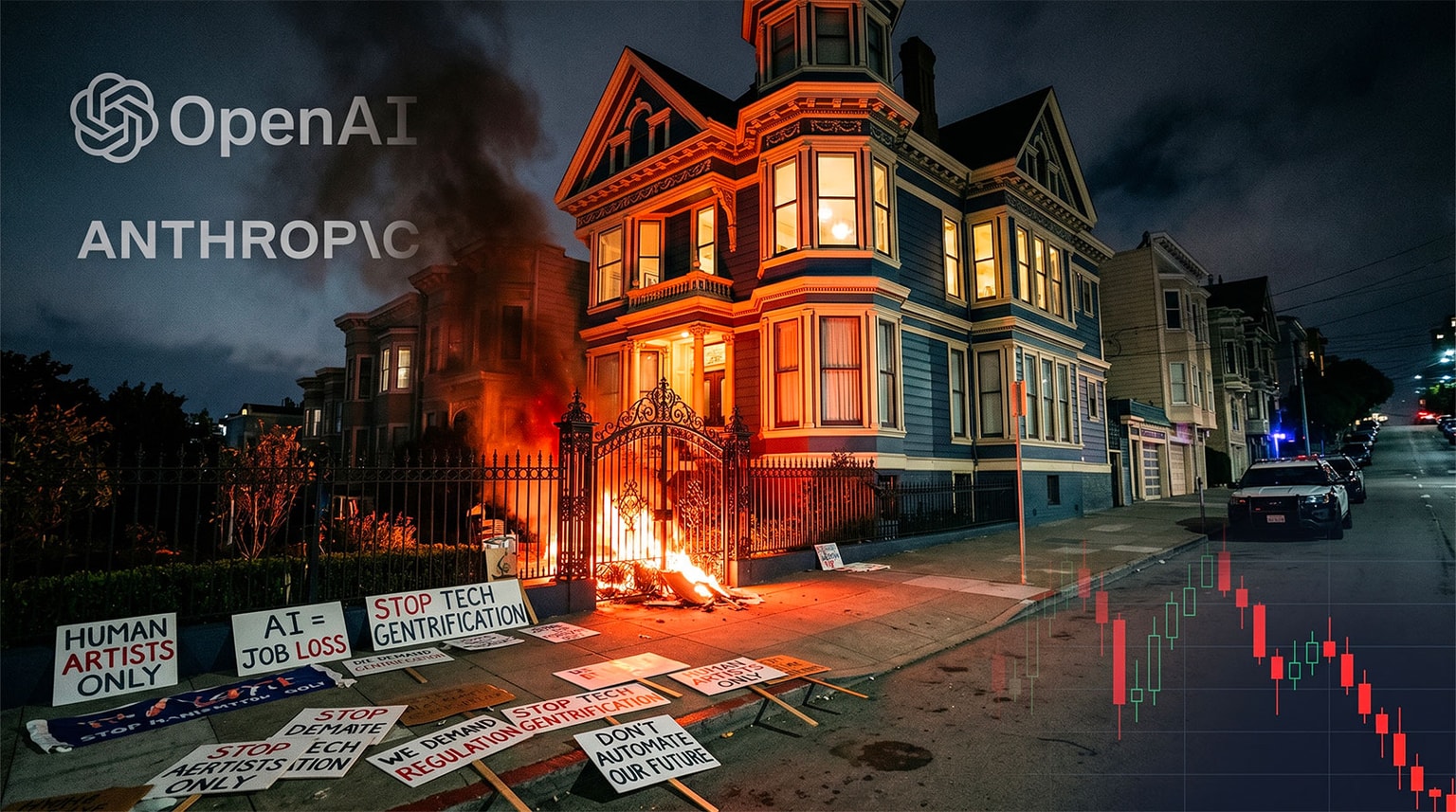
On April 11, 2026, a 20-year-old named Daniel Moreno-Gama traveled from Texas to San Francisco, threw a Molotov cocktail at the gate of Sam Altman's $27 million Pacific Heights home, then went to OpenAI's headquarters where he tried to smash the glass doors with a chair while threatening to burn the building down. Days later, a second incident: gunshots fired from a vehicle toward Altman's property. The suspect has been charged with attempted murder at the state level and faces federal domestic terrorism charges. In his manifesto, investigators found a list of names and addresses of AI executives, board members, and investors.
What Happened: The Full Sequence
Friday, April 11, early evening. Moreno-Gama, 20, from Spring, Texas, hurls an incendiary device at the exterior gate of Sam Altman's residence in San Francisco's Pacific Heights neighborhood. The gate catches fire. No one is injured.
About an hour later, police arrest him outside OpenAI's headquarters. He was trying to shatter the building's glass doors with a chair and threatening to burn the facility to the ground. Investigators recover a written manifesto in which he claims responsibility for the attack and details his motivations: the conviction that AI threatens to destroy humanity.
The document also contains a kill list — names and addresses of several AI executives, board members, and investors, according to prosecutors cited by Fortune.
Days after the first incident, a second attack: a passenger in a vehicle fires a gun toward Altman's property. Two attacks in days on the same target.
Moreno-Gama is now charged with attempted murder by the State of California and faces federal charges potentially including domestic terrorism.
| Event | Date | Detail |
|---|---|---|
| Incendiary attack | April 11, 2026 | Molotov cocktail on gate, Pacific Heights SF |
| Attempted break-in at OpenAI | April 11, 2026 | ~1h later, chair against glass doors |
| Arrest | April 11, 2026 | Outside OpenAI HQ |
| Shots fired at property | ~April 13, 2026 | From a moving vehicle |
| Charges filed | April 13, 2026 | Attempted murder + federal terrorism charges |
The Manifesto and the Kill List
This was not an isolated act by an unstable individual. It was a planned, documented act with a primary target and secondary targets identified by name and address. The manifesto articulates an ideological position: AI represents an existential threat to humanity and those who build it must be stopped.
What's striking is that the manifesto's rhetoric is not fringe. It takes — and radicalizes to the extreme — arguments that circulate widely in public debate. The gap between legitimate anxiety and physical violence has been crossed.
Gen Z: Between Adoption and Rejection
The underlying data explains why this event isn't an isolated case but a symptom.
A recent Gallup poll shows a clear fracture among American Gen Z: more than half use AI regularly, but less than a fifth feel hopeful about the technology. A third say AI makes them angry. Nearly half say it makes them afraid.
This is the central paradox: the generation that adopts AI the most is also the one that fears it the most. Usage doesn't create buy-in. It coexists with growing hostility.
Workers in creative industries — writers, illustrators, voice actors, musicians — describe a technology already being used to replace them, trained on their own work without consent or compensation. Communities near planned data centers are pushing back against facilities that consume enormous amounts of electricity and water, straining local power grids already under pressure.
According to Data Center Watch cited by CNBC, at least $156 billion in data center projects were cancelled or delayed in 2025 under local opposition pressure.
| Indicator | Data |
|---|---|
| Gen Z using AI regularly | >50% |
| Gen Z hopeful about AI | <20% |
| Gen Z angry about AI | ~33% |
| Gen Z afraid of AI | ~50% |
| Data center projects cancelled/delayed (2025) | $156 billion |
Altman's Response
Altman published a blog post the weekend after the attack. The tone is personal. He shares a photo of his partner and child — in the explicit hope of discouraging another act of violence. He acknowledges that criticism and disagreement about AI are valid given the "incredibly high stakes of this technology."
His key line: "We should de-escalate the rhetoric and tactics and try to have fewer explosions in fewer homes, figuratively and literally."
The call for de-escalation comes after a New Yorker article that Altman called "incendiary" — a word that takes on particular resonance in the context of a Molotov cocktail.
The Worst Timing for IPOs
It's the context that makes this crisis systemic, not anecdotal.
Both OpenAI and Anthropic are preparing their public offerings. OpenAI, valued at $852 billion, will allocate shares to retail investors according to CFO Sarah Friar. Anthropic, valued at $380 billion, is evaluating an IPO as early as October 2026 that could raise over $60 billion.
Both IPOs depend on public sentiment. Retail investors — the general public — are exactly the ones whose sentiment is turning. AI is becoming a central issue in the midterm elections. Polls show declining AI popularity in the United States.
And now, physical violence against sector leaders. With a kill list.
| Company | Valuation | Planned IPO | Risk signal |
|---|---|---|---|
| OpenAI | $852 billion | 2026 (date TBD) | Physical attack on CEO |
| Anthropic | $380 billion | ~October 2026 | Hostile public opinion |
Meanwhile, the competition between the two isn't slowing. Anthropic's annualized revenue jumped from $9 billion at end of 2025 to $30 billion by end of March 2026, driven primarily by demand for its coding tools. Some OpenAI investors are starting to question their position as Anthropic rises.
The Historical Parallel
Experts cited by Fortune and Axios draw parallels to the Industrial Revolution — the Luddites who destroyed weaving machines in early 19th-century England. The parallel is imperfect but instructive: a transformative technology displacing workers, an elite benefiting from it, and a fringe of the population moving from protest to destruction.
The difference: the Luddites targeted machines. Here, the target is human.
Two anti-AI groups — Pause AI and Stop AI — have come under scrutiny since the attack, though the reality is more complex than the media shortcut suggests. These organizations officially advocate for peaceful action. But the shift from existential rhetoric to physical violence raises the question of escalation.
In summary:
- Daniel Moreno-Gama, 20, threw a Molotov cocktail at Sam Altman's home on April 11, then tried to break into OpenAI HQ — charged with attempted murder and federal domestic terrorism
- His manifesto contained a kill list with names and addresses of AI executives, board members, and investors
- Second incident days later: gunshots fired at Altman's property from a vehicle
- Gallup poll: over 50% of Gen Z uses AI but less than 20% is hopeful — a third is angry, half are afraid
- $156 billion in data center projects cancelled or delayed in 2025 under local opposition
- Critical timing: OpenAI ($852B) and Anthropic ($380B) are preparing IPOs as public opinion turns
The Molotov cocktail in Pacific Heights isn't a local crime story. It's the moment the anti-AI backlash stopped being digital and became physical. A manifesto, a kill list, gunshots — while the two largest AI companies in the world prepare their public offerings and half of Gen Z says they're afraid of the technology defining their era. The AI industry is worth trillions of dollars. It has never been more unpopular.
Sources: Fortune — attack and kill list, NPR — charges, CNBC — public opinion and IPOs, Axios — SF backlash.