
Welcome to the Vibecoding Era: Your Agents Actually Code With You Now
GPT-5.3-Codex, Cursor 2.0, Copilot Workspace, Devin... In 2026, AI coding tools go far beyond autocomplete. The agentic layer is transforming development into human-agent collaboration.
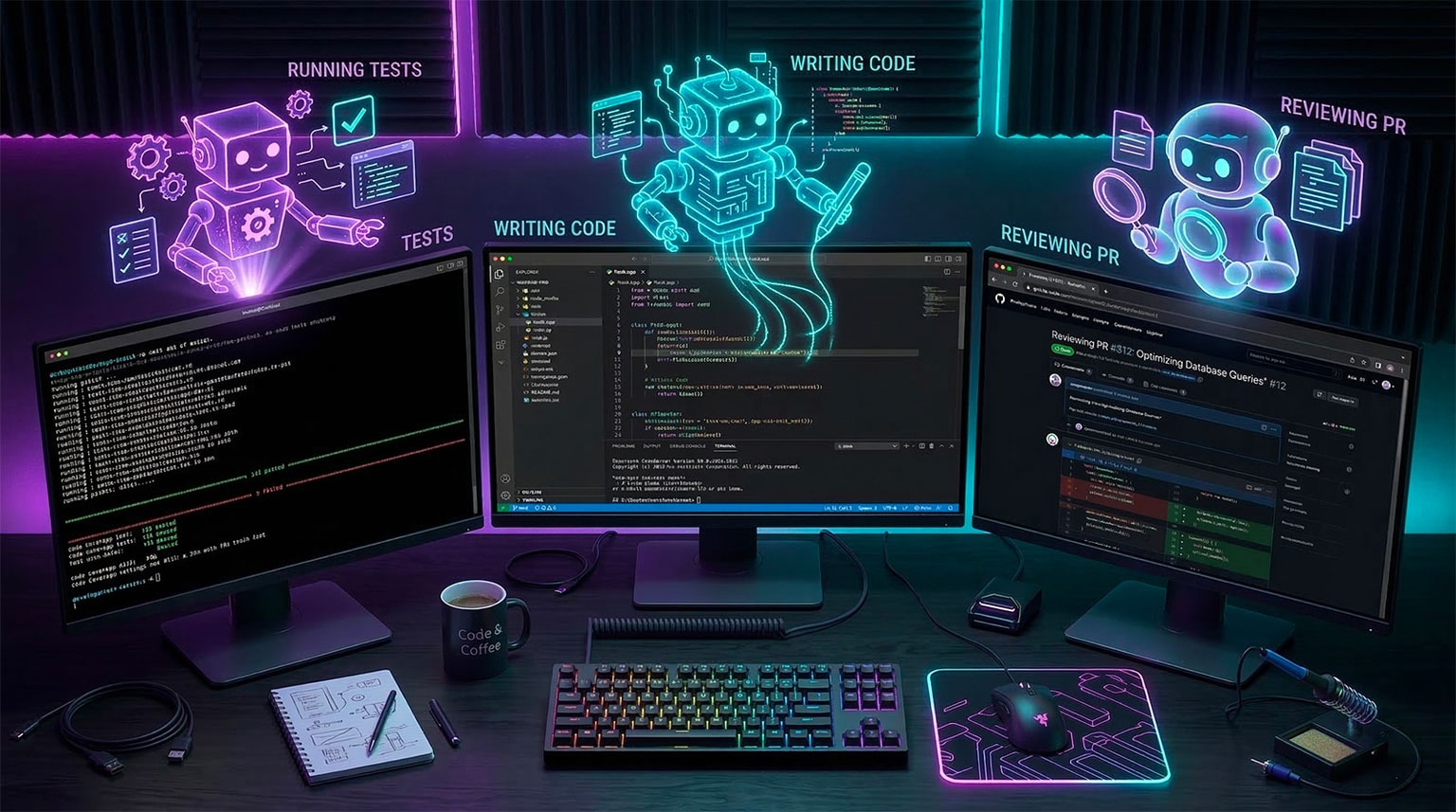
If you're still coding without an AI agent in March 2026, you're officially old school. And that's not a judgment — it's a statement of fact. AI-assisted development tools have crossed a threshold this year: they no longer just complete your lines of code, they understand your codebase, open PRs, run tests, and manage documentation. Welcome to the vibecoding era.
Coding Assistants: Far More Than Autocomplete
Cursor 2.0: The IDE That Understands Your Repo
Cursor 2.0 no longer just suggests the next line. It manages the complete repository context to orchestrate coherent multi-file modifications. You describe what you want, it navigates your codebase, identifies the relevant files, and proposes coordinated changes.
It's the difference between a spell checker and an editor who understands the entire book.
GitHub Copilot Workspace: From Natural Language to PR
Copilot Workspace goes even further for teams. The workflow: you describe a change in natural language, Workspace analyzes the repo impact, proposes a modification plan, and generates a complete pull request — code, tests, description. The human reviews and merges.
For teams managing dozens of microservices, it's a game-changer in terms of velocity.
GPT-5.3-Codex: The New Code SOTA
Released in February 2026, GPT-5.3-Codex is positioned as the best model for code generation. Its strengths:
- Intelligent multi-file refactoring
- Contextual test generation (it understands your test framework)
- Agentic coding: it can execute a sequence of actions (write → test → fix → re-test)
Devin: The Autonomous Dev Agent
Devin from Cognition autonomously executes "maintenance" backlog tasks: fixing a simple bug, updating a dependency, migrating a deprecated API. You assign it a ticket, it delivers a PR.
Supermaven Pro: The Monorepo Tamer
For teams working on massive monorepos, Supermaven Pro offers context of over one million tokens. It "sees" the entire project, understands internal dependencies, and proposes coherent modifications at monorepo scale.
The Agentic Layer: Orchestrating Agents, Not Just Coding
Beyond code assistants, a new layer is emerging: agent platforms. The idea: orchestrate multiple specialized agents that collaborate on complex workflows.
Microsoft Copilot Studio
Allows creating autonomous agents within the Microsoft 365 ecosystem. One agent monitors incidents, another updates documentation, a third notifies the team — all orchestrated.
CrewAI
An open source framework for creating teams of agents that collaborate. Each agent has a role (researcher, writer, reviewer) and they work together toward a common goal. Perfect for development workflows: one agent opens the PR, another runs tests, another updates the changelog.
UiPath Automation Platform
Mixes RPA and LLM for agents capable of manipulating both APIs and user interfaces. Useful for automating workflows involving legacy tools without APIs.
Google Vertex AI Agent Builder
A complete platform with monitoring, observability, and a marketplace of pre-built agents. The emphasis is on traceability: every action of every agent is logged and auditable.
Kore.ai
Specialized in enterprise conversational agents with automation capabilities. Integrates governance tools and agent permission controls.
Security and Governance: The Open Challenge
With agents modifying code, opening PRs, and interacting with third-party services, security questions are critical:
Rights and permissions. What access should an agent have? Read-only? Write? Push to main? Agent identity management is a new field of IAM (Identity and Access Management).
Action auditing. Every agent action must be traceable. If an agent introduces a bug in production, you need to trace back the chain: which prompt, which context, which decision.
Error prevention. Agents don't always understand the consequences of their actions. An agent that "optimizes" a configuration file by removing lines it deems unnecessary can break a deployment. Safeguards (sandboxing, dry-run, mandatory review) are essential. Our guide to securing AI-generated code details best practices.
Vendors have caught on: Vertex AI Agent Builder and Kore.ai natively integrate observability and control tools. But the work is far from done.
Practical Guide: Adopting Vibecoding in Your Team
If you're a CTO or tech lead looking to integrate these tools, here's a pragmatic approach:
1. Start with a Microservice
Don't deploy Cursor 2.0 or Copilot Workspace on your critical monolith overnight. Choose a secondary microservice (a notification service, data pipeline, internal tool) and test for 2-3 sprints.
2. Define the Rules
Before agents start opening PRs, define:
- Who reviews AI-generated PRs?
- Which repos are "agent-friendly" and which are off-limits?
- What minimum test coverage before merge?
3. Measure the Impact
Metrics to track:
- PR cycle time (from open to merge)
- Number of bugs introduced by agent PRs vs human
- Team satisfaction (bi-weekly survey)
- Test coverage (does AI tend to skip tests?)
4. Realistic Budget
Count between $30 and $100/month per developer for premium tools (Cursor Pro, Copilot Business, Supermaven Pro). It's an investment, not a cost — if productivity increases by 30%, the ROI is immediate.
5. Training, Not Just Installation
Installing Cursor isn't enough. Train your teams on prompt engineering applied to code: how to describe a change, how to provide context, how to review an AI-generated PR. It's a skill in its own right. For more, check out our Cursor vs Copilot comparison, our guide to multi-tool workflow with Cursor, Claude, and Lovable, and the 5 mistakes to avoid when starting vibecoding.
Vibecoding is no longer an early adopter curiosity. It's the new standard for software development. The question isn't "will this happen in my team" but "will I lead it or be subjected to it." To measure the financial impact, check out our analysis ROI vibecoding vs traditional development.


