
Yann LeCun Launches AMI and Raises €890M to Reinvent AI from Paris
Turing Award winner Yann LeCun founds AMI (Advanced Machine Intelligence) in Paris and closes a first round of €890M with Nvidia, Toyota, Samsung and Jeff Bezos. Goal: surpass LLMs with world models.
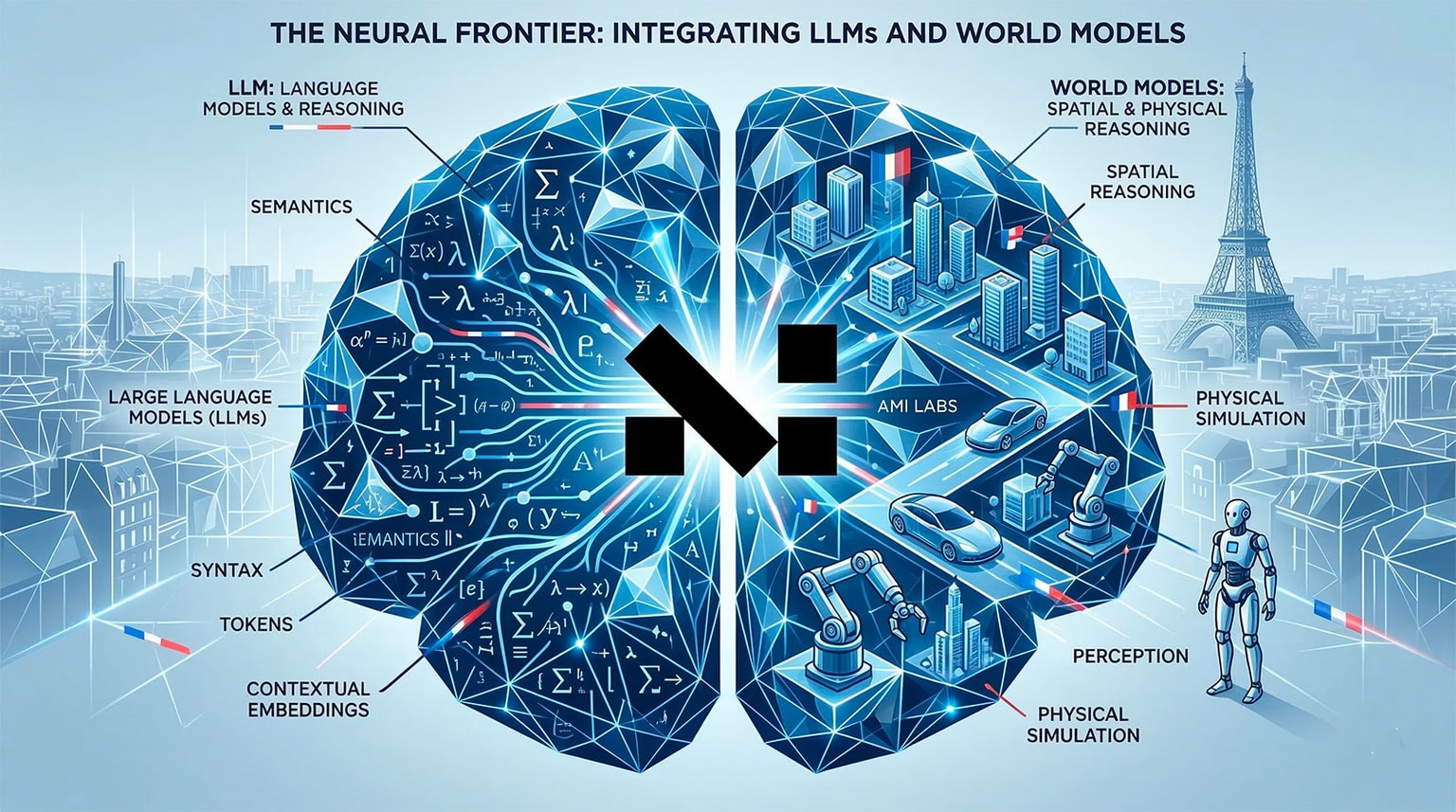
The Turing Award winner and former head of AI research at Meta just made a powerful move. On March 10, 2026, Yann LeCun announces the creation of AMI (Advanced Machine Intelligence), a Paris-based startup, and closes a first round of €890 million (approximately $1.03 billion). Valued at €3 billion pre-money, AMI instantly becomes one of Europe's best-funded AI startups — and sends a powerful signal about French ambition in the global AI race.
A Historic Raise for French Tech
The amount places AMI among the largest raises in French tech history. For reference, Mistral AI had closed a €1.7 billion round, but across multiple successive rounds. AMI reaches €890 million in its very first round — unprecedented for a European company with no revenue.
The founding team explains this investor confidence. Around LeCun, who serves as board chairman, you'll find Alexandre LeBrun as CEO (serial entrepreneur, former founder of Wit.ai acquired by Facebook), Saining Xie as scientific director, Pascale Fung heading research, and Michael Rabbat in charge of "world representations." Four offices are already open: Paris (HQ), New York, Singapore, and Montreal.
World Models: AI That Truly Understands the World
AMI isn't building yet another chatbot. The startup develops world models — AI systems capable of understanding the physical world, not just manipulating text.
The key architecture is called JEPA (Joint Embedding Predictive Architecture), a theoretical framework LeCun has been working on for a decade at Meta. To understand the difference from current LLMs, a simple analogy: an LLM like GPT or Claude is a student who has memorized the map — they can describe a route, but they don't understand geography. A world model is a student who understands the terrain — they can anticipate that a river blocks the path even if they've never seen it on the map.
LeCun doesn't mince words about the limitations of current LLMs. According to him, language models — whether GPT or Claude — are "incapable of planning, reasoning, or understanding causality." They predict the next word brilliantly, but build no internal representation of the world. JEPA aims to bridge this gap by learning abstract representations of reality, usable for planning, reasoning, and action in the physical world.
AMI has no revenue yet and likely won't for several years. It's a long-term R&D bet — exactly the kind that only patient investors convinced by the scientific vision can support.
A Global Round, a Deliberately French Anchoring
The investor list reads like a who's who of global tech:
- Nvidia, Toyota, Samsung — three industrial players betting on AI applied to the physical world (robotics, automotive, electronics)
- Jeff Bezos (personally) and Eric Schmidt (former Google CEO) — two figures who are rarely wrong when they write checks
- French side: Xavier Niel, Dassault, the Mulliez family, Cathay Innovation
- Complemented by Hiro Capital, Greycroft, and Clover Fund
Alexandre LeBrun emphasizes this "geographic balance" of the investor base. The goal: anchor AMI in Europe while ensuring access to American and Asian markets and talent. A pragmatic positioning, far from technological nationalism, but clearly designed so that the value created benefits the French ecosystem first.
Macron and the State: The Sovereign AI Bet
The political reaction was swift. On X, Emmanuel Macron hailed the announcement: "Yann LeCun opens a new era for artificial intelligence. This is the France of researchers, builders, and bold thinkers. Bravo!"
Beyond the tweet, AMI fits into France's national AI strategy and the "AI Pioneers" program launched by the Élysée. With Mistral on LLMs and now AMI on world models, France has two champions on two complementary approaches to artificial intelligence — a unique positioning against the American OpenAI/Anthropic duopoly.
The open question remains: can France compete durably when OpenAI raises $110 billion and Anthropic $30 billion? The open source vs proprietary AI debate is more relevant than ever. AMI's bet is that the race won't be won by stacking GPUs, but by finding the right architecture — and that JEPA could be that architecture.
In Brief: AMI vs the Giants
| AMI | OpenAI | Mistral AI | |
|---|---|---|---|
| Nationality | France | United States | France |
| Approach | World models (JEPA) | LLMs (GPT) | LLMs open-weight |
| Stage | R&D, pre-revenue | Products in production | Products in production |
| Valuation | €3B | ~$800B | ~€6B |
Next expected steps: publication of first JEPA research results applied to robotics and video, and a hiring wave — AMI targets 200 researchers by end of 2026, with Paris as the main hub. This raise is part of the record AI funding wave redefining global venture capital.


