Ads on ChatGPT: The End of 100% Free & The Remunerative Idlen Alternative
OpenAI officially introduces advertising for Free and Go accounts. Discover why this shift marks a turning point and how Idlen.io allows you to monetize your attention time instead of just enduring it.
It was inevitable. The honeymoon phase of "free and frictionless" artificial intelligence is officially coming to an end.
OpenAI confirmed it in their latest announcement: advertising is coming to ChatGPT. Following the launch of the affordable ChatGPT Go subscription in August 2025, the AI giant is shifting gears to recoup its colossal costs. The rollout begins now in the United States for users of the free and "Go" versions, with a broader expansion planned for the coming weeks.
On paper, OpenAI is playing the transparency and ethics card. They promise "useful" ads, clearly separated from AI responses, and guarantee that your data will not be sold. Their argument? These advertising revenues are necessary to "make AI accessible to the greatest number" and finance their quest for AGI (Artificial General Intelligence).
But there is a fundamental flaw in this equation.
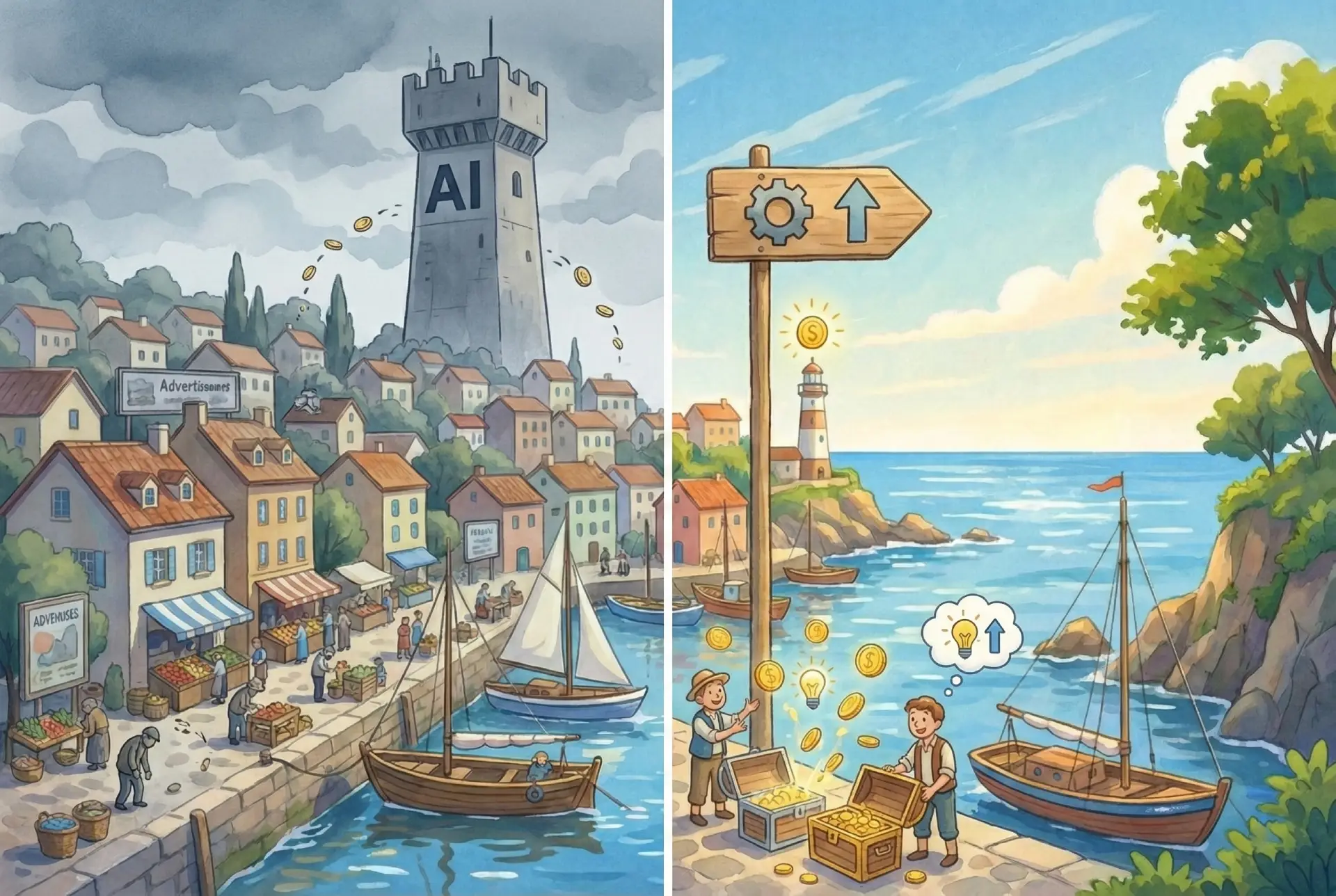
In this new model, your attention is monetized to pay the electricity bills of data centers, yet you derive no direct benefit from it. You endure the interruption; OpenAI pockets the revenue. It is the old Web2 model applied to Web3.
What if the arrival of advertising in AI was an opportunity to completely rethink this power dynamic? As you begin to see ads at the bottom of your ChatGPT responses, a question arises: why aren't you being paid for this attention? This is precisely where Idlen.io changes the game, by transforming your passive wait times into active income.
Here is a breakdown of an announcement that changes everything, and how you can profit from it rather than just suffering through it.
1. The New AI Social Contract: What OpenAI's Announcement Changes
For a long time, access to ChatGPT felt like a technological utopia: quasi-infinite intelligence, available for free or at a low cost, without the usual distractions of the modern web. That chapter is now closed.
With this announcement, OpenAI is finally aligning its model with that of traditional Tech giants (Google, Meta). Here is concretely what changes for the user.
The Reality of the Rollout
OpenAI isn't doing things by halves. Advertising affects not only free users but also those on the ChatGPT Go subscription (the entry-level offer at 8 USD/month).
The Format: Visual ads will now appear at the bottom of AI responses.
The Trigger: If your conversation relates to a marketable topic (a product, service, or purchase intent), the algorithm will insert a contextual advertisement.
The Target: The deployment starts in the US for users over 18, but the stated goal is clear: extend this model to all countries where ChatGPT is available.
The Promises of "Ethical AI"
We must credit OpenAI with an effort towards transparency. In their press release, they heavily emphasize guardrails to reassure users:
Independence of Responses: Advertisers cannot pay to bias the AI's answer. The ad is separated from the generated content.
Privacy: OpenAI promises not to "sell" your conversations to advertisers, but to use internal targeting mechanisms.
Control: Ability to disable personalization (but not the ads themselves, unless upgrading to Pro/Enterprise subscriptions).
The Hidden Problem: Value Asymmetry
Here is the rub. Even with all the ethical guarantees in the world, the economic model remains fundamentally asymmetric.
OpenAI needs to fund the phenomenal computing power required by its models. To do this, they are turning your attention into currency. When you wait for an answer or read it, you are captive to the interface. By inserting advertising, OpenAI captures 100% of the value generated by your presence on their platform.
You provide the prompt, you indirectly train the model through your interactions, and now, you consume the advertising that funds their infrastructure. In this equation, the user is a passive spectator who "pays" with their brain time, without any return on investment other than the service itself.
It is the Web2 standard imposing itself on Web3. But in 2026, is this really the only possible model?
2. The Invisible Cost: The "Idle Time" Problem
While displaying ads at the bottom of the page is the visible part of the iceberg, there is another cost that every AI user pays daily without realizing it: latency.
Even with the fastest models like GPT-4o, response generation is not instantaneous. For complex tasks, deep reasoning (o1 models), or code generation, there is always that moment of suspension.
The Blinking Cursor Syndrome
Analyze your own behavior. What do you do when you send a prompt? In 90% of cases, you remain fixated on the screen, waiting for the first word to appear. This is what we call "Idle Time."
It is a window of a few seconds to several minutes per day where your attention is captive, available, but totally unused. Until now, this time was simply lost.
The Double Penalty for the User
With OpenAI's introduction of advertising, the equation becomes even more unbalanced for the free or "Go" user:
- You lose time waiting for the AI to think (technical latency).
- You "pay" afterwards by being exposed to an ad once the response is displayed.
You therefore suffer the technical inconveniences and the commercial pressure, while the platform captures all the value. Your impatience and your attention have become sellable commodities.
The realization is brutal: Today, your wait time is digital waste. You throw it in the trash with every prompt.
But what if we changed perspective? What if this loading time, this famous "Idle Time," wasn't a dead loss, but your most underestimated asset? This is precisely the flaw in OpenAI's model that Idlen.io has identified and transformed into an opportunity.
3. The Idlen.io Response: Earn Instead of Endure
Since advertising is becoming inevitable in the AI ecosystem, the question is no longer "how to avoid it" (unless paying for expensive Pro subscriptions), but "who should profit from it."
This is where Idlen.io steps in. Our approach is not to block the system, but to ethically hack it to turn it to your advantage.
The "Earn While You Prompt" Concept
Idlen starts from a simple principle: if your attention has value, you should be the one cashing the check.
Concretely, Idlen is a browser extension that activates precisely during those famous "dead times" identified earlier. When you launch a prompt on ChatGPT (or Claude, Gemini, etc.) and the model is "thinking," Idlen displays relevant and remunerative content in a non-intrusive interface. This is part of a broader trend called GEA (Generative Engine Advertising)—the paid advertising equivalent of GEO (Generative Engine Optimization).
Instead of staring at an empty cursor, you discover dev tools, tech news, or crypto opportunities. And because it is your time being used, it is you who gets rewarded.
A Radical Redistribution of Value
Where OpenAI uses advertising to maximize its margins or cover server costs, Idlen operates on a revenue-sharing model.
- With OpenAI: The advertiser pays OpenAI. You see nothing.
- With Idlen: The advertiser pays for your attention. A significant part of this value is paid back to you.
You move from the status of "product" to that of "partner."
Comparison: The Old World vs. The New Economy
Here is why Idlen's approach is superior to the classic advertising model currently being deployed:
| Criteria | OpenAI Advertising (New Standard) | Idlen.io Approach |
|---|---|---|
| Revenue Beneficiary | 100% OpenAI | Shared with the user |
| Display Moment | Bottom of responses (pollutes reading) | During loading (fills the wait) |
| Content Type | Mass market / Generalist | Targeted Tech / Dev / Web3 |
| Philosophy | Monetization of user (Endured) | Monetization of time (Chosen) |
| Privacy | Corporate "Black Box" | Transparency & Control |
Total Control
Idlen's final argument is consent. Unlike native ads that impose themselves on you within the chat interface, Idlen is a layer you choose to add. You are the one deciding to transform your browser into a financial asset.
OpenAI's announcement marks the end of naive free access. Idlen marks the beginning of the smart user's remuneration.
4. Conclusion: Don't Let AI Profit Alone from Your Attention
OpenAI's announcement is a strong signal: the artificial intelligence economy is entering its maturity phase. Costs are real, and advertising is the chosen method to cover them. It is useless to fight against this reality, but it is dangerous to accept it unconditionally.
By introducing advertising, OpenAI implicitly validates a truth we defend at Idlen: AI user attention is worth gold.
The fundamental difference lies in the distribution of this wealth. Today, you have three options facing this new era:
- Pay full price ($20+/month) to avoid advertising.
- Remain passive and let OpenAI monetize your gaze to fund its growth.
- Become an actor with Idlen.io, by reclaiming a share of the value you create with every interaction.
Don't just be a spectator of the AI revolution. Don't let your "available brain time" be exploited for free. If you have to see ads or wait for answers, make sure it's worth it—for your wallet.
The model has changed. The way you use it must change too.
🚀 Take Action
Transform your ChatGPT wait times into income right now. Join the thousands of developers and early adopters who have already realized that their attention deserves a salary.
Frequently Asked Questions
It's better than free: it pays. The Idlen extension is completely free to download. Unlike a subscription model where you pay out of pocket, we operate on a reverse model: we share the ad revenue generated during your wait times directly with you.
Idlen tracks the attention time you spend on content displayed while the AI is generating answers. These interactions generate points that you can convert into real rewards (gift cards, crypto-currencies, or transfers depending on your location) directly from your dashboard.
Absolutely not. Idlen is a lightweight layer optimized to activate only when your browser is waiting for data (the "Idle Time"). The extension does not consume resources during your normal browsing or while you are typing your prompts.
Yes. Privacy is at the core of our architecture. Idlen only detects the "loading" state of the page. We never access the content of your prompts or the answers generated by the AI. Unlike intrusive contextual advertising models, we target your general user profile, not your private conversations.
Related Articles
- What is GEA? Generative Engine Advertising Explained — Understand the new AI advertising landscape
- What is GEO? Generative Engine Optimization Explained — The SEO of the AI era
- GEA: The Complete Guide for Developers — Deep dive into earning from GEA
- 10 Passive Income Ideas for Developers in 2026 — More ways to earn while you code
- Best AI Coding Assistants in 2026 — Tools that work with Idlen
Reach developers where they work
Advertise directly inside developer tools. Native ads, real engagement, zero wasted impressions.