Big Tech AI brain drain: Meta, Google and OpenAI hemorrhage top talent — $18.8B already poured into startups founded since 2025
Top researchers are fleeing Meta, Google and OpenAI labs to launch their own AI startups. $18.8B already invested in 2026 in startups founded after January 2025, on pace to surpass the $27.9B raised in 2025. The face of AI innovation is shifting.
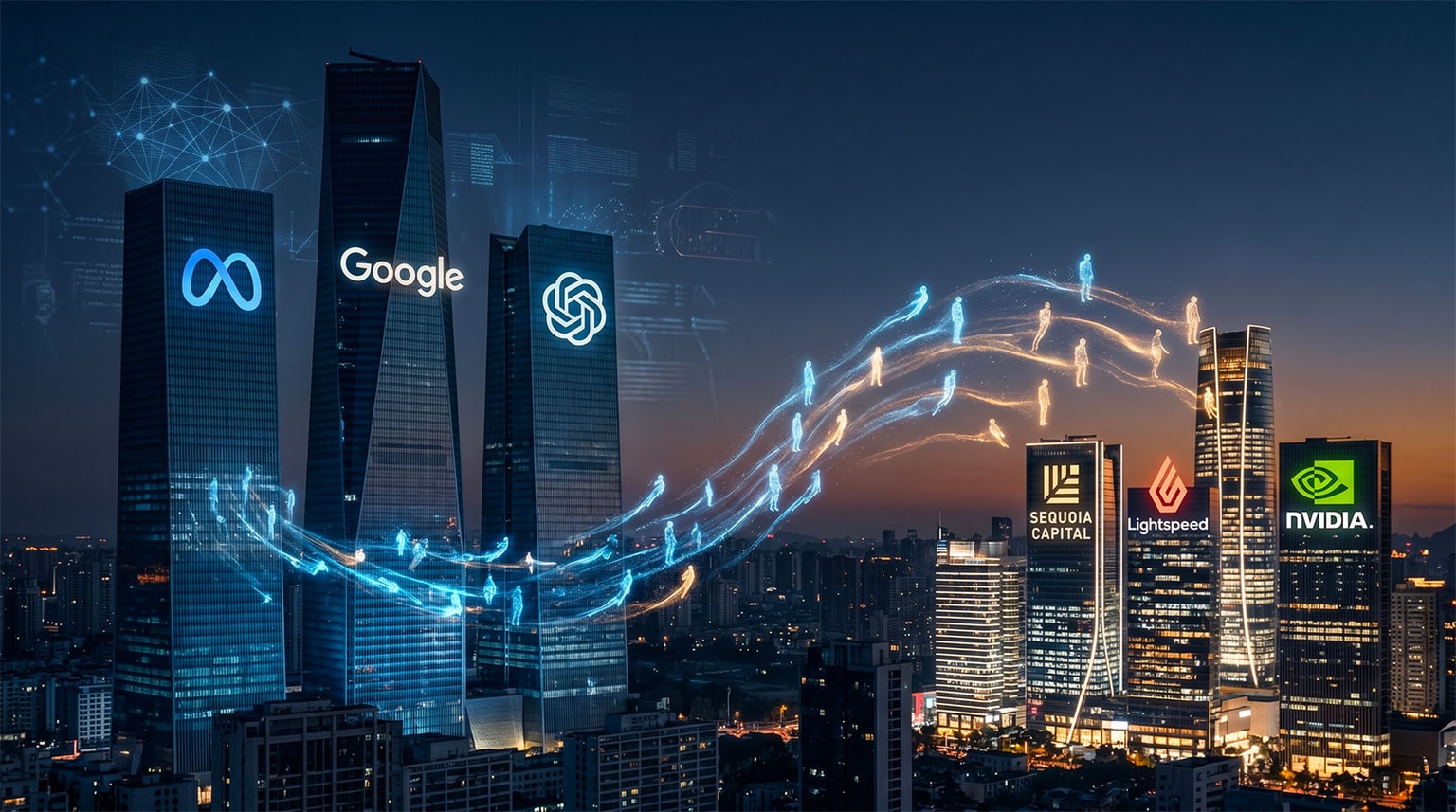
On April 28, 2026, CNBC finally said out loud what every Big Tech HR lead refused to admit publicly: Meta, Google and OpenAI are bleeding their most valuable talent. And we're not talking about random engineers — these are principal researchers, division leads, foundational model architects. They're leaving. And they're raising amounts that make no sense for startups with no product.
The number that changes everything: $18.8B in four months
According to Dealroom data cited by CNBC, $18.8 billion in venture capital has already been injected in 2026 into AI startups founded after January 1, 2025. At this pace, the year will far exceed the $27.9B raised in 2025 by companies founded after early 2024.
| Period | VC capital into new AI labs |
|---|---|
| 2025 (cohort founded since 2024) | $27.9B |
| 2026 (cohort founded since 2025) | $18.8B in 4 months |
| 2026 annualized projection | ~$56B |
Let that sink in. More venture capital is now flowing into AI startups founded by DeepMind, OpenAI and Meta FAIR alumni than into the entirety of European fintech series A/B/C funding over the same period.
The departures that hurt
Ineffable Intelligence — David Silver (DeepMind → record seed)
On April 27, David Silver, former head of reinforcement learning at DeepMind, architect of AlphaGo and AlphaZero, came out of stealth with Ineffable Intelligence and a historic $1.1B seed at $5.1B valuation. Sequoia, Lightspeed, Nvidia, Google, and even the UK's Sovereign AI Fund are on the cap table. No product, no revenue, no public roadmap. Just a name on a slide.
Ami Labs — Yann LeCun (Meta → $1B)
In March 2026, Yann LeCun left Meta after publicly disagreeing with the group's LLM-centric roadmap. His new entity, Ami Labs, raised $1 billion immediately after to explore non-LLM architectures (energy-based models, world models). Mark Zuckerberg loses one of Meta's three Turing Award holders.
Recursive Superintelligence — Tim Rocktäschel (DeepMind)
Tim Rocktäschel, ex-DeepMind, is reportedly seeking up to $1B for Recursive Superintelligence according to Sand Hill Road rumors. The thesis: recursive self-improvement, agents that modify their own code.
Periodic Labs — OpenAI + DeepMind alumni ($300M)
Periodic Labs, founded by ex-OpenAI and DeepMind staff, raised $300M in September 2025. Just months after launching.
Humans& — reinforcement learning from real experience ($480M)
Humans& secured $480M in January 2026 to explore reinforcement learning from real-world experiences rather than internet data — a direct bet against the LLM-first doctrine of the major labs.
Recursive Intelligence — $335M across two rounds
Finally, Recursive Intelligence (not to be confused with Rocktäschel's startup) accumulated $335M across two rounds after launching in September 2025.
Why researchers are fleeing
CNBC points to three structural factors that explain the exodus.
1. Commercial pressure kills foundational research
"The pressure to deliver benchmark performance and maintain rapid release cycles leaves limited room for genuinely exploratory research, particularly outside the dominant LLM paradigm."
When OpenAI has to justify its $500B valuation and Anthropic its $380B after the Google $40B deal, agent research, interpretability, new architectures and vertical models take a back seat. Not because they don't matter — but because they don't win the quarterly race.
2. Equity has lost its magic
When Anthropic was at $40B, a senior researcher could reasonably target a 10x on RSUs. At $380B, the upside becomes marginal. Meanwhile, founding Ineffable at $5.1B with 30% equity = $1.5B on paper as of the seed. The math is brutal.
3. Alternative architectures are back in fashion
For three years, the market bet exclusively on scale-out LLMs. The defectors are now betting on non-LLMs: reinforcement learning from real experience, world models, energy-based models, neuro-symbolic. These architectures require research freedom that commercial labs can no longer offer.
What this means for founders
For "normal" founders
If Sequoia signs a seed at $5.1B for an ex-DeepMind researcher with no product, your $5M seed for a working MVP is actually a good deal for VCs. The rarity of "real AI talent" pushes top valuations into orbit — but the tier below remains accessible.
For developers who want to capitalize
The new labs created by DeepMind/OpenAI defectors need systems, infra and frontend developers without PhDs. Salaries there are often more generous than Meta's, because they pay equity on very low valuations (in the sense of $5.1B vs $380B). The full-stack profile with an AI layer is the first to be targeted.
For AI operators
If you're building a consumer or B2B tool on OpenAI/Anthropic/Google APIs, know that non-LLM architectures are coming. In 18 to 36 months, your stack could be obsolete if it assumes a transformer in the backend. Watch the new entrants.
The Big Tech paradox
The giants created the conditions of their own bleeding.
- OpenAI closed access to its internal models for its researchers. Result: they leave to rebuild elsewhere.
- Meta paid Alexandr Wang $14B for Scale AI while laying off 10% of its non-strategic AI staff. Message received by researchers: only the top 0.1% is untouchable.
- Google DeepMind merged Google Brain and DeepMind, creating internal political conflicts. Silver, Rocktäschel and several others voted with their feet.
What about Europe?
Ineffable is in London. Mistral aims for $1B in revenue in 2026. H Company, Poolside, and several French labs are hiring. The UK Sovereign AI Fund co-invested in Ineffable. The narrative "all AI talent is in California" is crumbling.
Europe is no longer just a consumption market for American AI products. It's becoming a production hub again — driven by researchers who want to stay near their home universities and no longer need Silicon Valley to raise $1B.
Conclusion: phase 2 of the AI era
Phase 1 (2022-2025) was the race to scale and LLMs. A handful of centralized labs, ever-larger models, stratospheric valuations for OpenAI and Anthropic.
Phase 2 (2026+) will be distributed. Dozens of labs born from the brain drain, each specialized in an architecture, a domain, a learning method. Big Tech will continue to dominate distribution (ChatGPT, Gemini, Copilot), but upstream innovation migrates to the startup ecosystem.
This is excellent news for those who can navigate the noise. And a nightmare for those who thought AI was already settled. To understand how to monetize this new wave, our guide indie hacker AI: profitable projects without funding is more relevant than ever.
The Big Tech brain drain to startups is not a blip. It's a market signal: AI researchers' pricing power has exploded, alternative architectures are returning, and upstream innovation is leaving commercial labs. Founders who understand this shift today will have a 12-18 month lead on the rest of the market. To dig deeper into 2026 trends, read the major tech trends transforming development.