
Anthropic + NEC: Claude Code for 30,000 Employees in Japan — The Asian Conquest Operation Begins
On April 23, 2026, NEC became Anthropic's first Japan-based global partner. Claude Opus 4.7 and Claude Code will be deployed across 30,000 NEC Group employees worldwide, integrated into BluStellar Scenario, and used to build a Center of Excellence dedicated to AI-native engineering. Anthropic's Japanese bet takes shape.
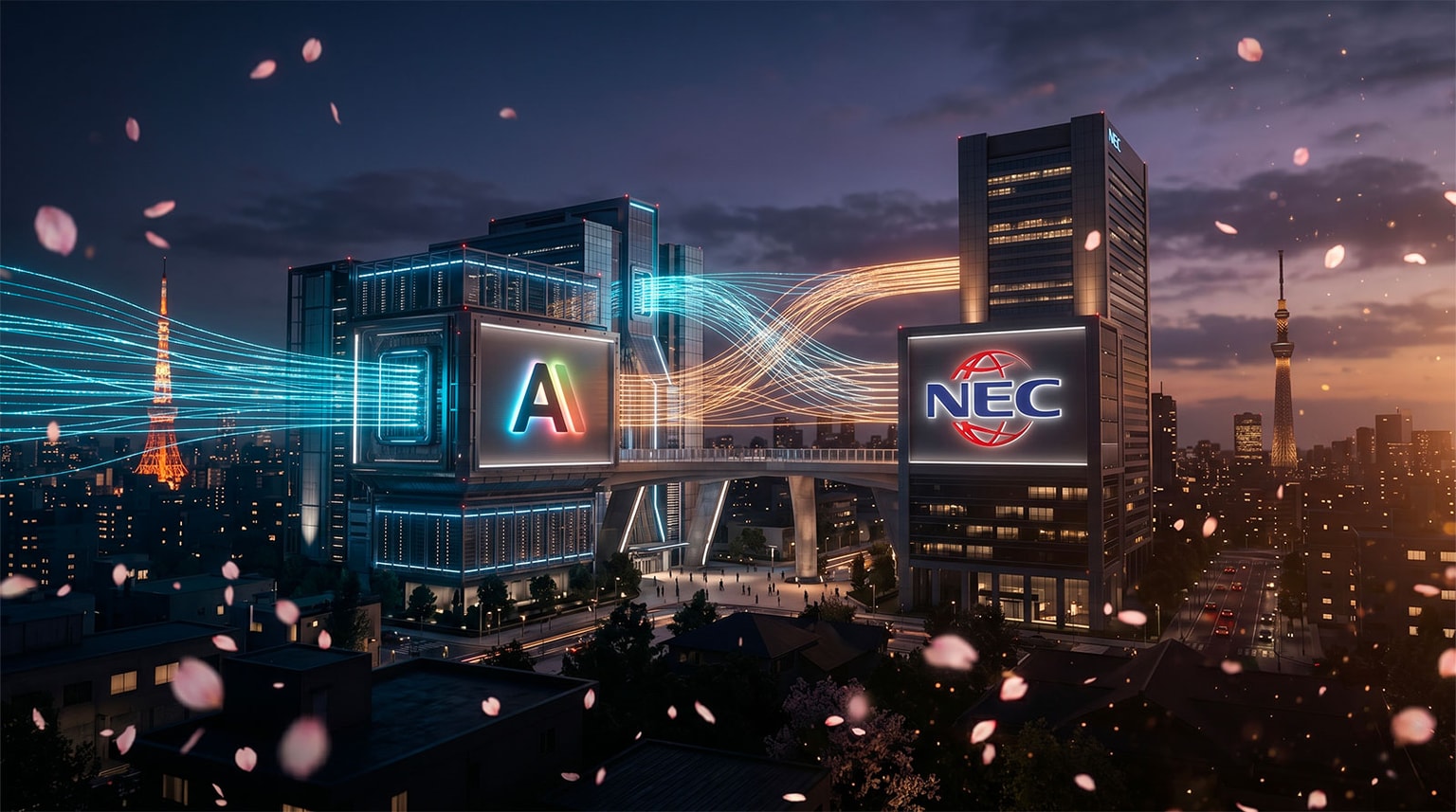
On April 23, 2026, NEC Corporation and Anthropic announced a strategic collaboration that positions the Japanese IT giant as Anthropic's first Japan-based global partner. The scope of the deal is significant: Claude — including Claude Opus 4.7 and Claude Code — will be deployed across 30,000 NEC Group employees worldwide, embedded into the BluStellar Scenario platform, and will fuel a Center of Excellence dedicated to AI-native engineering. This is Anthropic's most ambitious Asian conquest move since its $40 billion funding deal with Google and its $25 billion Amazon investment.
Key Numbers in the Partnership
| Element | Detail |
|---|---|
| Announcement date | April 23, 2026 |
| NEC status | First Japan-based global partner of Anthropic |
| Workforce reached | ~30,000 NEC Group employees worldwide |
| Models deployed | Claude (incl. Opus 4.7), Claude Code, Claude Cowork |
| Integration platform | NEC BluStellar Scenario |
| Priority verticals | Finance, manufacturing, local governments |
| Internal initiative | Center of Excellence for AI-native engineering |
| Adoption model | Client Zero (NEC consumes before reselling) |
NEC says it intends to build one of Japan's largest AI-native engineering teams, with Claude Code as a daily production tool. The company will also use Claude in its Security Operations Center services, already critical for defending its customers against rising cyber threats. The rollout is staged over 12 to 18 months according to Japanese sources.
Why Japan, Why NEC
The Japanese enterprise AI market lagged the Western 2023-2025 wave for three reasons: strict compliance requirements, historical reliance on domestic vendors (Fujitsu, NEC, NTT Data), and a custom-build culture incompatible with standardized US SaaS. Anthropic in particular was nearly absent from Japan before 2026.
NEC changes the equation along several dimensions:
- Regulatory legitimacy. NEC is the reference IT systems integrator for the Japanese state (local governments, defense). Trusting it with Claude provides compliance signaling to conservative Japanese Fortune 500 CIOs.
- Physical distribution. NEC employs over 100,000 people in total and runs a sales force that reaches verticals (heavy industry, public services, transport) outside the typical US SaaS perimeter.
- Client Zero integration. NEC commits to using Claude internally before selling it. This mechanism immediately produces premium case studies: testimonials signed by a historical Japanese player, a powerful argument for conservative IT directors.
For Anthropic, this is also a strategic counterweight to OpenAI in Japan. OpenAI multiplied Microsoft / SoftBank partnerships in 2024-2025 but never landed a deal as structuring as a 30,000-seat deployment with an industrial partner.
The Strategic Ingredient: Claude Code in Industrial Workflows
The most underestimated aspect of the deal is not the seat count — it is the integration of Claude Code into NEC's engineering workflows. Concretely:
- Legacy → cloud-native migration. NEC operates tens of millions of lines of COBOL, Java EE and legacy code at its banking and insurance customers. Claude Code excels at multi-file migration and refactoring on aging stacks (see the Opus 4.7 SWE-bench 87% benchmarks).
- Industry-specific generation. The partnership includes co-developed sectoral tools: finance agents (KYC, anti-money laundering), manufacturing (digital twins, MES), local governments (administrative workflow). Anthropic gains a rare industrial experimentation ground.
- Security by design. NEC already integrates Claude into its Security Operations Center. This aligns with the doctrine surfaced in Microsoft × Claude Mythos Security Development Lifecycle, proof that Anthropic structures its enterprise storytelling around cybersecurity.
NEC's stated objective is clear: transform its engineering organization into an AI-native team in less than 24 months. If the operation succeeds, it becomes an exportable model for all Japanese SI players.
The Anthropic Side: Companion Move to the Google Deal
The NEC partnership fits a particularly dense strategic announcement cadence for Anthropic since the start of 2026:
- March 31, 2026 — Anthropic overtakes OpenAI on enterprise revenue ($30B ARR projected)
- April 17, 2026 — Refusal of $800B valuation round, preemptive offers blocked
- April 18, 2026 — Release of Claude Opus 4.7 (87% SWE-bench Verified)
- April 21, 2026 — Amazon commits an additional $25B on AWS Trainium
- April 22, 2026 — Reconciliation with the Trump administration and the Pentagon
- April 23, 2026 — NEC Japan partnership (this news)
- April 24, 2026 — Microsoft adopts Claude for its Security Development Lifecycle
- April 25, 2026 — Google injects an additional $40B (cloud + TPU)
In four weeks, Anthropic has locked in two of the three hyperscalers (AWS + Google), Microsoft on security, the Pentagon on defense, and NEC on Japan. No competitor matches that geopolitical mesh in such a short timeframe.
OpenAI Workspace Agents in the Background
The timing of the NEC deal is notable: it lands on the same day as OpenAI's launch of GPT-5.5 and Workspace Agents. Anthropic and OpenAI now fight three simultaneous frontal segments:
| Segment | Anthropic | OpenAI |
|---|---|---|
| Frontier model | Opus 4.7 (87% SWE) | GPT-5.5 (announced) |
| Coding agent | Claude Code | Codex / Workspace Agents |
| Office productivity | Claude Cowork | ChatGPT Business + Agents |
| Asia enterprise distribution | NEC (Japan) | SoftBank / Microsoft |
| US enterprise distribution | Microsoft (security) | Microsoft (Copilot) |
The market is starting to segment around strategic alliances rather than features. NEC gives Anthropic an Asia channel that OpenAI cannot replicate quickly.
For Publishers and Developers: What to Take Away
1. Anthropic's Asia-Pacific taxonomy is materializing. NEC is the cornerstone; expect analogous deals with Samsung SDS (Korea) and TCS / Infosys (India) within 6-12 months. If you publish enterprise tools, the Anthropic Partner Program → Regional SI → Local Fortune 1000 distribution rail becomes a viable path.
2. Claude Code becomes a B2B engineering standard. At 30,000 seats with a single partner, you exit the indie developer market. Adjacent tooling vendors (SDKs, plugins, monetization layers) have an interest in positioning explicitly on the Claude ecosystem — see the pattern of Idlen for native chat AI monetization.
3. Services managers gain in value. The NEC Center of Excellence will sell "Claude-ready" consulting to Japanese Fortune 500. Capgemini, Accenture, Wipro and IBM Consulting are preparing similar offers. If you're an independent Anthropic consultant, your billable hours will double within 12 months.
4. Compliance becomes a commercial argument. NEC pushes secure deployment as a value-add. This converges with Microsoft Agent Governance Toolkit. Expect Anthropic to publish a formal "Claude Enterprise Compliance" framework before Q3 2026.
Friction Points to Watch
Compute capacity. 30,000 actively used Claude Code seats represent hundreds of millions of tokens daily. With recent $40B from Google and $25B from Amazon, Anthropic has the capacity — but regional asymmetry (US Trainium AWS, global Google TPU8) complicates latency routing for Japanese users.
Language and local benchmarks. Claude is still better in English than in Japanese. NEC will need to co-invest in domain-specific evals (legal, finance, manufacturing JP) to validate performance on internal corpora.
Internal competition risk. NEC will commercialize AI-native products built on Claude that may compete with those of other Anthropic partners or Microsoft Japan. Sectoral exclusivity boundaries remain unclear in the initial communication.
Bottom line:
- NEC + Anthropic: first Japan-based global partner, announced April 23, 2026
- 30,000 NEC Group employees on Claude / Claude Code / Claude Cowork
- BluStellar Scenario integration, Center of Excellence for AI-native engineering
- Priority verticals: finance, manufacturing, local governments
- Client Zero approach: NEC consumes before reselling
- Strategic timing: same day as OpenAI's Workspace Agents
- Anthropic completes its geopolitical mesh: AWS + Google + Microsoft + Pentagon + NEC
The NEC partnership changes the very nature of the Anthropic vs OpenAI competition in Japan. Where OpenAI bet on consumer distribution (ChatGPT Japan, Microsoft 365 integration), Anthropic is betting on regional system integrators as the armed wing of enterprise rollout. The bet is elegant: let a legitimate Japanese player carry the Claude messaging to conservative IT directors, instead of opening a local subsidiary that would have taken 24 months to ramp. If NEC succeeds in transforming its 30,000 engineers into an AI-native team by the end of 2027, the model will be replicated in Seoul, Mumbai and Singapore. And the enterprise consolidation of the AI market will increasingly run through regional strategic alliances rather than pure model performance.
Sources: Anthropic — Anthropic and NEC partner to build AI-native engineering at scale in Japan, NEC — Strategic Collaboration with Anthropic Press Release, Cybernews — Japanese IT giant NEC tells 30,000 employees to use Anthropic's Claude, IT Brief Asia — Anthropic partners NEC to deploy Claude across 30,000 employees.


