Factory AI Raises $150M at $1.5B Valuation — Droids Ship Code at Nvidia, Adobe and Adyen
On April 16, 2026, Factory closes a $150M Series C led by Khosla Ventures at a $1.5B valuation. Its Droids — AI agents that code, test, review and deploy — are used by hundreds of thousands of developers at Nvidia, Adobe, Bayer, EY, MongoDB and Zapier. The enterprise vibe-coding category has hit capital maturity.
On April 16, 2026, Factory announced a $150 million Series C led by Khosla Ventures, with participation from Sequoia Capital, Insight Partners, and Blackstone. Post-money valuation: $1.5 billion. The startup, founded in 2023 by Matan Grinberg (former Berkeley PhD) and Eno Reyes, sells Droids — AI agents that don't just generate code, but also handle testing, review, documentation, and deployment across the full cycle. Nvidia, Adobe, EY, Palo Alto Networks, Adyen, MongoDB, Bayer, Zapier, and hundreds of other companies claim production deployments. Keith Rabois (Khosla) joins the board.
The Factory thesis: "coding = the full cycle, not just generation"
Factory built its positioning on a simple observation: code generation is only a third of a professional developer's work. The rest — writing tests, reviewing PRs, authoring docs, triggering a deploy, patching an incident — stays manual in most competing "AI coding" tools. Cursor, Copilot, Claude Code focus on the editing phase. Factory wants to cover the full pipeline.
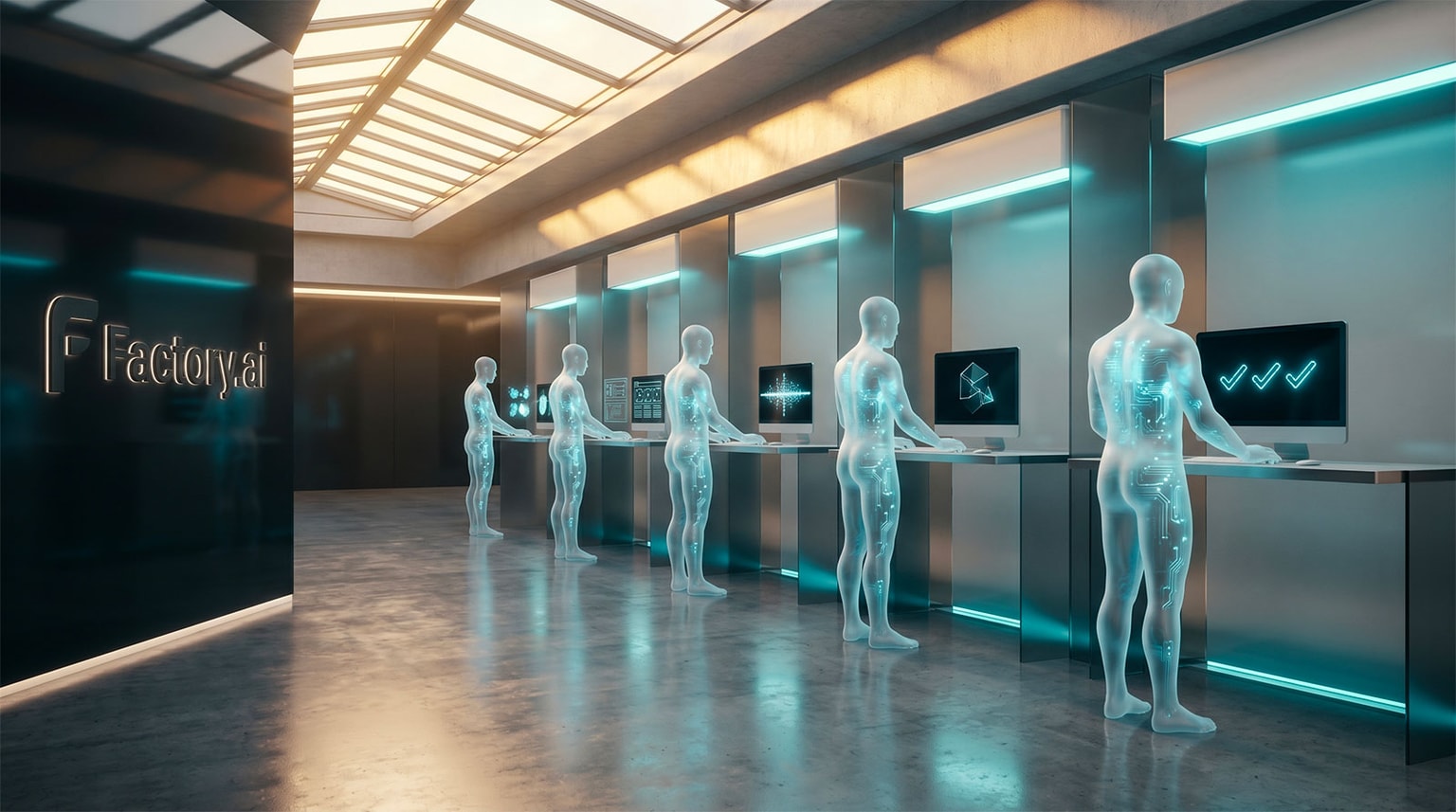
Droids are therefore multi-agent by design. A "Writer" Droid generates the initial code, a "Reviewer" Droid evaluates the PR, a "Tester" Droid writes and runs tests, a "Docs" Droid produces the associated documentation, a "Deployer" Droid pilots the release. Orchestration across Droids enables an end-to-end chain the team sells as the first real "software development lifecycle automation" that can hold up in enterprise environments.
| Component | Role | Typical output |
|---|---|---|
| Writer Droid | Generates the implementation | Git branch with initial commit |
| Reviewer Droid | Reviews the PR | Inline comments + scoring |
| Tester Droid | Writes + runs tests | Coverage report + logs |
| Docs Droid | Authors README / changelog | Generated markdown |
| Deployer Droid | Pilots the release | CI/CD trigger + monitoring |
The differentiator: multi-model, not mono-provider
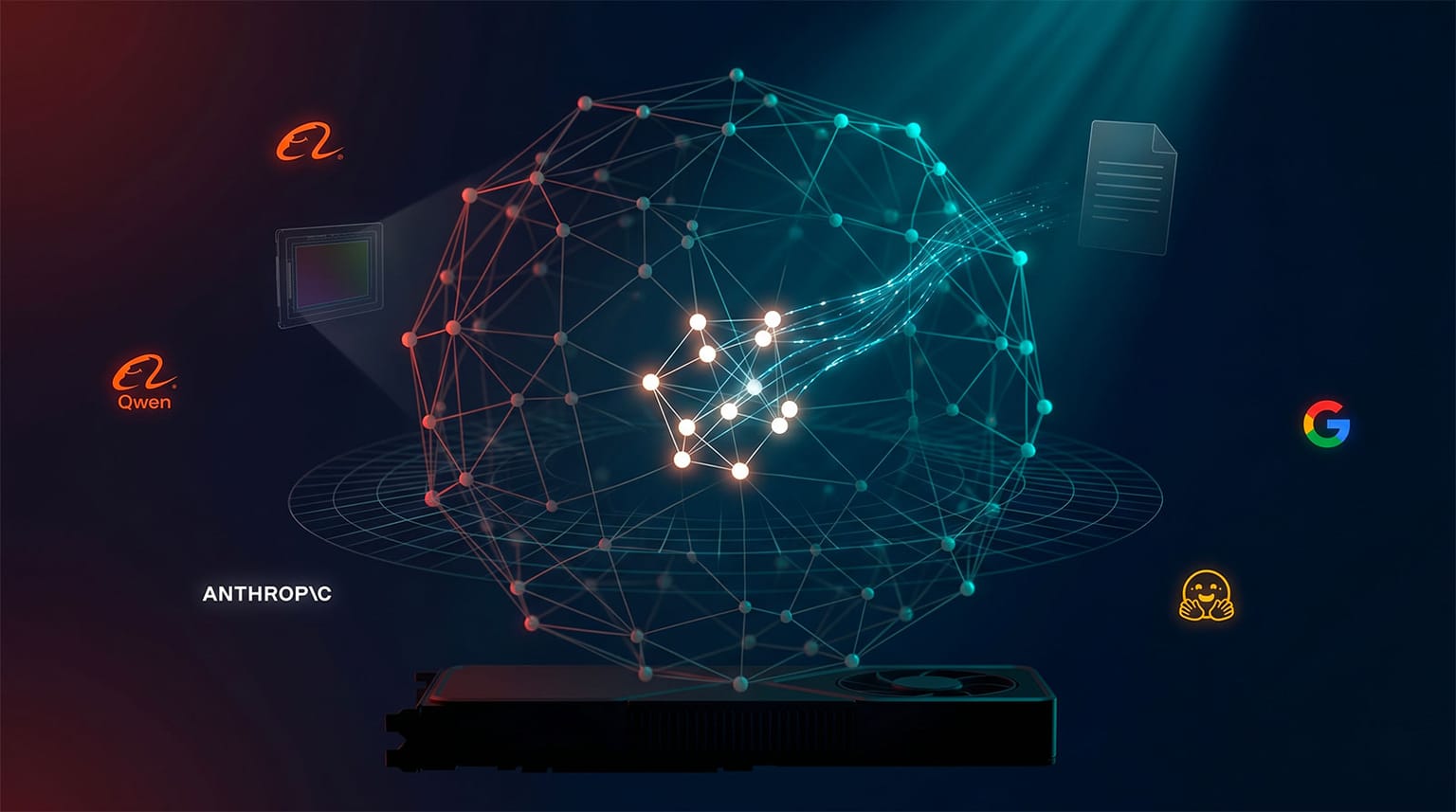
Matan Grinberg told the Wall Street Journal that the decisive enterprise-adoption factor is the Droids' ability to switch across several foundation models — Anthropic's Claude, OpenAI's GPT-5, Google's Gemini, DeepSeek V4, or Alibaba's Qwen 3.6. For a CIO trying to avoid lock-in, that sells. For a compliance team, it sells even better — some tasks can route to an on-prem model (Qwen, Llama) when they touch sensitive data, others to Claude Sonnet 4.5 when quality is paramount.
That architectural flexibility is rare in the landscape. Cursor is mostly wired to Claude and GPT. Claude Code runs only on Claude. Codex runs only on OpenAI models. Factory, by positioning itself as orchestrator rather than vertical product, captures routing value — each task goes to the most efficient model at time t, according to price, latency, and expected quality.
The pattern mirrors what Harvey did for legal or what Glean did for enterprise search. Sell the orchestration and the vertical workflow, leave compute and pure R&D to foundation labs. Valuation: $1.5B in less than three years.
The clients that matter: Nvidia, Adobe, Bayer, Adyen
The claimed customer list is worth more than any pitch slide. Here's why each logo says something:
- Nvidia — the world's largest GPU maker uses Droids for its own software development. Implicit message: Droids hold up on hardware + driver + CUDA stack scale.
- Adobe — 30,000+ engineers at Adobe, mostly on massive C++ and Java codebases. Validates the use case on legacy code and non-trivially modern languages.
- Bayer — FDA-regulated pharma, maximum compliance constraints. Validates the on-prem + audit-trail story.
- Adyen — European fintech operating payments at scale. Validates zero tolerance for production bugs.
- EY, MongoDB, Palo Alto Networks, Zapier — cover consulting, database, cybersecurity, and automation. Horizontal coverage confirmed.
For a Series C, having this level of social proof across 8 verticals simultaneously is rare. Most AI-coding startups at this stage claim 1–2 big logos and a lot of SMB customers. Factory shows the reverse pattern.
Why the round's timing makes sense
$1.5B valuation on a $150M raise is a raise/valuation ratio of 10% — standard for a hot Series C. Sequoia was already on the cap table (Shaun Maguire answered Grinberg's cold email in 2023); Khosla comes in to lead. Insight Partners and Blackstone add balance-sheet depth to support large-account rollouts. The board gains Keith Rabois, known for his hard-operator style and for pushing PayPal and Square into scale phases.
The timing is justified by three converging dynamics. First, enterprise demand for coding agents is exploding. Anthropic crossed $30B run-rate, mostly on Claude Code. OpenAI just expanded Codex with computer use and 90 plugins. CIOs are ready to sign 7-figure contracts — Factory wants to be on the short list.
Second, the market is polarizing. Cursor is valued at $50B, Lovable has $400M ARR, Replit raised $400M. Big rounds concentrate on the leaders. Factory needs to consolidate its top-5 position before a buyout or horizontal merger becomes the natural option.
Third, compute-cost pressure is intensifying. A multi-model agent like Droids consumes massive token volumes — and API prices will drop thanks to Nvidia/Trainium/TPU competition. Factory can now afford to grow volumes without killing margins.
Gray zones yet to be cleared
No Factory press release publishes revenue. That's an anomaly at a $1.5B valuation. Two hypotheses: either ARR is low (below $30M) and Factory prefers not to say so to avoid attention on a high multiple, or ARR is very high (above $100M) and Factory keeps that card for the next round. Given the enterprise client list, the second scenario is more likely but not confirmed.
Second gray zone: dependency on external APIs. Droids rely on Claude, GPT, and Gemini. If one of the three labs decides to acquire a Factory competitor (or launch its own equivalent product), Factory loses a strategic supplier. Anthropic has already launched its native app builder integrated into Claude — nothing prevents a pivot toward a "Claude for Enterprise SDLC" that would encroach on Factory territory.
Third zone: the agentic SDLC market is still early. Most CIOs run pilots, not mass deployments. The real benchmark of success will be the share of Writer Droids that commit code to production without human intervention in 12 months. Today, most deployments keep a human in the loop on every PR.
What Factory signals for the market
Factory's Series C is a macro signal. It confirms that the "AI coding agent for the enterprise" category has reached financial maturity. We're now talking about hundreds of millions raised, Fortune 500 logos in production, and roadmaps that include GDPR, SOC 2, HIPAA, and FedRAMP. This isn't vibe coding for indies or startups — it's industrialized software.
For developers watching the landscape in 2026, the question is no longer "should I use a coding agent" — the answer is yes. The question is "which agent, for which use case." Cursor for fine-grained editing, Claude Code for complex workflows, Codex for the ChatGPT ecosystem, Factory for multi-step enterprise orchestration. Each tool earns its niche, and competition keeps pushing capabilities up and prices down.
TL;DR:
- Factory raises $150M Series C at $1.5B post-money valuation
- Lead investor: Khosla Ventures; participants: Sequoia, Insight, Blackstone
- Keith Rabois joins the board
- Droids: multi-role agents (Writer, Reviewer, Tester, Docs, Deployer)
- In-production customers: Nvidia, Adobe, EY, Palo Alto Networks, Adyen, MongoDB, Bayer, Zapier
- Differentiating edge: multi-model switching (Claude, GPT, Gemini, DeepSeek, Qwen)
- Enterprise vibe coding category = capital maturity in April 2026
Factory embodies the 2026 generation of AI coding startups: multi-model by design, enterprise-ready from the first logo, valued at 10x its cash raised because investors believe in a world where 70% of enterprise code runs through an agent before merge. The $150M Series C buys runway to hold the frontal competition with Cursor, Lovable, Replit, Claude Code, and the new Codex Desktop. The real test arrives in 18 months: can Factory publicly show $500M ARR, or does it remain a premium niche player?
For vendors building on top of these agents — IDE plugins, orchestrators, productivity dashboards — the Factory pattern is worth remembering: the enterprise doesn't pick a model, it picks a multi-model platform that routes intelligently. That's also the logic we apply at Idlen on the publisher side: expose a single SDK and let the platform choose the right ad format, the right advertiser, and the right scoring model on every call.
Sources: TechCrunch — Factory hits $1.5B valuation to build AI coding for enterprises, The AI Insider — Factory raises $150M at $1.5B valuation, Factory.ai — Official site, Tech Funding News — Factory AI 150M Series C.