
Google AI Studio Goes Full Stack: Antigravity and Firebase Redefine Vibe Coding
Google overhauls vibe coding in AI Studio with the Antigravity agent and native Firebase integration, enabling full-stack app creation and deployment from a single interface.
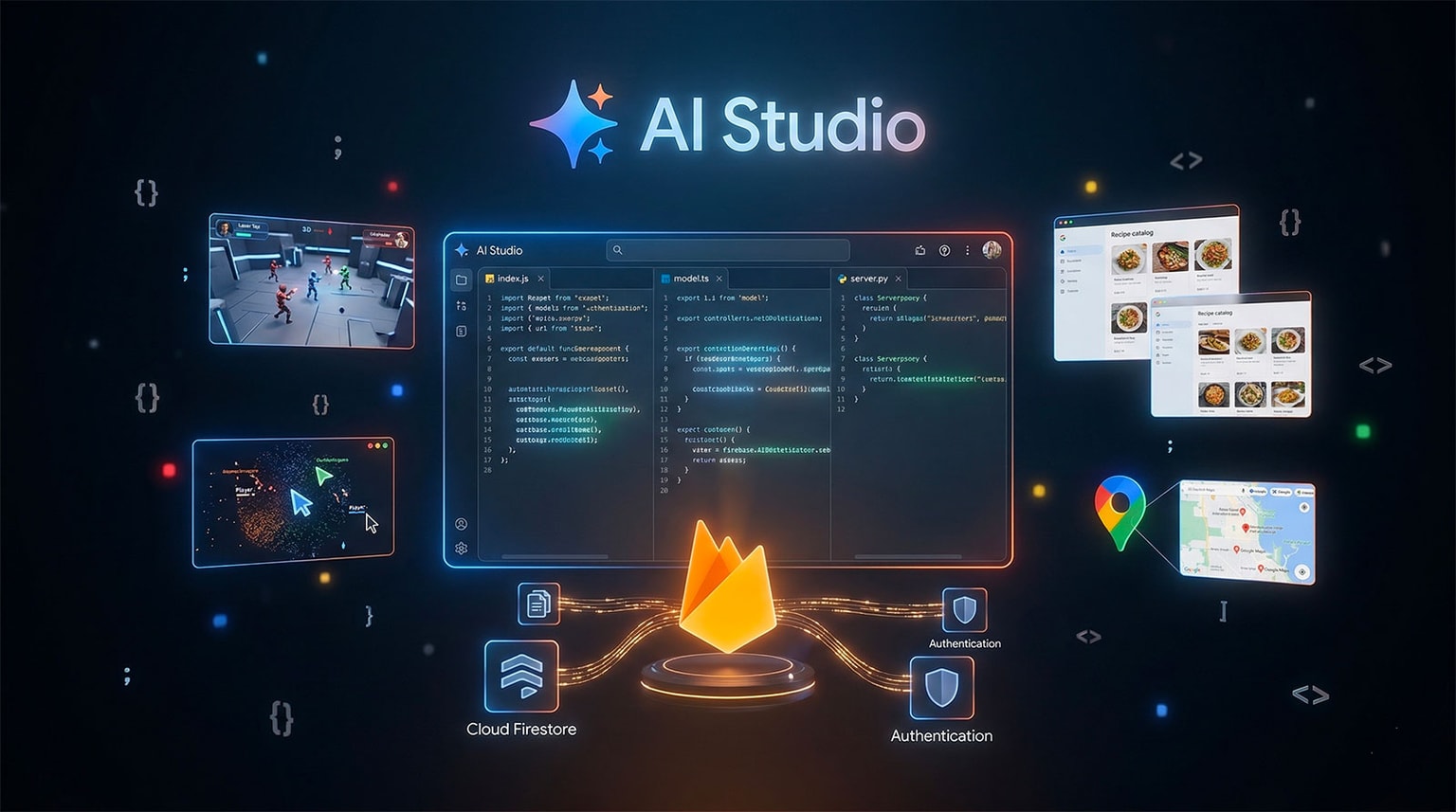
On Thursday, March 19, 2026, Google announced a major overhaul of the vibe coding experience in Google AI Studio. The update integrates the Antigravity coding agent and native Firebase connectivity, allowing developers to create, configure, and deploy full-stack applications — front-end, back-end, authentication, and secrets management — without leaving the interface.
From Idea to Deployment: What the New Experience Enables
The ambition is clear: go from a simple prompt to a deployable application with complete back-end infrastructure. In practice, the Antigravity agent automatically detects a project's technical requirements and provisions the corresponding services. Cloud Firestore handles data storage, Firebase Authentication manages secure user sign-in, and a Secrets Manager stores third-party API keys — payments, maps, databases.
Beyond back-end provisioning, the update introduces several production-ready features: real-time multiplayer experiences, automatic installation of external web libraries (Framer Motion, Shadcn, Three.js), session persistence across devices and browsers, and Next.js support alongside React and Angular.
Antigravity: The Agentic IDE at the Core
Launched in November 2025 alongside Gemini 3, Antigravity is an agentic development environment built by Google. The tool understands a project's complete structure and performs autonomous multi-file modifications — generating components, configuring routes, and setting up APIs.
Google states that this new experience has already been used internally to build hundreds of thousands of applications in recent months. The agent is now directly embedded in AI Studio, eliminating the friction between rapid prototyping and transitioning to a full IDE.
Firebase: The Key Back-End Infrastructure
Firebase is Google's suite of cloud services for web and mobile application infrastructure: real-time database, authentication, hosting, and file storage. In this new setup, Firebase is automatically provisioned by Antigravity based on project needs.
Provisioning covers Cloud Firestore for data persistence, Firebase Authentication for user account management, and the Secrets Manager for securing third-party API keys. All without manual configuration — the agent detects dependencies and sets up the infrastructure after user validation.
Concrete Use Cases Built from AI Studio
To showcase the platform's capabilities, Google presented several applications created directly from the interface:
- A real-time multiplayer laser tag game with leaderboards and embedded AI, generated from a single prompt.
- A collaborative 3D space where each cursor generates animated particles, with real-time synchronization via Three.js.
- A geolocation app connected to Google Maps through the Secrets Manager for API key storage.
- A collaborative recipe catalog powered by Gemini, with user sharing and persistent data storage.
These examples are accessible and remixable directly from Google AI Studio. They illustrate the concrete transition from prompt to usable product, complete with a functional back-end and persistent data.
An Increasingly Competitive Vibe Coding Market
This announcement is part of Google's broader strategy around AI-driven development. The company first integrated vibe coding into AI Studio in October 2025, building on Opal, its experimental tool launched during the summer. Antigravity was then unveiled in November as a standalone agentic IDE. The March 19 overhaul marks the convergence of these two building blocks.
In parallel, Google introduced Stitch, its "vibe design" tool that takes on Figma in the space of AI-driven interface design.
The market is heating up. Cursor, Replit, Lovable, and Windsurf all offer AI-assisted development environments with varying degrees of autonomy. Google is betting on tight integration with its cloud ecosystem and Gemini models to stand out. The company plans to connect AI Studio to Google Workspace soon and add a direct export path to Antigravity.
Key Takeaways
- Google AI Studio now supports full-stack app creation (front + back) directly from the interface, with Firebase automatically provisioned.
- The Antigravity agent detects technical requirements, generates multi-file code, and configures cloud infrastructure without manual intervention.
- Firebase Authentication, Cloud Firestore, and a Secrets Manager are natively integrated to handle users, data, and API keys.
- Google unveiled Stitch for vibe design and plans a Google Workspace connection, broadening its AI developer tools offensive.
- The vibe coding market intensifies against Cursor, Replit, Lovable, and Windsurf, but Google plays the vertical integration card with its cloud and Gemini.
| Criteria | Google AI Studio + Antigravity | Cursor | Replit | Lovable |
|---|---|---|---|---|
| Approach | Full-stack vibe coding (prompt → deployed app) | AI-augmented IDE (assisted coding) | Cloud IDE + integrated deployment | Prompt-to-app no-code/low-code |
| Native back-end | Yes (Firebase auto-provisioned) | No (manual setup) | Yes (Replit DB + hosting) | Partial (Supabase optional) |
| Autonomous agent | Antigravity (multi-file, infra provisioning) | Tab autocomplete + chat | Replit Agent (project generation) | App generation agent |
| AI model | Gemini 3 | GPT-4o / Claude | GPT-4o / third-party models | Claude / GPT-4o |
| Cloud ecosystem | Google Cloud, Firebase, Workspace (soon) | None (local IDE) | Replit Cloud | None |
| Supported frameworks | React, Angular, Next.js | All (editor-agnostic) | Python, JS, HTML/CSS | React, Next.js |
| Primary audience | Developers, prototypers, product teams | Experienced developers | Beginners, education, prototyping | Non-developers, founders |


