
Shield AI Raises $2B at $12.7B — Hivemind Pilots 26 Vehicle Classes as US Defense Enters the Agentic Era
On April 9, 2026, Shield AI closes a $1.5B Series G + $500M preferred equity at a $12.7B valuation (2.4x in a year). The company acquires Aechelon to industrialize its simulation pipeline, while Hivemind already pilots F-16s, drones, boats, and ground vehicles.
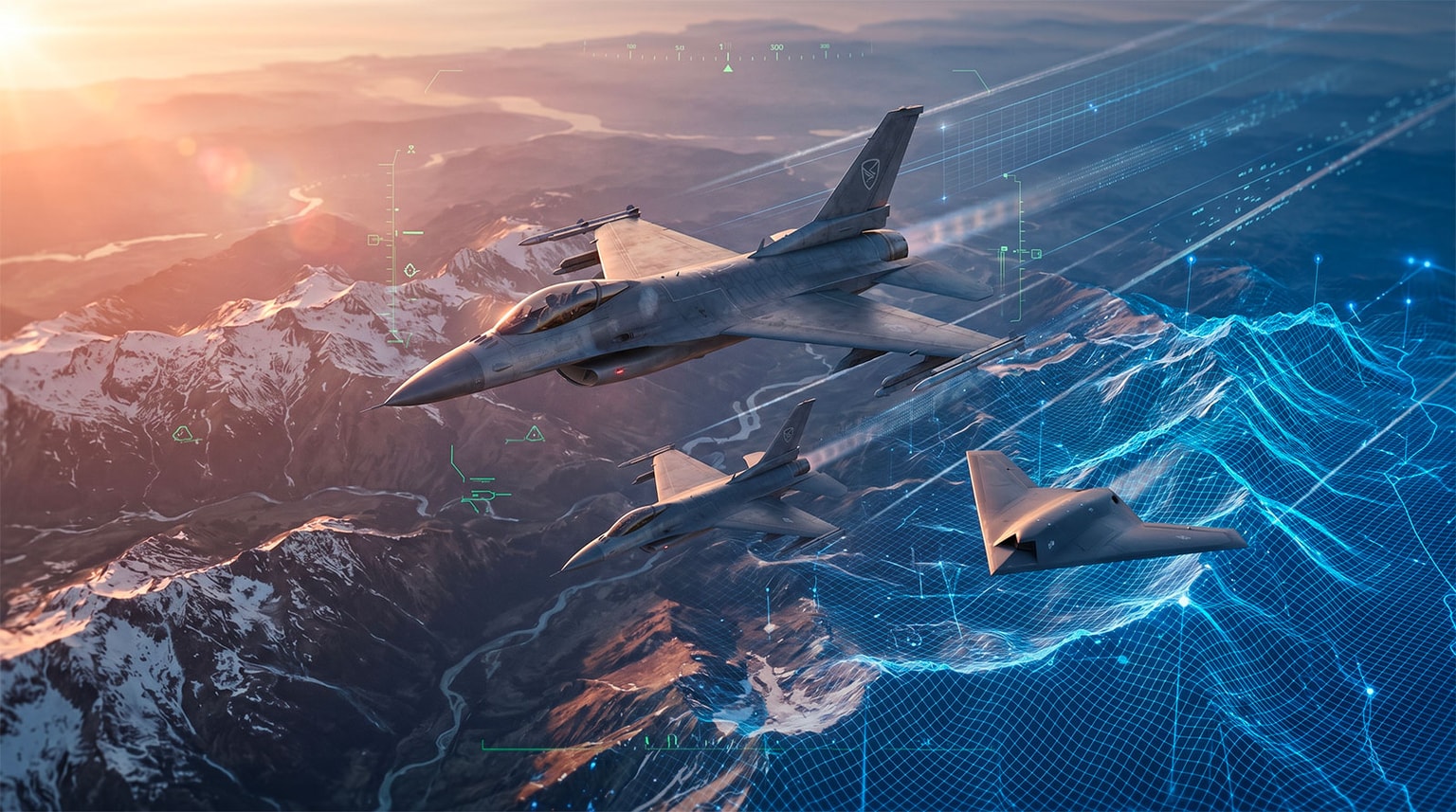
On April 9, 2026, Shield AI announced a double deal that reshapes the US defense AI landscape: a $1.5 billion Series G led by Advent International and co-led by JPMorgan Chase's Security and Resiliency Initiative, plus $500 million in fixed-return preferred equity from Blackstone, plus a $250 million delayed-draw facility. Total package: $2.25 billion. Post-money valuation: $12.7 billion — a 2.4x jump in one year. To put the money to work, the company acquired Aechelon, a San Francisco-based provider of geo-specific flight simulators. The message is clear: agentic AI is leaving SaaS and entering operational defense.
The Deal in Numbers
| Component | Amount | Type |
|---|---|---|
| Series G equity | $1.5B | Led by Advent, co-led by JPMorgan |
| Preferred equity | $500M | Blackstone, fixed return |
| Delayed-draw facility | $250M | Blackstone |
| Total | $2.25B | Mix equity / preferred |
| Post-money valuation | $12.7B | +140% vs 12 months ago |
| Acquisition | Aechelon | Geo-specific simulators |
The equity/preferred ratio is unusual for a defense startup. The fixed-return Blackstone preferred looks more like quasi-senior debt than growth capital — Blackstone captures an annual coupon, Shield AI keeps dilution under control. That's a pattern you typically see at mature scale-ups like SpaceX or Anduril. Shield AI joins the club.
Hivemind: 26 Vehicle Classes Piloted
Shield AI's engine is Hivemind — the foundation model for autonomy in contested environments. For the first time, the company published the number that justifies the valuation: Hivemind has already piloted 26 different vehicle classes, including:
- F-16 — the US Air Force's workhorse fighter
- Jet-powered UAVs — fast combat drones
- Helicopters — notably the MH-60 Seahawk
- Surface drones — autonomous boats for the Navy
- Ground vehicles — armored and logistics systems
That's an argument neither OpenAI, Anthropic, nor xAI can produce: a model that already pilots 26 types of machines in GPS-denied environments. Where consumer AI argues over MMLU benchmarks, Shield AI argues over real missions in contested airspace.
Selection by the US Air Force for the Collaborative Combat Aircraft (CCA) program in March 2026 is what tipped the valuation. For the first time, the Air Force decoupled mission autonomy software from the airframe itself. CCAs — escort drones for F-35s and F-47s — can be piloted by Hivemind independently of the hardware chosen. It's the "Android moment" of military aviation.
Why Buy Aechelon
The Aechelon deal is the piece that was missing. Hivemind is trained in simulation before being deployed on real hardware. That simulation has to be geo-specific: a model flying an F-16 over Taiwan must have been trained on a pixel-accurate representation of Taiwan, not generic geography.
Aechelon, based in San Francisco, provides exactly that: geo-specific simulators + physics-based sensor AI. The company has been around since the 2000s and already supplies the Navy, the Air Force, Boeing, and Lockheed. Shield AI isn't buying an AI startup — it's buying the source of truth for simulation training.
The strategic message: Shield AI internalizes the sim-to-real loop. The Hivemind Foundation Model for Defense is trained in Aechelon simulation, refined on real-world operations, redeployed. The company now owns every layer of the stack, from simulation pixels to flight controls.
The Thesis: Agentic AI Leaves SaaS
Look at the three biggest rounds of the week of April 14, 2026:
| Company | Round | Valuation | Focus |
|---|---|---|---|
| Shield AI | $2.25B | $12.7B | Defense, flight autonomy |
| Perplexity Comet iPhone | - | ~$18B | Consumer AI browser |
| Emergent Wingman | $100M | $1B | Vibe coding, India |
Shield AI is the only one not chasing UX or software distribution. It's autonomy embedded in metal. And the only one of the three to raise above $10B this week.
The investor bet is clear: generative AI has hit a valuation ceiling. What hasn't hit one yet is AI that pilots physical systems. Autonomous vehicles (Waymo at $16B), industrial robots (ABB + NVIDIA), combat drones (Shield AI, Anduril). The next cycle of returns.
JPMorgan in Defense Tech: A Signal
The co-lead from JPMorgan's Security and Resiliency Initiative is the angle markets will talk about for six months. It's the first time a JPMorgan national-security initiative has led a round in a defense tech startup. The effect: opening the institutional-capital floodgates to defense, where most large LPs (pension funds, sovereign wealth) have historically avoided the sector.
Advent International, the lead, manages $125 billion in assets. Blackstone, on the preferred, manages $1.1 trillion. For the first time, Shield AI has a tier-1 Wall Street cap table, not just a VC cap table. This is the moment defense AI enters mainstream capital markets.
What It Changes for the Ecosystem
Anduril. Shield AI's direct competitor is also raising at similar valuations (~$14B). The two companies split the US market: Anduril leans into munitions and command, Shield AI leans into air and maritime autonomy. The Shield AI raise puts pressure on Anduril to match quickly.
Frontier AI labs. OpenAI, Anthropic, Google — none can sell to defense without an approved integrator. Shield AI becomes that integrator for embedded autonomy. Expect model-component partnerships (vision, spatial reasoning) within 12 months.
European defense startups. Helsing, Tekever, ARX Robotics — the Shield AI round lifts European valuations but also widens the capital gap. A $2.25B Series G exceeds all combined European defense-tech fundraising in 2025. The UK sovereign AI fund at £500M looks undersized next to this.
The CCA program. With Hivemind selected and $2.25B in fresh capital, Shield AI can deliver on the Pentagon's timeline: first operational CCA flights by 2028. Traditional aerospace — Lockheed, Boeing, Northrop — now has to integrate Hivemind or lose the contract.
Bottom line:
- $1.5B Series G led by Advent, co-led by JPMorgan + $500M preferred equity from Blackstone + $250M delayed-draw
- Post-money valuation: $12.7B, 2.4x in 12 months
- Hivemind already pilots 26 vehicle classes (F-16, UAVs, helicopters, surface drones, ground vehicles)
- Selected for Collaborative Combat Aircraft with the US Air Force — first decoupling of mission autonomy from airframe
- Aechelon acquisition: geo-specific simulators for the sim-to-real loop
- JPMorgan Security and Resiliency Initiative leads a defense-tech round for the first time
- Agentic AI exits SaaS and enters physical systems — the next valuation frontier
Shield AI's raise is the signal that investors have understood the next AI cycle isn't in the chatbot or the IDE. It's in systems that move — cars, drones, robots, fighters. Hivemind is to defense what ChatGPT was to SaaS in 2023: the moment a technology leaves the lab and enters the chain of command. At $12.7 billion, with JPMorgan, Advent, and Blackstone on the cap table, Shield AI is no longer a startup. It's a new-generation defense contractor, arriving 15 years ahead of the Pentagon's doctrine with an AI model already flying what its competitors can only imagine on PowerPoint.
Sources: Shield AI — Series G announcement, Defence Innovation Review — Shield AI Raises $2B at $12.7B, TNW — Shield AI raises $2B at $12.7B for Hivemind, Washington Technology — Shield AI closes Series G.


