DeepSeek Raises at $20 Billion: Tencent and Alibaba Turn China's AI Champion Into an Industrial War Weapon
On April 22, 2026, Bloomberg and The Information revealed that Tencent and Alibaba are negotiating stakes in DeepSeek — the startup's first external round — at a valuation that jumped from $10 billion to more than $20 billion in 48 hours. Tencent reportedly proposed taking up to a 20% stake.
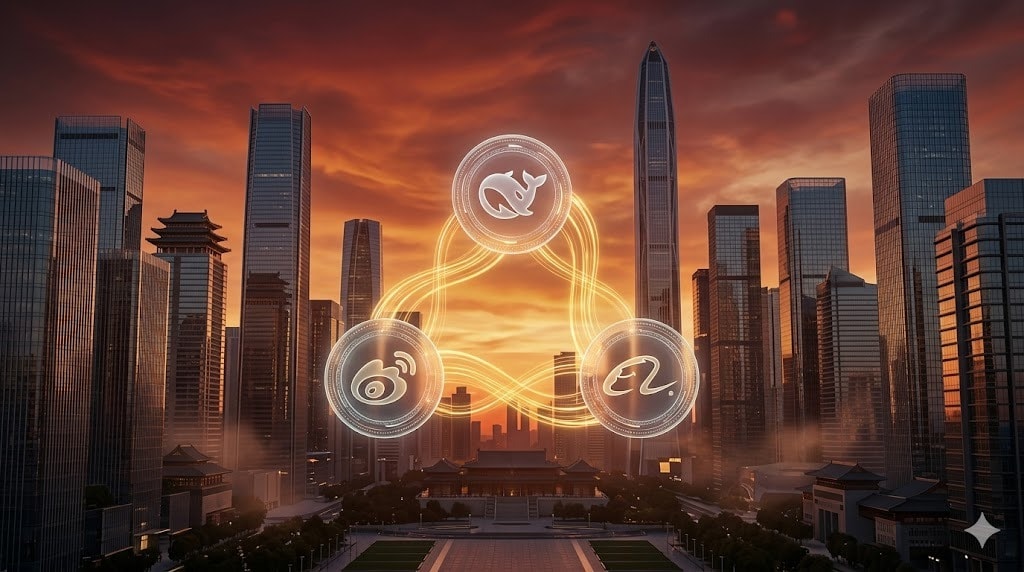
DeepSeek had never taken a dollar from outside investors. In 48 hours, that anomaly turned into a full-blown battle. On April 22, 2026, Bloomberg and then The Information reported that Tencent and Alibaba are in parallel talks to take stakes in the Chinese AI startup — on a valuation that moved from $10 billion at the opening of discussions to more than $20 billion in less than two days of escalation. Tencent reportedly proposed acquiring up to 20% of the company, which DeepSeek's leadership is currently refusing as too concentrated. The official target of the round: raise at least $300 million in the first tranche, i.e. less than 2% dilution. China just gave DeepSeek what it was missing: an army of industrialists standing behind it.
Why a first round, why now
DeepSeek has run for two years on the balance sheet of High-Flyer Quant, the quantitative hedge fund of its founder Liang Wenfeng. No outside investors, no round pressure, no dilution. That model allowed the startup to publish back-to-back open-weight models that forced the entire market to reposition. The pivot is explained by three simultaneous factors:
- Worsening H100/H200 GPU shortage. US export restrictions and the total capacity already committed by OpenAI, Anthropic, and Google make the compute race increasingly expensive.
- The preparation of DeepSeek V4 — a model announced at the trillion-parameter scale with a one-million-token context window, expected to ship in the coming days.
- Competitive pressure on the open-weight side — between Alibaba's Qwen 3.6 shipped as 35B-A3B MoE under Apache 2.0 and Meta Llama 4 Scout/Maverick with 10M context, DeepSeek is no longer the only open-source challenger at the frontier.
Opening the cap table means securing the V4 and V5 trajectory without routing every silicon delivery through Washington. It's also a heavily geopolitical decision: the simultaneous arrival of the two largest Chinese tech conglomerates turns DeepSeek from a technical outsider into a national champion. Beijing finally framed what Washington already framed with the OpenAI-Anthropic-Google alliance against Chinese distillation at the Frontier Model Forum.
The deal terms — and the 20% sticking point
The numbers circulating, aligned across multiple sources:
| Parameter | Value |
|---|---|
| Pre-money valuation | $10B (start) → $20B+ (48h later) |
| Tranche 1 target | $300M+ |
| Total dilution | < 2% |
| Proposed Tencent stake | up to 20% (DeepSeek refusing) |
| Alibaba stake under negotiation | not public |
| Valuation benchmark | MiniMax Group (~$40B) |
The sticking point is Tencent's 20%. Ceding one-fifth of the cap table to a single Chinese conglomerate would effectively hand over a strategic veto. DeepSeek built its scientific authority on radical independence — publish the weights, don't court the giants, refuse exclusive cloud partnerships. Accepting a 20% shareholder inverts the equation. The most likely counter-scenario, per bankers quoted by The Information: a two-headed round with Tencent + Alibaba capped at 9.9% each, plus a pool of legacy High-Flyer LPs. Classic Silicon Valley structure — imported to Hangzhou.
The MiniMax benchmark, and what it says about the Chinese market
The number that circulates as the valuation "anchor" in banker conversations is MiniMax Group, priced at around $40 billion. That means DeepSeek at $20B is being negotiated at roughly a 50% discount to its direct rival — which has leaned into enterprise integrations and doesn't carry the geopolitical weight DeepSeek earned from its notoriety among Western developers.
That discount is a deliberate choice by the DeepSeek board: preserve headroom for a second round at $40-60B in the next 12 months if V4 delivers the advertised performance. It's exactly the playbook Anthropic used when it refused the $800 billion valuation offered by preemptive VCs: don't burn the market's signal on a single round. China doesn't have its Andreessen Horowitz, but it has Tencent and Alibaba — and they're just as capable of inflating a valuation when they need a trophy.
Why Tencent AND Alibaba — not just one
Normally, these two groups step on each other. Cloud, e-commerce, gaming, social: Tencent and Alibaba have been at open war across nearly every business line for a decade. Their agreement to enter the cap table of the same AI lab signals several things:
- Neither wants to cede to the other. DeepSeek's strategic value — public weights, global adoption, distillation capacity — is too large to let the rival capture it alone.
- Beijing is pushing for cooperation. Chinese regulators have made it clear to both groups that a joint stake is politically desirable, precisely because it blocks any individual veto.
- Cloud customers are already split. DeepSeek is hosted on both Tencent Cloud and Alibaba Cloud, and simultaneous entry sanctifies that bi-locality.
The Western parallel is Amazon's $25 billion investment in Anthropic paired with the Trainium expansion — except it was a single cloud buyer. Here, the two largest Chinese hyperscalers are co-investing. That's unprecedented.
What the entry changes for DeepSeek
Three material short-term changes:
GPU stops being an existential problem. Tencent Cloud and Alibaba Cloud together hold capacity comparable to AWS — and each has inventories of Chinese H20 chips (degraded versions sold before the latest restrictions) that only monetize if they get used. DeepSeek inherits preferential access to orders of magnitude of compute the startup couldn't have afforded alone.
The team can triple without breaking the culture. DeepSeek is under 200 people. A minimum $300M round lets it reach 500-600 people without touching the flat structure and rapid-publication culture that defined its brand.
Enterprise support is coming. This is the most visible shift. Until now, DeepSeek only released the weights and let the community carry the integration. With Tencent and Alibaba behind it, the lab can build a real enterprise stack — SLAs, security, private deployments — without betraying the open-weight posture. It's the same industrial bet Google validated with the Gemini Enterprise Agent Platform and the A2A protocol in production at 150 organizations.
The Western counter-move
On the same day, Anthropic confirmed its extended partnership with Google Cloud and Broadcom — 3.5 gigawatts of TPU capacity starting in 2027, extending the hardware trajectory already set in motion. And OpenAI launched GPT-5.5 with doubled pricing and the super app positioning.
DeepSeek opening its cap table the same week as these two announcements isn't a scheduling coincidence. It's China aligning its response to American escalation: more industrial capital, more inter-group coordination, more ambition for V4 and V5. We're not watching a race between models — we're watching a race between national systems. The models are the deliverables, not the protagonists.
What investors and developers should take away
Chinese open-weight is going industrial. The "DeepSeek is a one-off miracle tied to a genius founder" thesis no longer holds. With Tencent and Alibaba on the cap table, the lab can ship three to five models a year without depending on talent scouting across a single cohort.
API prices will stay under pressure. GPT-5.5 at $5 input is only sustainable if developers don't mass-migrate to Qwen 3.6 or DeepSeek V4. The massive influx of Chinese capital into DeepSeek means open-weight models will stay competitive on standard tasks — coding, knowledge work, math reasoning.
AI geopolitics becomes an investment criterion. European sovereign funds — like the UK's £500M Sovereign AI Fund — will need to position. Between a Claude at 87% SWE-Bench that's expensive, a GPT-5.5 with doubled pricing, and a DeepSeek V4 open-weight capitalized by China, "sovereign stack" becomes an alliance call, not a technical detail.
In summary:
- DeepSeek is opening its first external round at over $20B valuation, per Bloomberg and The Information.
- Tencent and Alibaba are in parallel negotiations to take stakes, with Tencent proposing up to 20% (refused).
- The valuation jumped from $10B to $20B+ in 48 hours of escalation.
- Tranche 1: $300M minimum, implying under 2% dilution.
- DeepSeek V4 — a trillion-parameter model with 1M tokens of context — is expected in the coming days.
- The valuation benchmark is MiniMax Group (~$40B), leaving room for a muscular second round.
What DeepSeek just triggered isn't a fundraise. It's an alignment. By accepting Tencent and Alibaba onto the cap table, the startup chooses to become China's industrial standard for open-weight AI. Beijing, Washington, Brussels, and San Francisco will each read the signal through their own lens — competitor, threat, opportunity, windfall. But the number that will stick from this week: in five days, OpenAI doubled the token price, Google closed 3.5 GW of TPU for Anthropic, and China valued DeepSeek at $20 billion. Escalation is no longer a PowerPoint — it's the sector's daily reality.
Sources:
- Tencent, Alibaba in Talks to Join DeepSeek's First Funding Round — Bloomberg
- Tencent, Alibaba in Talks to Invest in DeepSeek at $20 Billion-Plus Valuation — The Information
- Tencent, Alibaba circle DeepSeek in US$20 billion AI deal talks — DigiTimes
- DeepSeek Seeks $20 Billion Valuation as Tech Giants Weigh Investment — PYMNTS
- Tencent and Alibaba in Talks to Invest in DeepSeek — IndexBox