
Trustpilot No Longer Wants to Be a Review Site — It Wants to Be AI Shopping Agents' Memory
Trustpilot is repositioning as the source of truth for AI shopping agents. 330M reviews, DA 93, 190K new reviews/day: the GEO pivot explained.
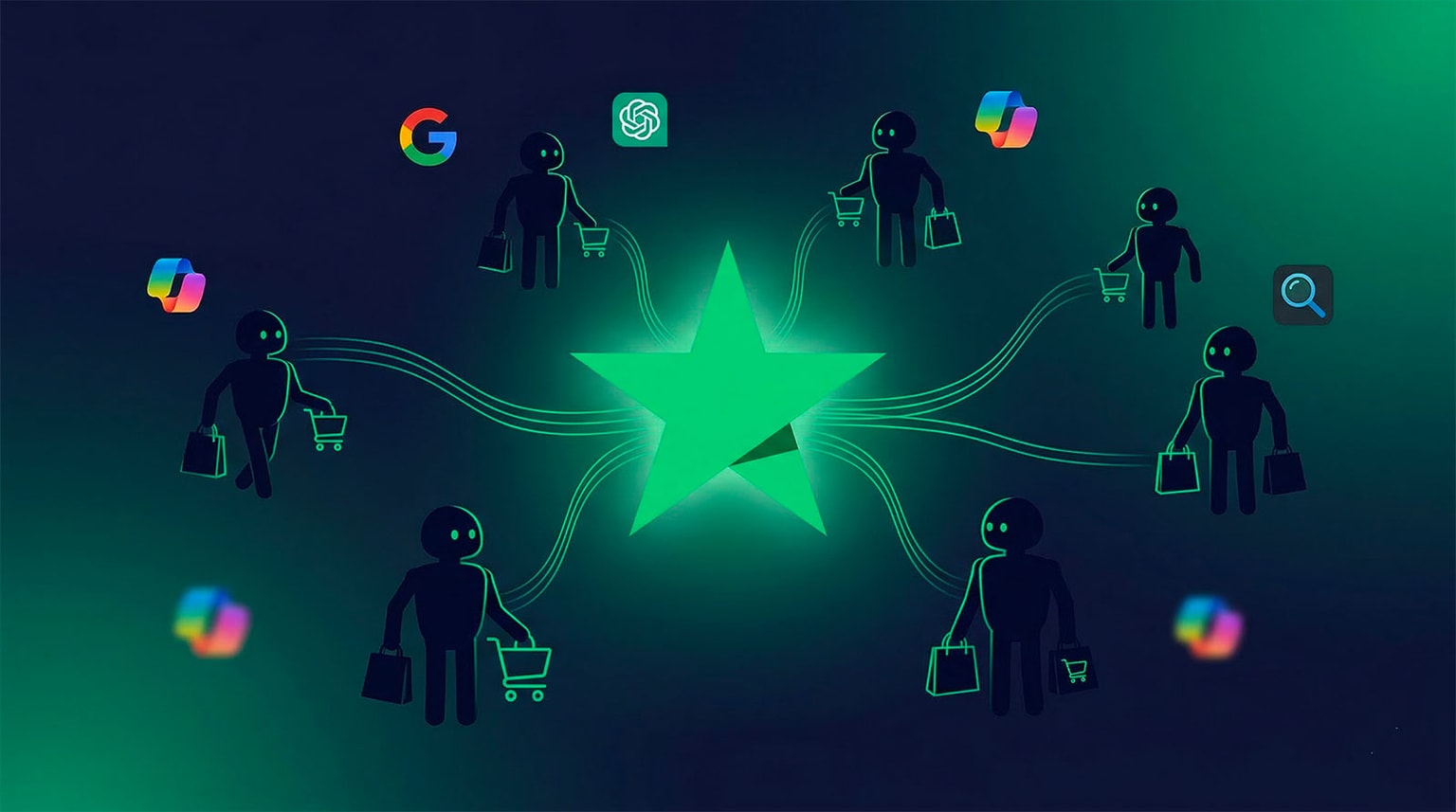
58% of consumers now prefer AI over Google to find a product (Capgemini, 2026). When an AI agent recommends a purchase, it cites its sources. Trustpilot understood before anyone else that those sources are them.
Google Shopping Is No Longer Alone — AI Agents Buy for You
E-commerce is entering a new era. In November 2025, Google launched its Gemini shopping agent. It can autonomously buy when a price drops, call stores, and compare products in real time. Behind it: the Google Shopping Graph, a database of 50 billion products updated at a rate of 2 billion per hour.
Microsoft is doing the same. Copilot integrates with Shopify, Stripe, PayPal, Urban Outfitters, and Etsy to place orders on behalf of users. Same logic at Perplexity with its Comet shopping agent — blocked by a court ruling for now, but the signal is clear.
The tipping point is here. E-commerce search no longer goes through a Google search bar. It goes through a conversation with an AI agent. And when that agent recommends a product, it needs a trusted source to justify its answer.
Trustpilot: 330 Million Reasons to Be Cited
Founded in 2007 in Copenhagen and listed on the London Stock Exchange, Trustpilot holds structural advantages that few platforms can match.
- 330 million reviews accumulated
- 190,000 new reviews per day
- Domain Authority of 93/100 — one of the highest on the web
These three indicators match exactly what large language models (LLMs) prioritize when selecting a source to cite. An LLM like ChatGPT, Claude, or Gemini doesn't recommend a product randomly. It relies on sources that are authoritative, fresh, and structured. Trustpilot checks all three boxes.
The 3Rs: How Trustpilot Becomes AI's Source of Truth
According to Trustpilot Business, the pivot rests on an internal framework called the 3Rs.
Relevance. Trustpilot reviews are structured by product, category, and purchase intent. When a user asks ChatGPT "which robot vacuum should I buy in 2026?", the agent can directly extract relevant reviews. It's not free text — it's exploitable data.
Ranking. With a Domain Authority of 93 and 330 million reviews, Trustpilot is an authoritative source in the way LLMs understand it. The more a source is cited, linked, and recognized, the more models favor it in their responses.
Recency. 190,000 new reviews per day create a continuous freshness signal. AI models penalize outdated sources. Trustpilot, by its participatory nature, is updated in real time — without editorial effort.
Trustpilot's official message is unambiguous: "SEO is dead. Here comes GEO."
GEO vs SEO: The Rules of the Game Have Changed
GEO (Generative Engine Optimization) means optimizing content to be cited by LLMs — ChatGPT, Gemini, Claude, Perplexity. It's the AI equivalent of traditional SEO, which targeted Google search result pages.
AEO (Answer Engine Optimization) goes one step further. It means structuring content to directly answer questions asked to conversational AI agents. The more precise, factual, and well-formatted an answer is, the more likely it is to be selected by the agent.
| Criterion | Traditional SEO | GEO | AEO |
|---|---|---|---|
| Target | Google algorithm | LLMs (GPT, Gemini, Claude) | Conversational AI agents |
| Ideal format | Backlinks + keywords | Factual content + named entities | Direct Q&A |
| Key signal | PageRank | Authority + freshness | Precision + structure |
| Example tool | Ahrefs, SEMrush | Trustpilot, Wikipedia | Structured FAQ, schema.org |
| Timeline | 2010-2024 | 2024-2026+ | 2025-2026+ |
For a deeper dive into GEO, check out our complete guide to Generative Engine Optimization.
Frank Cooper III, CMO of Visa, sums up the stakes: "AI will amplify both credibility and risk… making trust the most critical differentiator in a B-to-AI world." The B-to-AI world — where brands no longer sell directly to consumers but to AI agents that buy for them — is already here.
What This Means for E-Commerce Merchants and Creators
Trustpilot's pivot isn't just a case study. It's an action plan for every e-commerce merchant or creator selling online.
Collect structured reviews. Don't settle for stars. Encourage detailed reviews that mention the product, the use case, and the outcome. That's what AI agents extract.
Respond publicly. A review with a brand response is an additional trust signal for LLMs. Public conversation reinforces authority.
Maintain an active presence. 190,000 reviews per day means freshness is a competitive advantage. A Trustpilot profile inactive for 6 months will be ignored by AI agents in favor of an active competitor.
Think GEO, not just SEO. Optimizing for Google is no longer enough. Every product page, every sales page must be designed to be cited by ChatGPT, Perplexity, or Claude — not just to rank on Google page 1.
Platforms like Whop, which already automate digital sales, will also need to integrate this GEO logic to stay visible in a world where agents do the shopping.
Key Takeaways
- 58% of consumers prefer AI over Google to find a product in 2026 (Capgemini)
- Trustpilot is repositioning as the source of truth for AI shopping agents, not just a review site
- Its advantage: 330M reviews, DA 93, 190,000 new reviews per day — exactly what LLMs cite
- Google Gemini and Microsoft Copilot can now autonomously buy on behalf of consumers
- Brands must optimize to be cited by AI agents (GEO) as much as for Google (SEO)
Trustpilot's pivot is a wake-up call for every content creator. At Idlen, every GEO-optimized article is a chance to be cited by ChatGPT or Perplexity rather than just showing up on Google page 1. If you don't feed AI agents' memory today, you won't exist in their answers tomorrow. The battle is no longer about blue links — it's about generated responses.


