CPM, CPC, CPA: Which Pricing Model for Developer Advertising?
Complete guide to advertising pricing models for developer audiences. CPM, CPC, CPA comparison with benchmarks, budget planning frameworks, and recommendations for choosing the right model based on campaign goals.
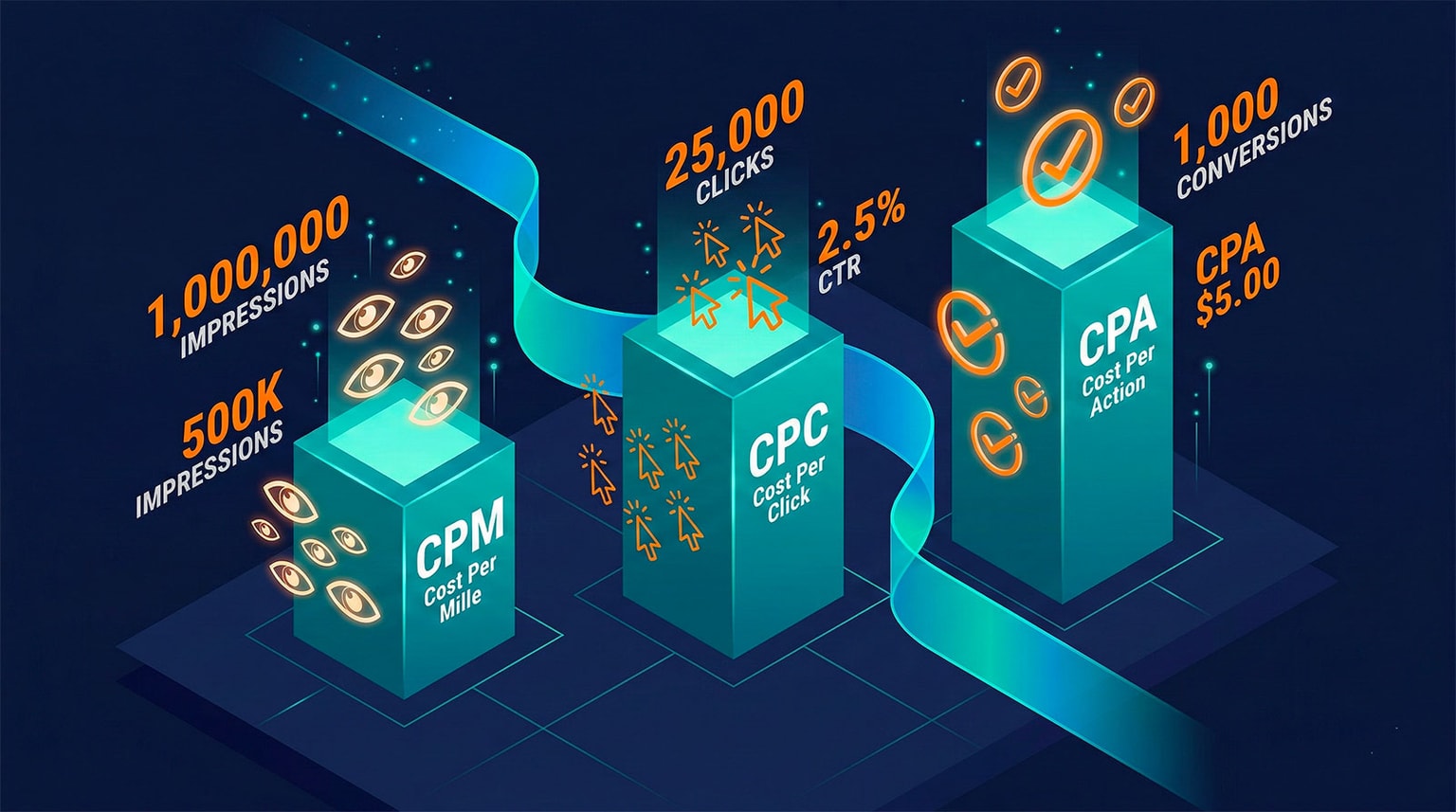
CPM, CPC, CPA: Which Pricing Model for Developer Advertising?
Advertising to developers requires a different playbook than advertising to any other B2B audience. Developers are technically sophisticated, deeply skeptical of marketing, and highly likely to use ad-blocking tools. But when you reach them with the right message in the right context, they convert at rates that make other B2B segments look anemic.
The pricing model you choose for your developer advertising campaign — CPM, CPC, CPA, or a hybrid — determines not just how much you pay, but how your campaign is optimized, what kind of results you can expect, and whether your budget stretches to deliver meaningful data or evaporates before you learn anything useful.
This guide explains each pricing model in the context of developer advertising, provides real benchmarks from developer-focused campaigns, compares the advantages and drawbacks of each model, and offers a practical framework for choosing the right approach based on your goals, budget, and stage.
The Three Core Pricing Models Explained
CPM — Cost Per Mille (Cost Per Thousand Impressions)
How it works: You pay a fixed rate for every 1,000 times your ad is displayed, regardless of whether anyone clicks on it.
Formula: Total Cost = (Total Impressions / 1,000) x CPM Rate
Example: At a $30 CPM, 100,000 impressions costs $3,000.
CPM is the oldest and simplest digital advertising pricing model. You are buying visibility — the guarantee that your message will appear in front of a defined audience a certain number of times. The advertiser bears the risk: if nobody clicks, you still pay.
When CPM makes sense for developer advertising:
- Brand awareness campaigns for new tools or categories
- Launching a new product and needing market exposure
- Retargeting campaigns where you want consistent visibility with engaged prospects
- High-quality placements where impression value is inherent (premium developer sites, in-IDE)
CPC — Cost Per Click
How it works: You pay only when a user clicks on your ad. The platform absorbs the risk of serving impressions that do not convert to clicks.
Formula: Total Cost = Total Clicks x CPC Rate
Example: At a $3.50 CPC, 1,000 clicks costs $3,500.
CPC aligns cost with engagement. You are buying traffic — visitors to your landing page, documentation, or product page. The platform is incentivized to show your ad in contexts where clicks are most likely, which generally means better targeting and placement.
When CPC makes sense for developer advertising:
- Driving traffic to product pages, documentation, or blog content
- Mid-funnel campaigns targeting developers who are evaluating solutions
- Limited budgets where you need to guarantee a minimum level of engagement
- Testing multiple channels when you need comparable cost-per-engagement data
CPA — Cost Per Action (Cost Per Acquisition)
How it works: You pay only when a user completes a specific action — signing up for a free trial, creating an account, downloading a package, or making a purchase.
Formula: Total Cost = Total Actions x CPA Rate
Example: At a $25 CPA, 200 signups costs $5,000.
CPA is the most performance-oriented model. All the risk sits with the platform or publisher: they must deliver both impressions and clicks that convert to your desired action. In exchange, CPA rates are significantly higher on a per-event basis.
When CPA makes sense for developer advertising:
- Performance-focused campaigns with clear conversion goals
- Mature products with optimized landing pages and onboarding flows
- Scaling proven campaigns where you know your acceptable cost per acquisition
- Affiliate and partnership programs where publishers earn per conversion
Developer Advertising Benchmarks by Pricing Model
CPM Benchmarks for Developer Audiences
| Channel | CPM Range | Notes |
|---|---|---|
| General developer sites (dev.to, Medium tech) | $5-15 | Broad reach, lower intent |
| Niche technical publications | $15-35 | More targeted, higher quality |
| Stack Overflow | $25-50 | High intent, tag-targeted |
| Developer newsletters (TLDR, JavaScript Weekly) | $30-60 | Measured as effective CPM from sponsorship cost |
| In-IDE advertising (Idlen) | $20-45 | Highest engagement context |
| GitHub / OSS sponsorships | $15-40 | Brand alignment, community goodwill |
| Podcast sponsorships (developer podcasts) | $25-50 | Measured as effective CPM |
| Reddit (developer subreddits) | $8-20 | Community context, variable quality |
Key insight: Developer CPMs are 2-5x higher than general B2B CPMs, reflecting the audience's purchasing influence, technical decision-making authority, and high lifetime value. See our developer advertising benchmarks for 2026 for more granular data.
CPC Benchmarks for Developer Audiences
| Channel | CPC Range | Typical CTR | Notes |
|---|---|---|---|
| Google Search (developer keywords) | $3-12 | 2.0-4.0% | High intent, competitive keywords |
| LinkedIn (developer targeting) | $5-15 | 0.3-0.6% | Good for senior/manager targeting |
| Stack Overflow | $2-6 | 0.5-1.2% | Tag-targeted, technical intent |
| Developer newsletters | $1-4 | 1.0-3.0% | High engagement audience |
| In-IDE advertising (Idlen) | $0.80-3.00 | 2.1-3.5% | Highest CTR in developer channels |
| Reddit (developer subreddits) | $1-5 | 0.3-0.8% | Variable by subreddit |
| Carbon Ads / EthicalAds | $1-3 | 0.3-0.8% | Developer documentation sites |
| Twitter/X (developer audience) | $2-8 | 0.5-1.5% | Declining organic reach |
Key insight: In-IDE advertising through Idlen delivers the best combination of low CPC and high CTR, making it the most cost-efficient developer advertising channel on a per-click basis.
CPA Benchmarks for Developer Audiences
| Action Type | CPA Range | Notes |
|---|---|---|
| Free trial signup | $15-50 | Depends on friction of signup flow |
| Account creation (freemium) | $8-30 | Lower barrier = lower CPA |
| Package/SDK download | $5-20 | Lowest friction action |
| Demo request | $50-150 | Higher intent, more qualified |
| Paid conversion | $100-500 | Full funnel cost |
| Enterprise lead (qualified) | $200-800 | Long sales cycle |
Key insight: CPA varies enormously based on the definition of "action." Advertisers must carefully define what constitutes a valuable action and set CPA targets accordingly.
Comparing the Models: Decision Framework
Risk Allocation
| Model | Advertiser Risk | Publisher Risk | Who Bears Optimization Burden |
|---|---|---|---|
| CPM | High (pays for impressions regardless of engagement) | Low (guaranteed revenue per impression) | Advertiser must optimize creative and targeting |
| CPC | Medium (pays for clicks, but clicks may not convert) | Medium (must deliver clicks to earn revenue) | Shared — publisher optimizes for clicks, advertiser for conversions |
| CPA | Low (pays only for results) | High (must deliver full-funnel conversions) | Publisher must optimize everything |
Budget Efficiency by Campaign Stage
| Campaign Goal | Recommended Model | Why |
|---|---|---|
| Brand awareness (new tool launch) | CPM | Need maximum visibility; engagement is secondary |
| Developer education (content promotion) | CPC | Want to drive readers to educational content |
| Product trial growth | CPC or CPA | Need measurable conversions at predictable cost |
| Scaling proven campaigns | CPA | Know your economics; optimize purely for outcomes |
| Market testing (new channel) | CPC | Comparable cross-channel metric for evaluation |
| Retargeting warm audiences | CPM | Known audience, just need visibility to stay top-of-mind |
The Math Behind Model Selection
To compare models fairly, convert everything to effective CPA:
From CPM:
- Effective CPA = CPM / (CTR x Conversion Rate x 10)
- Example: $30 CPM, 2% CTR, 10% conversion = $30 / (0.02 x 0.10 x 10) = $1,500... Wait, let's recalculate properly.
- Example: $30 CPM = $0.03 per impression. At 2% CTR = $0.03 / 0.02 = $1.50 effective CPC. At 10% conversion = $1.50 / 0.10 = $15 effective CPA.
From CPC:
- Effective CPA = CPC / Conversion Rate
- Example: $3.50 CPC at 10% conversion = $3.50 / 0.10 = $35 effective CPA.
Direct CPA:
- CPA = negotiated rate, e.g., $25 per signup.
By converting all channels to effective CPA, you can compare apples to apples:
| Channel | Model | Rate | Est. CTR | Est. Conv. Rate | Effective CPA |
|---|---|---|---|---|---|
| In-IDE (Idlen) | CPM | $30 | 2.5% | 12% | $10 |
| Stack Overflow | CPC | $4 | — | 8% | $50 |
| Google Search | CPC | $8 | — | 6% | $133 |
| Developer newsletter | CPC | $2.50 | — | 10% | $25 |
| CPC | $10 | — | 4% | $250 |
Budget Planning for Developer Advertising
Minimum Viable Test Budgets
Testing a new developer advertising channel requires enough budget to achieve statistical significance. Choosing the right channel from the best dev tool advertising platforms is equally critical. Here are minimum test budgets by channel:
| Channel | Minimum Monthly Budget | Expected Data Volume | Test Duration |
|---|---|---|---|
| In-IDE (Idlen) | $2,000-5,000 | 50,000-150,000 impressions, 1,000-5,000 clicks | 30 days |
| Stack Overflow | $10,000 | 200,000-500,000 impressions | 30-60 days |
| Google Search (dev keywords) | $3,000-8,000 | 500-2,000 clicks | 30 days |
| Developer newsletters | $500-3,000 | 1-4 placements | 4-8 weeks |
| $1,500-5,000 | 100,000+ impressions | 30 days | |
| $3,000-10,000 | 300-1,000 clicks | 30 days |
Budget Allocation Framework
For a $10,000/month developer advertising budget, here is a recommended allocation by campaign stage:
Stage 1: Market Learning (Months 1-2)
| Channel | Allocation | Goal |
|---|---|---|
| In-IDE advertising (Idlen) | 40% ($4,000) | Test highest-intent channel |
| Developer newsletter | 30% ($3,000) | Test content-based approach |
| Google Search | 20% ($2,000) | Capture active search intent |
| Creative testing | 10% ($1,000) | A/B test messaging approaches |
Stage 2: Optimization (Months 3-4)
- Double down on the top-performing channel from Stage 1
- Kill underperforming channels (effective CPA > 2x target)
- Test one new channel with freed budget
- Iterate on creative based on Stage 1 learnings
Stage 3: Scaling (Months 5+)
- Allocate 60-70% to proven channels
- Maintain 20-30% for testing and expansion
- Shift from CPC to CPA on mature channels to lock in performance, leveraging programmatic advertising for developer tools for automated optimization
Budget Scaling Rules
- Do not scale a channel more than 50% month-over-month — rapid scaling often degrades performance as you exhaust the highest-intent audience segment
- Never allocate more than 60% of budget to a single channel — diversification protects against platform changes
- Reserve 10-15% for creative refresh — ad fatigue sets in faster with developer audiences
- Plan for seasonality — developer tool purchases peak in Q1 (new year budgets) and Q3 (pre-planning)
Common Pricing Mistakes in Developer Advertising
Mistake 1: Optimizing for the Cheapest CPM
The lowest CPM channel is almost never the most effective. A $5 CPM on a general tech site with 0.1% CTR and 2% conversion produces an effective CPA of $250. A $35 CPM on an in-IDE platform with 2.5% CTR and 12% conversion produces an effective CPA of $12. Always optimize for effective CPA, not raw CPM — and remember that contextual advertising consistently outperforms behavioral for developer audiences.
Mistake 2: Setting Unrealistic CPA Targets
Developer tools have long sales cycles and high lifetime values. A $50 CPA that seems expensive for a $10/month tool looks very different when the average customer retains for 24 months ($240 LTV) and 20% upgrade to enterprise plans ($2,000+ LTV). Set CPA targets based on LTV, not monthly revenue. Our guide on measuring ROI in developer advertising covers this in detail.
Mistake 3: Insufficient Test Duration
Developer purchasing decisions take time. A CPC campaign that looks unprofitable after one week may show strong CPA performance after 30 days as developers who clicked complete their evaluation cycle. Run tests for a minimum of 30 days before making channel decisions.
Mistake 4: Ignoring Post-Click Quality
Not all clicks are equal. A $2 CPC from a bot-heavy traffic source is worthless. A $5 CPC from an in-IDE placement that delivers a developer actively looking for your product category is a bargain. Track post-click metrics (time on site, signup rate, activation rate) to evaluate true click quality.
Mistake 5: Comparing Channels Without Normalization
Comparing a $3 CPC from newsletters against a $8 CPC from Google Search is meaningless without considering conversion rates, lead quality, and customer lifetime value. Normalize all channels to effective CPA and LTV-adjusted CPA before making budget decisions.
Hybrid Pricing Strategies
CPM + Performance Bonus
Some developer advertising platforms offer a base CPM rate with bonus payments for exceeding click or conversion targets. This aligns incentives: the publisher is guaranteed base revenue, and the advertiser gets rewarded performance.
CPC with Spend Cap
Setting a daily or monthly spend cap on CPC campaigns prevents budget overruns while maintaining the per-click accountability. This is particularly useful when testing new channels or creative approaches.
Tiered CPA
Offer different CPA rates for different action values:
- $10 for a free account signup
- $30 for a trial activation (installed/integrated the product)
- $100 for a paid conversion
This gives publishers flexibility in how they optimize while ensuring you pay proportionally to value received.
FAQ
What is the average CPM for developer advertising?
CPM rates for developer advertising range from $5-15 for general developer sites, $15-35 for niche technical publications, $25-50 for premium placements like Stack Overflow and in-IDE platforms, and $35-60 for highly targeted segments like DevOps or security engineers. The developer advertising market commands a premium over general B2B because of the audience's purchasing influence and high lifetime value.
Should I use CPM, CPC, or CPA for developer tool advertising?
The best pricing model depends on your campaign goal. Use CPM for brand awareness campaigns when launching a new developer tool. Use CPC for mid-funnel campaigns driving traffic to landing pages, documentation, or demos. Use CPA for performance campaigns where you only want to pay for signups or trial activations. Many successful advertisers use a mix: CPM for top-of-funnel and CPC or CPA for bottom-of-funnel.
How much should I budget for a developer advertising campaign?
A meaningful test budget for developer advertising is $5,000-15,000 per month for 2-3 months. This allows enough data to evaluate 2-3 channels, test multiple creative approaches, and achieve statistical significance. Early-stage startups can start smaller ($2,000-5,000/month) by focusing on a single high-intent channel like in-IDE advertising through Idlen or developer newsletter sponsorships.
Launch Your Developer Advertising Campaign with the Right Pricing Model
Choosing the right pricing model is the foundation of a successful developer advertising campaign — but the platform matters just as much. Idlen offers flexible CPM and CPC pricing for in-IDE advertising, delivering the highest engagement rates in developer advertising (2.1-3.5% CTR) at the most competitive effective CPA. Whether you are launching a brand awareness campaign or scaling a proven acquisition channel, explore Idlen's advertising options and start reaching developers where they spend their working day.
Reach developers where they work
Advertise directly inside developer tools. Native ads, real engagement, zero wasted impressions.