Freelance AI Developer: Rates, Tools & How to Get Started in 2026
Complete guide for freelance AI developers in 2026. Discover rates by specialization, essential tools, how to find clients, build a portfolio, and multiply your productivity with AI. Includes platform comparisons and income strategies.
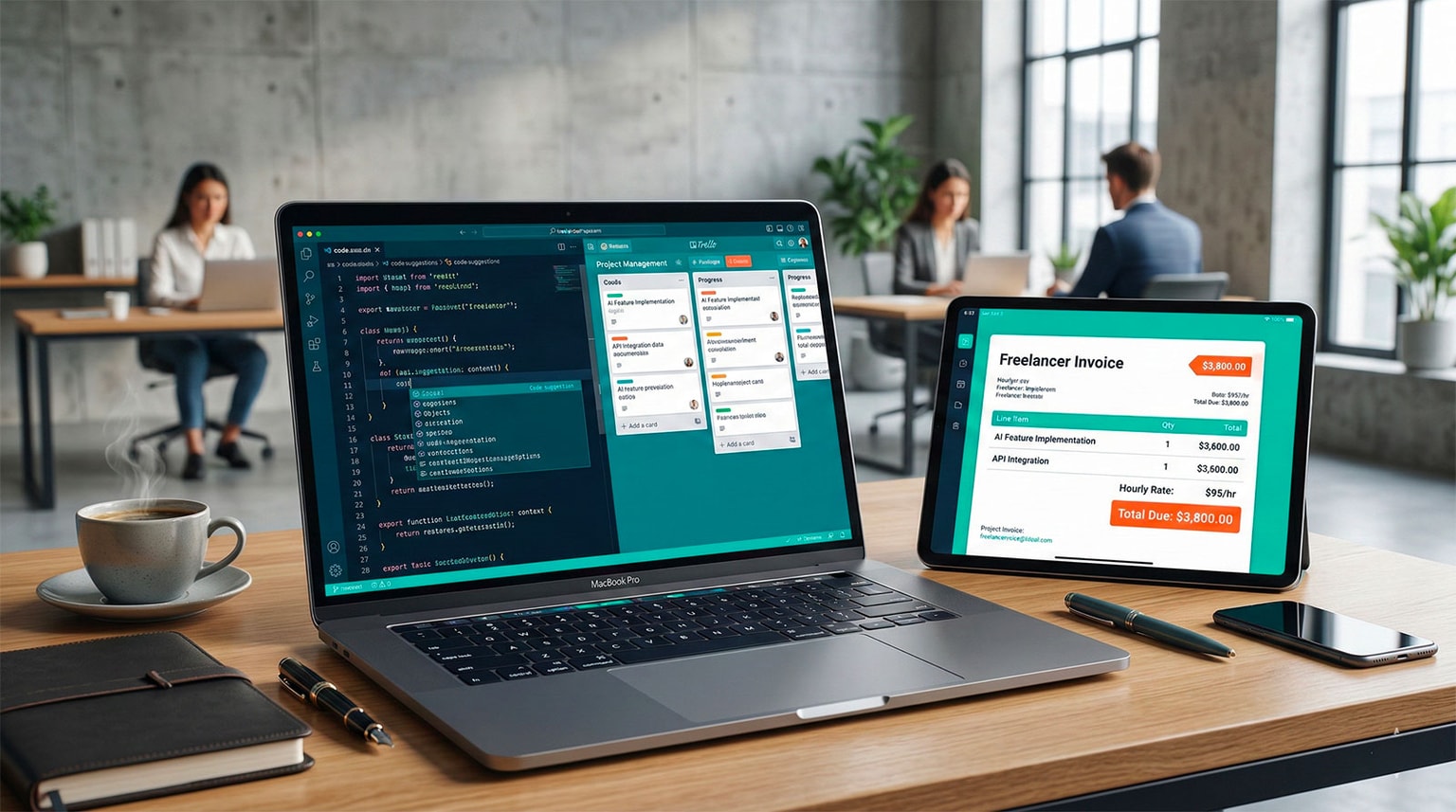
Freelance AI Developer: Rates, Tools & How to Get Started in 2026
The demand for AI development skills has exploded. Every company --- from startups to Fortune 500 --- wants to integrate AI into their products, workflows, and customer experiences. But most do not have in-house AI expertise.
That is where freelance AI developers come in.
In 2026, freelance AI development is one of the highest-paying and most in-demand specializations in tech. This guide covers everything you need to know: current rates, essential tools, how to find clients, build a portfolio, and maximize your income.
Why Freelance AI Development in 2026
The Supply-Demand Gap
The numbers tell a clear story:
| Metric | Value |
|---|---|
| AI job openings globally | 2.5M+ |
| Qualified AI developers | ~500K |
| Supply-demand ratio | 5:1 (demand exceeds supply) |
| Average AI freelance rate increase (YoY) | +25-40% |
| Companies planning AI integration (2026) | 78% |
Why Companies Hire AI Freelancers
- Speed: They need AI features now, not after a 6-month hiring process
- Expertise: Specialized AI skills are rare and expensive to maintain full-time
- Cost efficiency: A freelancer at $150/hour is cheaper than a $300K+ full-time senior AI engineer with benefits
- Flexibility: Project-based work with no long-term commitment
- Fresh perspective: Freelancers bring cross-industry experience
Freelance AI Developer Rates in 2026
Rates by Experience Level
| Experience Level | Hourly Rate (USD) | Daily Rate | Annual Equivalent |
|---|---|---|---|
| Junior (0-2 years) | $50 - $100 | $400 - $800 | $80K - $160K |
| Mid-level (2-5 years) | $100 - $200 | $800 - $1,600 | $160K - $320K |
| Senior (5-10 years) | $200 - $350 | $1,600 - $2,800 | $320K - $560K |
| Expert/Specialist (10+ years) | $300 - $500+ | $2,400 - $4,000+ | $480K - $800K+ |
Rates by Specialization
Not all AI work pays the same. Here is how rates break down by specialization:
| Specialization | Hourly Rate | Demand Level |
|---|---|---|
| AI/ML Engineering | $150 - $350 | Very High |
| Prompt Engineering | $75 - $200 | High |
| LLM Integration (APIs) | $100 - $250 | Very High |
| RAG System Development | $125 - $300 | Very High |
| Computer Vision | $150 - $350 | High |
| NLP/NLU Specialist | $130 - $300 | High |
| AI Agent Development | $150 - $400 | Very High |
| Fine-tuning/Training | $175 - $400 | Medium-High |
| AI Strategy Consulting | $200 - $500 | High |
| AI UX/Product Design | $100 - $250 | Medium |
| Vibecoding/AI App Building | $75 - $175 | High |
Rates by Project Type
| Project Type | Typical Budget | Timeline |
|---|---|---|
| AI chatbot integration | $2,000 - $10,000 | 1-3 weeks |
| RAG system (document Q&A) | $5,000 - $25,000 | 2-6 weeks |
| AI API wrapper | $3,000 - $15,000 | 1-4 weeks |
| Custom AI agent | $10,000 - $50,000 | 4-12 weeks |
| AI workflow automation | $5,000 - $20,000 | 2-6 weeks |
| LLM fine-tuning | $10,000 - $40,000 | 4-8 weeks |
| AI product MVP | $8,000 - $30,000 | 3-8 weeks |
| AI strategy consulting | $5,000 - $20,000 | 1-4 weeks |
Geographic Rate Variations
While AI freelancing is global, rates vary by region:
| Region | Rate Multiplier | Typical Range |
|---|---|---|
| US / Canada | 1.0x (baseline) | $100 - $350/hr |
| Western Europe | 0.8-1.0x | $80 - $300/hr |
| UK | 0.9-1.0x | $90 - $320/hr |
| Eastern Europe | 0.5-0.7x | $50 - $200/hr |
| India | 0.3-0.5x | $30 - $150/hr |
| Latin America | 0.4-0.6x | $40 - $175/hr |
| Australia / NZ | 0.9-1.1x | $90 - $350/hr |
Essential Tools for Freelance AI Developers
AI-Powered Development Tools
These AI coding assistants multiply your productivity by 3-5x, allowing you to deliver more in less time:
| Tool | Purpose | Cost | Productivity Boost |
|---|---|---|---|
| Cursor | AI-powered code editor | $20/month | 3-5x faster coding |
| GitHub Copilot | Code auto-completion | $10-19/month | 2-3x faster coding |
| Claude (Anthropic) | Complex reasoning, code review, architecture | $20/month | 2-4x faster planning |
| ChatGPT (OpenAI) | Brainstorming, quick prototyping | $20/month | 2-3x faster ideation |
| Lovable | Full-stack app generation | $20-50/month | 10x faster MVPs |
| Bolt | Rapid prototyping from prompts | $20-50/month | 10x faster prototypes |
| v0 (Vercel) | UI component generation | Free-$20/month | 5x faster frontend |
AI Development Frameworks and Libraries
| Tool | Purpose | When to Use |
|---|---|---|
| LangChain | LLM application framework | Complex AI chains and agents |
| LlamaIndex | Data indexing for LLMs | RAG systems and document Q&A |
| Hugging Face | Model hub and inference | Open-source model deployment |
| Pinecone / Weaviate | Vector databases | Semantic search and RAG |
| Vercel AI SDK | AI streaming UI | Building AI-powered web apps |
| CrewAI / AutoGen | Multi-agent frameworks | AI agent systems |
Business and Productivity Tools
| Tool | Purpose | Cost |
|---|---|---|
| Linear / Notion | Project management | Free-$10/month |
| Toggl | Time tracking | Free-$10/month |
| FreshBooks / Wave | Invoicing | Free-$25/month |
| Calendly | Meeting scheduling | Free-$12/month |
| Loom | Async video updates | Free-$15/month |
| Slack | Client communication | Free |
| GitHub | Code hosting and collaboration | Free-$4/month |
The Freelancer's AI-Powered Workflow
Here is how the best AI freelancers structure their workflow:
- Client brief → Use Claude to analyze requirements and identify edge cases
- Architecture design → Use ChatGPT or Claude to explore solution approaches
- Development → Use Cursor for AI-assisted coding at 3-5x speed
- Testing → Use AI to generate test cases and edge case scenarios
- Documentation → Use Claude to generate client-facing documentation
- Delivery → Use Loom for async demo videos
Result: What used to take 40 hours now takes 10-15 hours --- but you still charge for the value delivered (40 hours worth of output).
How to Find Clients
Freelance Platforms
| Platform | Best For | Commission | Avg. AI Project Rate |
|---|---|---|---|
| Toptal | Senior developers, enterprise clients | ~20% | $100-250/hr |
| Upwork | All levels, high volume | 10-20% | $50-200/hr |
| Lemon.io | Vetted developers, startups | ~15% | $60-150/hr |
| Gun.io | Senior developers, US companies | ~15% | $80-200/hr |
| Contra | No-commission freelancing | 0% | $50-175/hr |
| Fiverr Pro | Productized services | 20% | $40-150/hr |
Direct Client Acquisition
The highest-paying clients rarely come from platforms. Here is how to find them directly:
LinkedIn Strategy:
- Optimize your profile with AI-specific keywords (LLM, RAG, AI integration, prompt engineering)
- Post 3-5 times per week about AI development topics
- Comment on posts from startup founders and CTOs
- Send personalized connection requests to decision-makers at companies hiring for AI
Twitter/X Strategy:
- Build in public: share your AI projects, experiments, and learnings
- Engage with the #BuildInPublic and AI development communities
- Create threads breaking down complex AI concepts
- Share case studies of client projects (with permission)
Content Marketing:
- Write blog posts about AI development challenges and solutions
- Create YouTube tutorials on AI integration
- Publish on Medium, Dev.to, and Hashnode
- Build a portfolio website showcasing your AI projects
Community Engagement:
- Participate in AI-focused Discord and Slack communities (great places to connect with indie hackers)
- Attend and speak at local tech meetups
- Answer questions on Stack Overflow and Reddit
- Contribute to open-source AI projects
Cold Outreach Template
When reaching out to potential clients directly, personalization is key:
Subject: Quick thought on Company Name's AI integration
Hi Name,
I noticed Company Name recently specific observation: launched a feature, raised funding, posted a job. I have been building AI integrations for type of companies and wanted to share a quick idea for how specific AI feature could help you specific outcome.
I recently helped similar company implement similar solution, which resulted in specific result: 40% time savings, 3x faster processing, etc..
Would a 15-minute call make sense to explore this?
Best, Your name
Building an AI Developer Portfolio
What to Include
Your portfolio should demonstrate both technical depth and business impact:
Essential portfolio elements:
- 3-5 case studies with:
- Problem description
- Technical approach
- Tools and technologies used
- Results and metrics
- Client testimonial (if possible)
- Open-source projects on GitHub showing your AI development skills
- Blog posts or tutorials demonstrating your expertise
- Live demos of AI projects potential clients can interact with
Portfolio Project Ideas
If you are just starting and need portfolio pieces, build these:
| Project | Skills Demonstrated | Build Time |
|---|---|---|
| AI chatbot with RAG | LLM integration, vector DB, full-stack | 1-2 weeks |
| AI content generator | Prompt engineering, UI/UX, API design | 1 week |
| AI code reviewer (GitHub App) | GitHub API, LLM integration, automation | 2 weeks |
| AI-powered search engine | Embeddings, semantic search, NLP | 2 weeks |
| Multi-agent AI system | Agent frameworks, orchestration, advanced LLM | 2-3 weeks |
Building Your Online Presence
| Channel | Purpose | Frequency |
|---|---|---|
| Personal website | Portfolio, case studies, blog | Update monthly |
| GitHub | Open-source projects, code samples | Active weekly |
| Professional networking, thought leadership | Post 3-5x/week | |
| Twitter/X | Community engagement, building in public | Daily |
| YouTube/Blog | Tutorials, deep dives | 1-2x/month |
How AI Tools Multiply Your Productivity (and Income)
The Freelancer's Leverage Equation
The fundamental insight of AI freelancing in 2026: you are paid for the value of your output, not the hours it takes.
Here is what this looks like in practice:
| Task | Time Without AI | Time With AI | Savings |
|---|---|---|---|
| Building a CRUD API | 8 hours | 2 hours | 75% |
| Writing documentation | 4 hours | 1 hour | 75% |
| Debugging complex issues | 3 hours | 45 min | 75% |
| UI component development | 6 hours | 1.5 hours | 75% |
| Database schema design | 2 hours | 30 min | 75% |
| Writing tests | 4 hours | 1 hour | 75% |
| Total project | 27 hours | 6.75 hours | 75% |
The income implication:
If you charge $150/hour and quote a project at 27 hours ($4,050), but complete it in 6.75 hours thanks to AI tools, your effective hourly rate is $600/hour.
This is not dishonest --- you are delivering $4,050 worth of value. The client gets the same quality output in less time. AI tools are your competitive advantage, just like a contractor's power tools.
Strategies for Maximizing AI-Powered Productivity
- Master your AI editor: Spend time learning Cursor's advanced features (multi-file editing, codebase context, agent mode)
- Build reusable prompts: Create a library of prompts for common tasks (API design, database schemas, error handling)
- Use AI for client communication: Draft proposals, status updates, and documentation with Claude
- Automate repetitive workflows: Set up AI-powered scripts for testing, deployment, and monitoring
- Invest in context: The better your AI tools understand the project context, the more productive they become
Setting Your Rates: A Practical Framework
Step 1: Calculate Your Minimum Rate
Start with your financial needs:
- Target annual income: $___
- Working weeks per year: 46 (accounting for vacation, sick days)
- Billable hours per week: 25-30 (the rest is admin, marketing, learning)
- Minimum hourly rate = Annual income / (46 x 25-30)
Example: $200,000 / (46 x 28) = $155/hour minimum
Step 2: Research Market Rates
Compare your minimum with market rates for your specialization (use the tables above). Your rate should be at or above the market average for your experience level.
Step 3: Apply the Value Premium
If your AI skills directly impact client revenue or costs, charge accordingly:
- Cost savings: If your work saves the client $100K/year, charging $20K is a no-brainer
- Revenue generation: If your AI feature generates $500K in new revenue, a $50K project fee is justified
- Speed premium: If you can deliver in 2 weeks what competitors deliver in 8 weeks, that speed has value
Step 4: Choose Your Pricing Model
| Model | Best For | Pros | Cons |
|---|---|---|---|
| Hourly | Uncertain scope, ongoing work | Low risk for you | Caps your income |
| Project-based | Well-defined deliverables | Higher effective rate | Scope creep risk |
| Retainer | Ongoing clients | Predictable income | May undervalue your time |
| Value-based | High-impact projects | Highest income potential | Harder to negotiate |
Recommendation: Start with hourly rates for your first 3-5 clients to understand project scoping. Then transition to project-based or value-based pricing as you build confidence in estimating work.
Growing Your Freelance AI Business
Year 1: Foundation (Months 1-12)
- Build your portfolio with 3-5 strong projects
- Establish your online presence (website, LinkedIn, GitHub)
- Land your first 5-10 clients through platforms and networking
- Target income: $80K - $150K
Year 2: Specialization (Months 13-24)
- Narrow your focus to 1-2 AI specializations
- Raise your rates by 30-50%
- Build a referral network
- Start creating content (blog, YouTube, newsletter)
- Target income: $150K - $300K
Year 3: Scale (Months 25-36)
- Transition to project-based or value-based pricing
- Build productized services (fixed-price AI solutions)
- Consider hiring subcontractors for overflow work
- Launch a complementary product (course, template, SaaS) --- becoming a true full-stack AI developer
- Target income: $250K - $500K+
Supplementary Income with Idlen
As a freelance AI developer, your income is directly tied to client work. Dry spells happen, and having supplementary income streams provides financial stability.
Idlen is the easiest supplementary income for AI developers:
- Install the Idlen extension on the tools you already use: Cursor, VS Code, ChatGPT, Claude
- Earn $40-100/month from non-intrusive developer-focused ads
- Revenue comes in whether you have active client projects or not
- Zero additional time commitment --- you earn while you work
As a heavy AI tool user, your Idlen earnings potential is higher than average because you spend more time in AI-powered environments. Think of it as getting paid to use the tools you would use anyway.
FAQ
How much do freelance AI developers charge in 2026?
Freelance AI developer rates vary by specialization and experience. Junior AI developers charge $50-100/hour, mid-level charge $100-200/hour, and senior specialists charge $200-400+/hour. AI prompt engineers charge $75-200/hour, while AI integration specialists charge $100-250/hour. Project-based rates range from $2,000 for simple chatbot integrations to $50,000+ for custom AI solutions. Geographic location, platform choice, and specialization niche all significantly impact rates.
What skills do you need to become a freelance AI developer?
Essential technical skills include proficiency in Python or JavaScript, experience with AI APIs (OpenAI, Anthropic, open-source models), understanding of prompt engineering, knowledge of RAG and vector databases, and familiarity with cloud deployment (AWS, GCP, or Vercel). Soft skills like client communication, project scoping, and business development are equally important for freelance success. You do not need a PhD or deep ML research experience --- most freelance AI work involves integration, application development, and prompt engineering rather than training models from scratch.
Where can freelance AI developers find clients?
The best channels for finding AI freelance clients are Toptal and Upwork for marketplace-based work, LinkedIn and Twitter/X for direct outreach, personal websites and blogs for inbound leads, developer communities for referrals, and platforms like Lemon.io and Gun.io for vetted developer marketplaces. Building in public and sharing AI project case studies generates the highest-quality inbound leads. Cold outreach on LinkedIn, when done with genuine personalization, also has high conversion rates for AI specialists given the current supply-demand imbalance.
Conclusion
Freelance AI development in 2026 is arguably the best career opportunity in tech. The demand far exceeds supply, rates are at historic highs, and AI tools themselves make you dramatically more productive --- meaning you can deliver more value in less time and earn accordingly.
The path is straightforward: build your skills, create a strong portfolio, establish your online presence, land your first clients, and systematically raise your rates as you gain experience and specialization.
Ready to get started? Install Idlen to start earning supplementary income from day one. While you build your freelance business, Idlen ensures you are making money every time you open your AI coding tools.
Earn passive income while you code
Install Idlen and earn money from your idle browser time. Zero extra work, 100% privacy.