Launch a Micro-SaaS with AI in 2026: From Concept to First Customer in 30 Days
Complete step-by-step guide to launching a micro-SaaS in 30 days using AI tools. From ideation with ChatGPT to your first paying customer, through vibecoding with Cursor, Lovable, and Bolt.
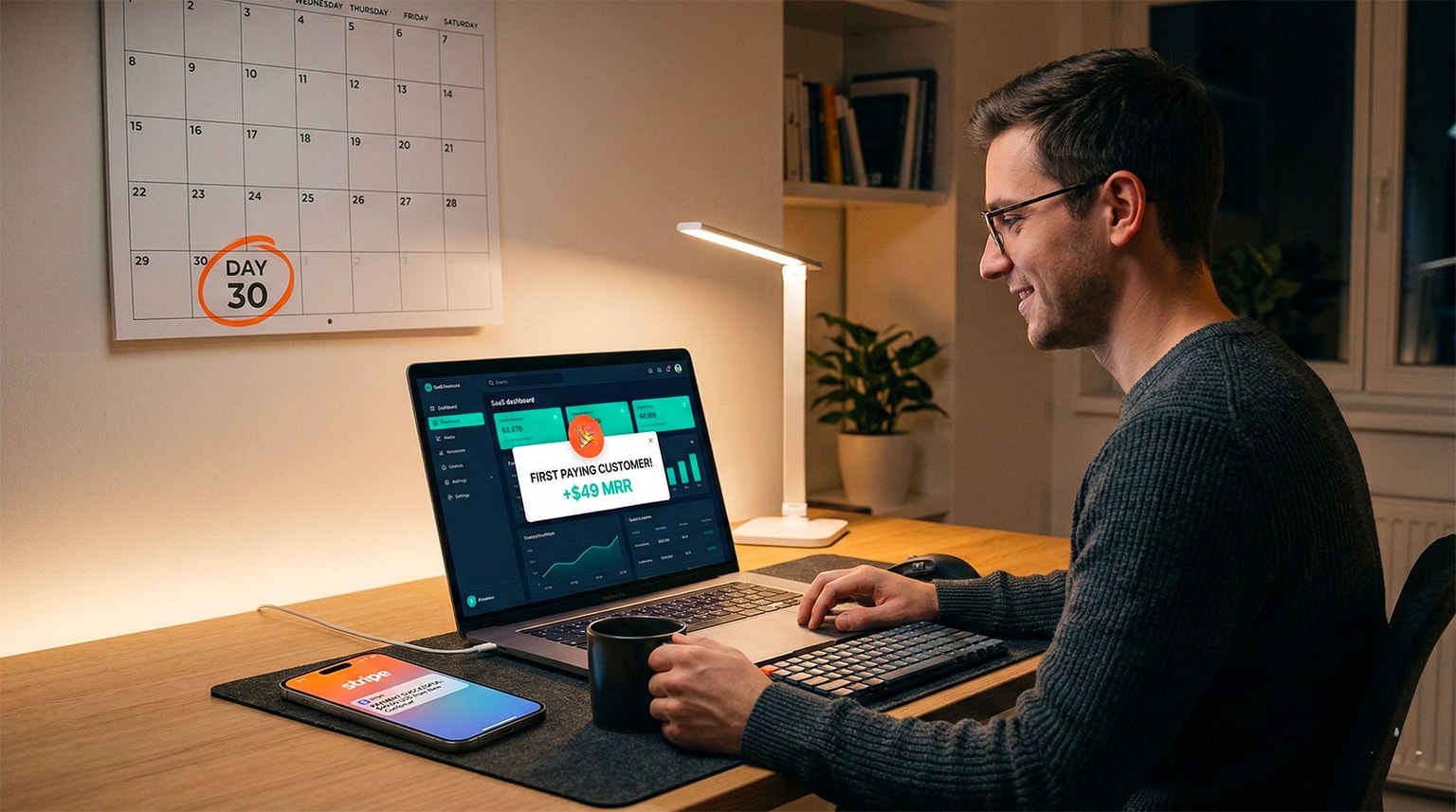
Launch a Micro-SaaS with AI in 2026: From Concept to First Customer in 30 Days
Just two years ago, launching a SaaS required months of development, a technical team, and often a round of funding. In 2026, AI tools have completely flipped that equation. With vibecoding and AI assistants, a solo indie hacker can go from a raw idea to a first paying customer in 30 days flat.
This guide walks you through it week by week, with concrete tools, real examples, and a detailed action plan to turn your idea into a profitable micro-SaaS.
Why 2026 Is the Golden Age for Micro-SaaS
The Cost Barrier Has Collapsed
Traditional SaaS development used to look like this:
| Expense | Traditional (2023) | AI-Powered (2026) |
|---|---|---|
| MVP Development | $15,000 - $80,000 | $50 - $300 |
| Time to MVP | 3-6 months | 1-4 weeks |
| Team size | 3-5 people | 1 person |
| Technical knowledge needed | Expert | Intermediate |
| Monthly infrastructure | $200 - $2,000 | $0 - $50 |
The Tools Are Mature
The vibecoding ecosystem has matured significantly:
- Cursor and GitHub Copilot for AI-assisted coding
- Lovable and Bolt for full-stack app generation from prompts
- Claude and ChatGPT for ideation, copywriting, and architecture
- Vercel and Railway for near-free hosting
- Stripe for instant payment integration
The Market Is Hungry
Businesses increasingly prefer niche, specialized tools over bloated enterprise software. A micro-SaaS solving one specific problem well can outperform a generic tool with hundreds of features.
Week 1: Ideation and Validation (Days 1-7)
Day 1-2: Find a Problem Worth Solving
The best micro-SaaS products are born from real pain points. Here is where to look:
- Your own workflow: What repetitive tasks annoy you daily?
- Reddit and Twitter/X: Search for complaints in niche communities (r/SaaS, r/smallbusiness, r/freelance)
- Product Hunt comments: What are people asking for that does not exist?
- Competitor reviews: Read 1-star reviews of existing tools on G2 and Capterra
- AI-assisted research: Ask Claude or ChatGPT to analyze pain points in a specific industry
Prompt for Claude:
"Analyze the top 10 complaints about existing tool on G2 reviews. Identify specific unmet needs that could be addressed by a simple, focused micro-SaaS. For each, estimate the potential market size and willingness to pay."
Day 2-3: Validate the Idea Before Writing a Line of Code
Validation is where most aspiring founders fail. They skip it and build something nobody wants. Use AI-powered product discovery to validate your idea in 48 hours. Here is a fast validation framework:
Step 1: Market Size Check
- Use Perplexity to research the Total Addressable Market (TAM)
- Look for at least 10,000 potential users willing to pay $10-50/month
- Check Google Trends for upward or stable demand
Step 2: Competitor Analysis
- Identify 3-5 direct competitors
- Map their pricing, features, and weaknesses
- Find your unique angle (simpler, cheaper, more specialized, better UX)
Step 3: Pre-sell Before Building
- Create a simple landing page with Lovable or Framer
- Describe the problem and your proposed solution
- Add an email signup or even a "pre-order" button
- Drive 100-200 targeted visitors via Reddit, Twitter, or niche communities
Validation benchmarks:
- 5%+ email signup rate = strong interest
- 2%+ pre-order rate = validated demand
- 10+ direct conversations with potential users = deep understanding
Day 4-5: Define Your MVP Scope
This is where discipline matters. Your MVP should be embarrassingly simple. Use the ICE framework (Impact, Confidence, Ease) to prioritize features:
| Feature | Impact | Confidence | Ease | ICE Score |
|---|---|---|---|---|
| Core feature A | 10 | 9 | 8 | 720 |
| Nice-to-have B | 6 | 5 | 7 | 210 |
| Complex feature C | 8 | 4 | 3 | 96 |
Rule of thumb: Your MVP should have 1-3 features maximum. If you cannot explain what it does in one sentence, it is too complex.
Day 6-7: Set Up Your Project Infrastructure
Before Week 2 coding begins, set up:
- GitHub repository with a clear README
- Project management: Linear, Notion, or simple GitHub Issues
- Domain name: Purchase on Namecheap or Cloudflare
- Analytics: Plausible or PostHog (privacy-friendly)
- Error tracking: Sentry (free tier)
- Payment processing: Stripe account (takes 1-2 days to verify)
Week 2: Build with Vibecoding (Days 8-14)
Day 8-9: Architecture and Tech Stack Selection
Choose your stack based on speed, not perfection:
Recommended stacks for micro-SaaS in 2026:
- Full-stack JavaScript: Next.js + Supabase + Tailwind CSS
- No-code/low-code hybrid: Lovable for frontend + Supabase for backend
- Python-based: FastAPI + React + PostgreSQL
AI-powered architecture design:
Ask Claude to design your database schema, API endpoints, and component structure. Provide your feature list and let AI generate the full architecture document.
Day 10-12: Core Feature Development
This is where vibecoding shines. Here is the workflow:
Using Cursor:
- Describe your feature in natural language
- Let Cursor generate the initial code
- Review, test, refine
- Repeat for each component
Using Lovable or Bolt:
- Describe your full application
- Iterate on the generated output
- Export to GitHub for customization
- Add backend logic with Cursor or manually
Daily coding targets:
- Day 10: Authentication, database setup, core data models
- Day 11: Main feature implementation, basic UI
- Day 12: Integration testing, edge case handling
Day 13: Payment Integration and Pricing
Stripe makes this straightforward:
- Set up Stripe Checkout for subscriptions
- Implement a free trial (7 or 14 days)
- Create 2-3 pricing tiers
Pricing strategy for micro-SaaS:
- Free tier: Limited features to attract users (a proven product-led growth strategy)
- Pro: $9-29/month for the core use case
- Team: $49-99/month for collaboration features
Day 14: Polish and Testing
- Fix critical bugs
- Add onboarding flow (3-5 steps max)
- Set up transactional emails (Resend or Loops)
- Test payment flow end-to-end
- Deploy to production (Vercel or Railway)
Week 3: Launch and Market (Days 15-21)
Day 15-16: Pre-Launch Content
Create marketing assets with AI assistance:
- Landing page copy: Use Claude to write persuasive copy
- Product screenshots: Create polished screenshots with annotations
- Demo video: Record a 60-second Loom walkthrough
- Blog post: Write a "building in public" post about your journey
- Social media content: Prepare 5-7 posts for launch week
Day 17: Product Hunt Launch
Product Hunt remains the most effective launch platform for developer tools and micro-SaaS:
- Preparation checklist:
- Hunter (someone respected to post your product)
- First comment drafted (your maker story)
- 5-10 friends ready to provide genuine feedback
- All links working and tested
- Support channels ready (email, chat)
- Launch day strategy:
- Launch at 12:01 AM PT (to maximize visibility time)
- Respond to every comment within 30 minutes
- Share across social media channels
- Email your pre-launch list
Day 18-19: Community-Based Marketing
Go where your users already hang out:
- Reddit: Post genuinely helpful content in relevant subreddits
- Twitter/X: Share your building journey with the #buildinpublic hashtag
- Hacker News: Submit a Show HN post
- Indie Hackers: Share your launch story with transparent metrics
- Discord/Slack communities: Offer beta access to niche groups
Day 20-21: Content Marketing Foundation
Set up a sustainable content engine:
- Write 2-3 SEO-optimized blog posts targeting long-tail keywords
- Create a "comparison" page (your tool vs. alternatives)
- Set up an automated email sequence for trial users
- Record 1-2 tutorial videos
Week 4: First Paying Customer (Days 22-30)
Day 22-24: Conversion Optimization
Analyze your first users' behavior:
- Where do they drop off? Fix friction points in onboarding
- What features do they use most? Double down on those
- What questions do they ask? Add in-app tooltips and documentation
- What are they willing to pay for? Adjust pricing accordingly
Day 25-27: Direct Outreach
Do not wait for customers to come to you:
- Email 20-30 potential users per day with personalized messages
- Offer extended trials or lifetime deals for early adopters
- Ask for feedback calls (15 minutes) in exchange for free access
- Partner with complementary tools for cross-promotion
Day 28-29: Iterate Based on Feedback
Your first real users will tell you what to build next:
- Prioritize feature requests by frequency and revenue impact
- Ship small improvements daily (vibecoding makes this fast)
- Communicate updates publicly to build momentum
Day 30: Close Your First Paying Customer
By day 30, you should have:
- 50-200 signups
- 10-30 active trial users
- 1-5 paying customers
- A clear roadmap based on real user feedback
Revenue Benchmarks: What to Expect
Here are realistic revenue benchmarks for solo micro-SaaS founders in 2026:
| Timeline | Revenue (MRR) | Users | Status |
|---|---|---|---|
| Month 1 | $0 - $200 | 10-50 | Pre-revenue / first customers |
| Month 3 | $200 - $1,000 | 50-200 | Early traction |
| Month 6 | $1,000 - $5,000 | 200-1,000 | Product-market fit |
| Month 12 | $5,000 - $20,000 | 500-5,000 | Sustainable business |
| Month 24 | $10,000 - $50,000+ | 1,000-10,000+ | Scaling phase |
Real Examples of AI-Built Micro-SaaS Success Stories
- ScreenshotOne: API for website screenshots, built solo, reaching $8K MRR
- Typefully: Twitter thread editor, bootstrapped to $30K+ MRR
- MagicPattern: Design tool built by one developer, acquired for 6 figures
- Plausible Analytics: Privacy-focused analytics, bootstrapped to $100K+ MRR
Essential Tool Stack Summary
| Category | Tool | Cost | Purpose |
|---|---|---|---|
| AI Coding | Cursor | $20/month | AI-powered code editor |
| App Generation | Lovable / Bolt | $20-50/month | Full-stack app from prompts |
| AI Assistant | Claude / ChatGPT | $20/month | Ideation, copy, debugging |
| Hosting | Vercel | Free-$20/month | Frontend deployment |
| Database | Supabase | Free-$25/month | Backend and auth |
| Payments | Stripe | 2.9% + $0.30 | Subscriptions |
| Analytics | Plausible | $9/month | Privacy-friendly analytics |
| Resend / Loops | Free-$20/month | Transactional emails | |
| Domain | Cloudflare | $10/year | Domain registration |
Total monthly cost: $50-$200
Common Mistakes to Avoid
1. Building Too Much Before Launching
Ship the simplest version that solves the core problem. You can always add features later.
2. Ignoring Distribution
A great product with no distribution strategy will fail. Spend 50% of your time on marketing from day one. Consider freelancing as an AI developer to fund your journey while building.
3. Pricing Too Low
Do not charge $5/month. It attracts low-quality users and makes the business unsustainable. Start at $15-29/month minimum for B2B tools.
4. Not Talking to Users
AI can help you build fast, but it cannot replace real user conversations. Talk to at least 10 potential users before and during development.
5. Perfectionism
Your MVP will be ugly and incomplete. That is the point. Ship it, learn, iterate.
Supplementing Your Revenue with Idlen
While building your micro-SaaS, you still need income to sustain yourself. Idlen provides a zero-effort way to earn passive revenue:
- Install the Idlen extension on your AI coding tools (Cursor, VS Code, ChatGPT, Claude)
- Earn $40-100/month from non-intrusive developer-focused ads
- Revenue comes in while you code your micro-SaaS
- No extra time or effort required
Think of it as your micro-SaaS funding source. The $50-100/month from Idlen can cover your tool subscriptions while you build toward profitability.
FAQ
How much does it cost to launch a micro-SaaS with AI in 2026?
The total budget for launching a micro-SaaS with AI ranges from $50 to $300. This includes AI tool subscriptions (Cursor, Lovable, or Bolt), hosting (Vercel, Railway), and a domain name. That is dramatically less than the $20,000 to $100,000 required in traditional development.
Do you need to know how to code to launch a micro-SaaS with vibecoding?
Not necessarily. Tools like Lovable and Bolt allow you to create complete applications from natural language descriptions. However, having basic web development knowledge helps with debugging and customizing the product more effectively. Understanding HTML, CSS, JavaScript fundamentals, and basic API concepts will give you a significant advantage.
What is the average revenue of a micro-SaaS launched by an indie hacker?
Successful micro-SaaS products typically generate between $500 and $10,000 in MRR (Monthly Recurring Revenue). The top performers exceed $50,000/month, but the majority of profitable projects fall in the $1,000-$5,000/month range. The key factor is solving a specific, well-defined problem for a clearly identified audience willing to pay.
Conclusion
Launching a micro-SaaS in 2026 is more accessible than ever. AI tools have compressed what used to take months and thousands of dollars into a 30-day, low-budget sprint. The barrier is no longer technical skill or capital --- it is execution and distribution.
Follow this 30-day playbook, stay disciplined about scope, and focus relentlessly on finding and serving your first customers. Your micro-SaaS journey starts today.
Ready to start building? Use Idlen to fund your journey while you code. Install it on your favorite AI tools and earn passive income from day one.
Earn passive income while you code
Install Idlen and earn money from your idle browser time. Zero extra work, 100% privacy.