Anthropic's FlashProve aims to prove which AI model actually answered you
On 2 November 2026 Anthropic's Frontier Red Team released FlashProve, an open-source prototype that lets a provider prove a reply came from a committed model without revealing its weights. It is research code, with no deployment planned.
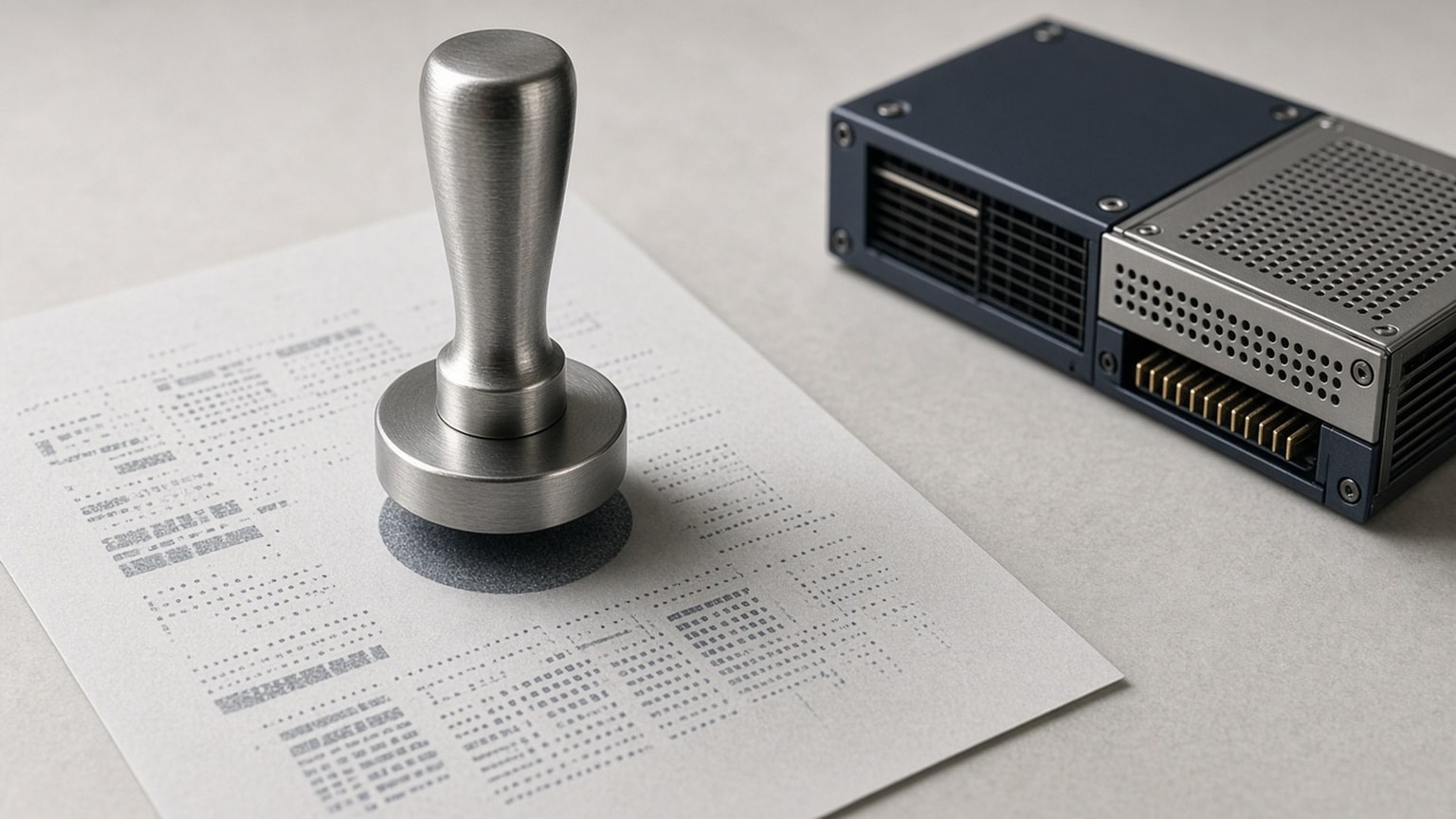
When you pay for a given model through an API, you see only the tokens that come back. Nothing proves the provider did not quietly route you to a cheaper model. On 2 November 2026, Anthropic's Frontier Red Team published progress on "provable inference" and released FlashProve, an open-source prototype meant to close that gap.
How it works
FlashProve has two phases (Anthropic):
- Offline: the provider publishes a commitment to the model weights, "a short fingerprint" that pins down one exact set of weights while keeping them hidden.
- Online: for each request, the provider produces a proof file showing that the committed model produces those output tokens.
Anyone holding the commitment, the prompt and the reply can check the proof without the weights. The GitHub repository says verification runs "on an ordinary CPU in seconds" with a tool called cp_verify. The system relies on zero-knowledge succinct proofs (zkSNARKs). It hides the weights, but hiding the model's architecture is not a goal (Anthropic).
The numbers
Anthropic tested it on Llama 4 Maverick, a 400B-parameter mixture-of-experts model, using its public 4-bit weights. A single H100 GPU generates proofs at around 110 tokens per second, with a proof of about 19 MB per 1,024-token request. That is roughly 70 to 95 times the GPU time of running the model itself on vLLM (Anthropic). The repository lists a 1,024-token context window for now (GitHub).
Anthropic says Claude produced improvements to the proof system, and that the team countered hard-to-audit optimisation choices by stating the security guarantees in Lean, a formal verification language. Code, Lean proofs and documentation are released under Apache 2.0 (Anthropic).
What it is not
This is not a product. Anthropic calls the post "intermediate progress, and not a completed research agenda" (Anthropic), the repository is marked as a research artifact that is not maintained (GitHub), and TechCrunch reports there are no plans to deploy it at Anthropic or any other lab (TechCrunch).
Why it matters for AI users
TechCrunch notes the researchers see it as a way to stop a provider from secretly swapping in a cheaper model, or a stronger one to inflate benchmark results (TechCrunch). For anyone buying model access through resellers or routers, or paying for a "frontier model reviewed this" claim, a checkable proof would replace trust with verification. The 70 to 95x compute overhead and the short context window show it is still far from everyday use.