
Cursor Hid That Composer 2 Runs on Kimi, a Chinese AI Model — The Scandal Embarrassing Silicon Valley
Cursor launched Composer 2 without disclosing that 25% of its compute runs on Kimi K2.5 from China's Moonshot AI. A developer found the truth in the code. Inside the scandal exposing Silicon Valley's hidden reliance on Chinese open-source models.
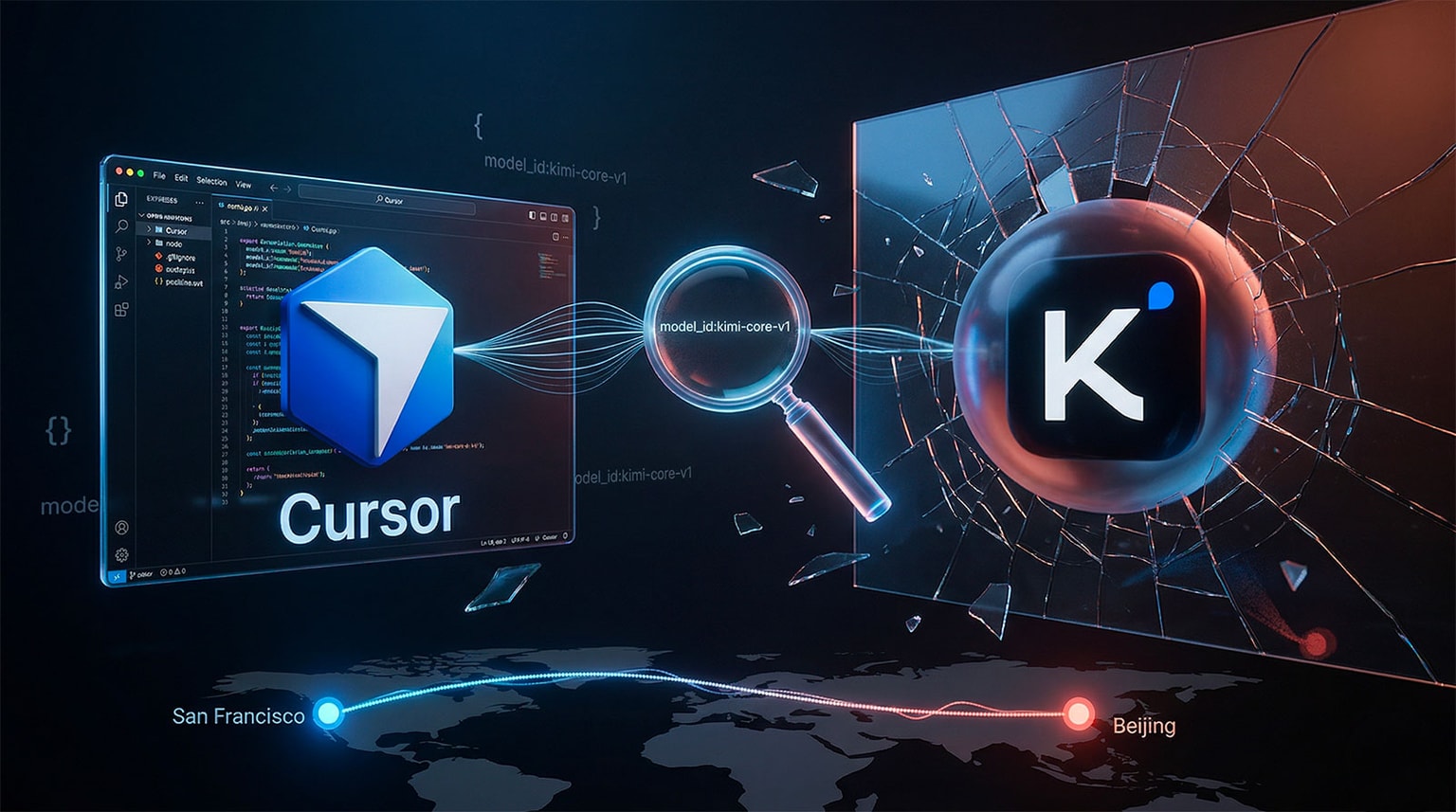
On March 19, 2026, Cursor unveiled Composer 2 as a proprietary breakthrough — a "frontier-level coding intelligence" — without mentioning one crucial detail: 25% of its compute runs on Kimi K2.5, an open-source model from Moonshot AI, a Chinese startup backed by Alibaba and HongShan (formerly Sequoia China). A single developer was enough to blow the cover. In the context of the US-China AI trade war, this affair exposes a hidden and systemic dependency of Silicon Valley on Chinese open-source models.
March 19: "Frontier-Level Coding Intelligence" — No Mention of China
That day, Cursor published a blog post celebrating the launch of Composer 2. The message was clear: the most popular AI IDE among developers had built its own coding intelligence. A proprietary model. A homegrown technical breakthrough.
Nowhere in the announcement did the words Kimi, Moonshot AI, or Chinese model appear. Yet a quarter of Composer 2's compute runs on Kimi K2.5, an open-source model trained in Beijing. The inference infrastructure — the layer that actually runs the model — is operated by Fireworks AI, a commercial partner.
For a startup valued at $29.3 billion, a direct competitor to GitHub Copilot and Windsurf, the omission was anything but trivial.
"At Least Rename the Model ID" — How Fynn Uncovered Everything
On that same March 19, a developer going by the handle Fynn inspected Composer 2's code. What he found was unambiguous: the model ID — the technical identifier of the model being used — pointed directly to Kimi 2.5.
His tweet was blunt: "at least rename the model ID." In other words: Cursor didn't even bother masking the Chinese model's identifier in its own code.
Within hours, the post exploded across X, Reddit, and HackerNews. The developer community — historically committed to transparency and open-source values — was unforgiving. The headline making the rounds: "Cursor passes off someone else's AI model as their own."
72 Hours of Crisis: From Silence to Admission
It took three days for Cursor to respond officially.
On March 22, Lee Robinson, VP of Developer Education at Cursor, conceded: "Indeed, Composer 2 originated from an open-source foundation!" On March 23, Aman Sanger, Cursor co-founder, went further: "It was an oversight not to mention the Kimi base in our blog from the start."
The crisis communication was late and clumsy. What could have been framed as a strength — choosing the best available open-source model, even a Chinese one — became a weakness through lack of transparency.
A viral comment summed up the paradox: "Cursor, a $29 billion company, looked at every base model available and decided a Chinese open-source model was the best one. That's the most valuable endorsement Moonshot AI could possibly get. And instead of saying so, they tried to take the credit."
Legally Clean, Morally Murky — The Important Nuance
Key clarification: Cursor did nothing illegal. Kimi K2.5 is an open-source model — its use is free and unrestricted under a permissive license. The commercial partnership with Fireworks AI for inference infrastructure is authorized. Moonshot AI has not filed any complaint or objection.
The problem isn't legal. It's a transparency problem. A startup valued at $29.3 billion presented a Chinese lab's work as its own. In an ecosystem where developer trust is the primary asset, the fine-tuning (Cursor's specialized training, accounting for 75% of compute) doesn't justify silence on the remaining 25%.
The Context That Makes This Explosive: DeepSeek, the US-China War, and Silicon Valley's Hypocrisy
This story would be a mere PR incident without the geopolitical context of 2026.
In early 2026, the DeepSeek debate shook the industry: Chinese AI models now rival American ones at a fraction of the cost. Anthropic and OpenAI explicitly asked the US government to restrict enterprise use of Chinese models. Chip export restrictions to China are intensifying.
And meanwhile, one of Silicon Valley's most popular vibe coding tools — Cursor — was quietly running on a model trained in Beijing.
The MIT Technology Review had warned earlier in the year: "Expect more Silicon Valley companies to quietly build on Chinese open models in 2026. Quietly being the key word."
The irony cuts deep. The very players championing American tech sovereignty are building on Chinese foundations. Cursor is likely not the only one — just the first to get caught. The affair comes as OpenAI acquires Astral to get closer to the developer ecosystem — the stack wars have never been fiercer.
Key Takeaways
- Cursor launched Composer 2 on March 19, 2026 without disclosing that 25% of its compute runs on Kimi K2.5, an open-source model from Moonshot AI (China, backed by Alibaba and HongShan).
- A developer (Fynn) discovered the model ID in the code on launch day — the story exploded across X, Reddit, and HackerNews.
- Cursor's co-founders admitted the facts on March 22-23: "an oversight not to mention the Kimi base."
- The use is legal (open source, partnership via Fireworks AI), but the lack of transparency triggered a trust crisis.
- In the context of the US-China AI war, the scandal reveals a hidden dependency of Silicon Valley on Chinese open-source AI models.
Kimi K2.5 is the perfect definition of an activated idle resource. A Chinese open-source model running silently at the heart of a $29 billion American tool — invisible, uncredited, yet indispensable. Chinese open source may be the most powerful — and most overlooked — idle resource in the global AI ecosystem. Cursor just forgot to say so.
| US Tool | Chinese Model | Publicly Disclosed |
|---|---|---|
| Cursor Composer 2 | Kimi K2.5 (Moonshot AI) | No — hidden, admitted after scandal |
| Perplexity | DeepSeek R1 | Yes |
| Various coding tools | Qwen 2.5 (Alibaba) | Varies |
| Element | Detail |
|---|---|
| Base model | Kimi K2.5 (Moonshot AI, open source) |
| Share in Composer 2 | ~25% of compute |
| Proprietary training | ~75% of compute (Cursor fine-tuning) |
| Inference infrastructure | Fireworks AI |
| Legality | Compliant (open-source license) |
| Transparency at launch | None |
| Admission | March 22-23, 2026 |
| Cursor valuation | $29.3 billion |


