
Era Computer Raises $11M to Build the OS of AI Gadgets — Glasses, Rings, Pendants and the Post-Smartphone Era
On April 23, 2026, Era Computer announces $11M raised (Abstract Ventures, BoxGroup, Mozilla Ventures, Collaborative Fund) to build the universal software layer for AI wearables. The bet: the future is not a single device, but a constellation of form factors orchestrated by one platform that supports 130+ LLMs.
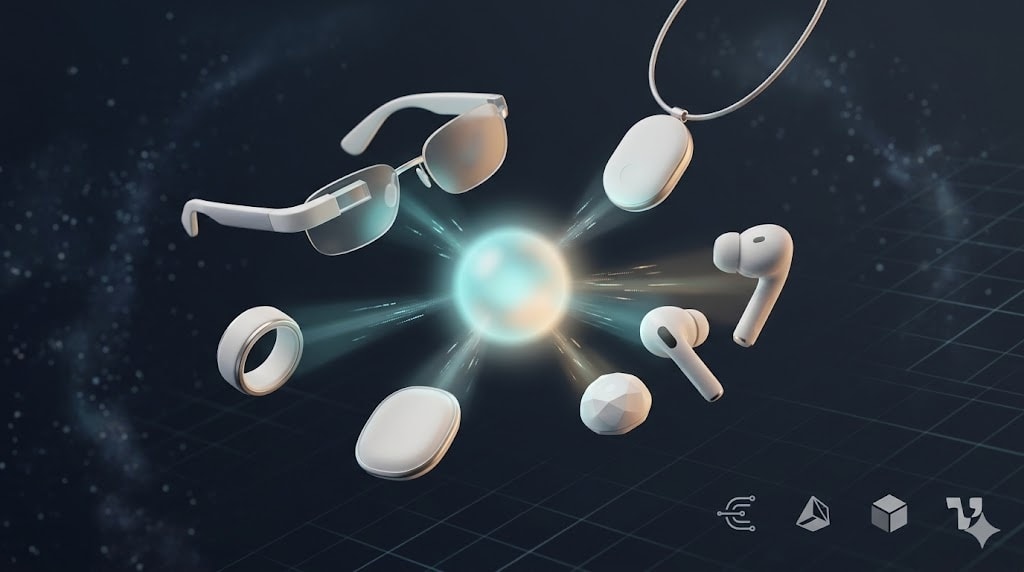
On April 23, 2026, Era Computer stepped out of semi-stealth with $11 million in cumulative funding: a $9M seed co-led by Abstract Ventures and BoxGroup (with Collaborative Fund and Mozilla Ventures participating), plus an earlier $2M pre-seed. The thesis is simple: the future of AI hardware is not a single dominant device, the way the iPhone was for mobile. It is a constellation of form factors — smart glasses, rings, pendants, intelligent earbuds, ambient sensors — that work together. Era wants to build the universal software layer for hardware makers, orchestrating 130+ large language models from 14+ providers. It is the most ambitious OS bet since Android, and it lands at the exact moment the smartphone starts to plateau.
The thesis: post-smartphone is multi-form-factor
To understand Era Computer, you have to accept one thing: the smartphone is the apex of the 2007-2025 era, but not the end. Several signals converge in 2026:
- Apple announces in March 2026 that Vision Pro 2 (yet to ship) will be positioned as a complement rather than a replacement to the iPhone.
- Meta Ray-Ban crossed 15 million units sold for FY 2025.
- Humane (the failed AI pin) was wound down in late 2025, but Friend Pendant, Limitless Ring and Frame 2 each crossed one million units.
- OpenAI is working with Jony Ive on an unidentified device planned for 2026.
- Perplexity is testing an AI browser integrated with a Mac mini (see Perplexity Personal Computer).
The pattern: each AI device solves a specific use case (vision, audio, capture, sleep, health), and they communicate. None will replace the smartphone 100%. Era wants to be the Android of this era, but at the LLM-orchestration layer rather than the system layer.
Era's offering: middleware for hardware makers
Concretely, Era offers hardware makers (startups and established brands):
| Era service | Maker benefit |
|---|---|
| Unified LLM API (130 models, 14 providers) | No need to manage each API individually |
| Customizable voice | Consistent brand-voice across the lineup |
| Multi-agent orchestration | The device knows when to route to GPT-5.4, Claude, Gemini or Llama |
| Skills marketplace | Third-party apps (Spotify, weather, calendar) integrated without dev effort |
| Privacy & local fallback | On-device inference for sensitive cases |
| OTA updates | Software updates without changing the hardware |
For a maker, the Era pitch is: "you design the object, we handle the brain". It lets a brand like Frame, Loop or Senso ship a product in 6-9 months instead of 18-24, without hiring an in-house ML/AI team.
The cap table: Mozilla Ventures, the ethical signal
The most interesting investor is not Abstract or BoxGroup (two classic early-stage funds) — it is Mozilla Ventures. The fact that Mozilla — which mainly invests in open-source and privacy-first AI — is in the round suggests Era has positioned its platform with:
- Local inference as a default option (distilled on-device models)
- No-data-out policy in strict mode
- Open-weights compatibility for community models (Llama, Mistral, Qwen, Gemma 4)
- Audit trail for LLM requests (who sees what)
This is the opposite of the iOS-first model where Apple intermediates everything via Apple Intelligence and where Siri cannot (yet) call Claude or GPT-5. Era promises the inverse: maximum modularity, making it the Android of AI wearables.
The angels: an ambient-era cast
Several notable angels appear on the cap table:
- Caterina Fake (Flickr co-founder) — pioneer of UGC web 2.0 platforms
- Ken Kocienda (iPhone keyboard creator, Apple) — UX and hardware-software design
- Other ex-Apple, Google, Meta angels not publicly named
This signal confirms two things: (1) Era explicitly targets the hardware-software convergence the iPhone executed in 2007, and (2) ex-Apple folks see the opportunity to build the next OS layer outside Cupertino.
Why now and not two years ago
AI hardware has had two false starts:
- 2018-2020: Amazon Echo, Google Nest, Apple HomePod. Competent but limited to voice command.
- 2023-2024: Humane Pin, Rabbit R1, Limitless Pendant. Hype, then massive flop (Rabbit shipped a faked demo, Humane was liquidated).
Why does 2026 work where 2024 failed?
- Real-time multimodal models (GPT-4o, Gemini Live, Sonnet 4.6) finally make ambient computing fluid.
- ASIC inference (Groq LPX, Cerebras, NVIDIA Jetson Thor) lifts on-device from 1 tok/s to 50+ tok/s.
- Mature SDKs: the Vercel AI SDK, OpenAI Agents SDK, Claude Code, Anthropic MCP layers enable real portability.
- User behavior: millions of users have domesticated ChatGPT, Claude and Gemini on mobile. The leap to a wearable AI device is cognitive, not behavioral.
Era arrives precisely when the stack is mature but before big tech (Apple, Google, Meta) lock the market with their own vertical OS. It is the 18-24 month window to become Android before iOS takes over.
The risk: the platform war
Era is up against giants already positioned:
- Apple: visionOS for Vision Pro, iPadOS, watchOS, AirPods firmware = a unified AI OS in construction (rumored "Apple Ambient OS" for 2027).
- Google: Android XR for Samsung headsets, plus an embedded version for Sony and OPPO wearables.
- Meta: Horizon OS (formerly Quest OS) extending to Ray-Ban and new Reality Labs gadgets.
- Snap: SnapOS for Spectacles 6, growing quietly.
Era has to be the neutral, multi-provider option for makers who do not want to lock into Apple or Google. This is exactly the Microsoft Windows vs. Apple Mac OS niche of the 1990s — a horizontal OS that equips dozens of OEMs vs. a vertical OS that equips a single brand.
Implications for hardware startups
If Era succeeds, it dramatically lowers the barrier to entry for AI hardware. Today, shipping an AI gadget requires:
- 50-100 ML/AI engineers
- 18-24 months of dev
- $5-15M of software R&D outside hardware
With Era, that cost drops to:
- 10-20 engineers (hardware + UX focused)
- 6-9 months of dev
- $1-3M in software licenses
It is the Shopify-for-e-commerce effect applied to AI hardware. We will likely see, in 2027-2028, an explosion of AI wearable brands the way DTC brands exploded in 2015-2018.
Bottom line
Era Computer is playing small ($11M) in a huge market (the future of AI hardware). That is exactly the investment profile that either disappoints or becomes a quiet unicorn. Mozilla Ventures + BoxGroup + Caterina Fake + Ken Kocienda are making noise in the silence: they signal that the AI wearable OS is up for grabs, and that no one has taken it yet. While OpenAI and Apple work on their own closed verticals, Era is building the open, multi-provider alternative. If the "constellation of form factors" thesis is right, Era could become the infrastructure of a new generation of AI hardware that will not compete with the iPhone but with the seat iOS holds in the value chain. Worth watching in 12 months to see which OEMs have signed.


