
Meta MTIA 300/400/450/500: The AI Chip Roadmap Aiming to Kill Nvidia Dependence — $115-135B in 2026 Capex
Meta unveils an unprecedented MTIA cadence: a new custom AI chip every six months (MTIA 300, 400, 450, 500), a 1 GW partnership with Broadcom, and a falling Nvidia dependence. 2026 capex jumps to $115-135B, double 2025. Inference becomes the main battlefield for Llama 5 and Muse Spark.
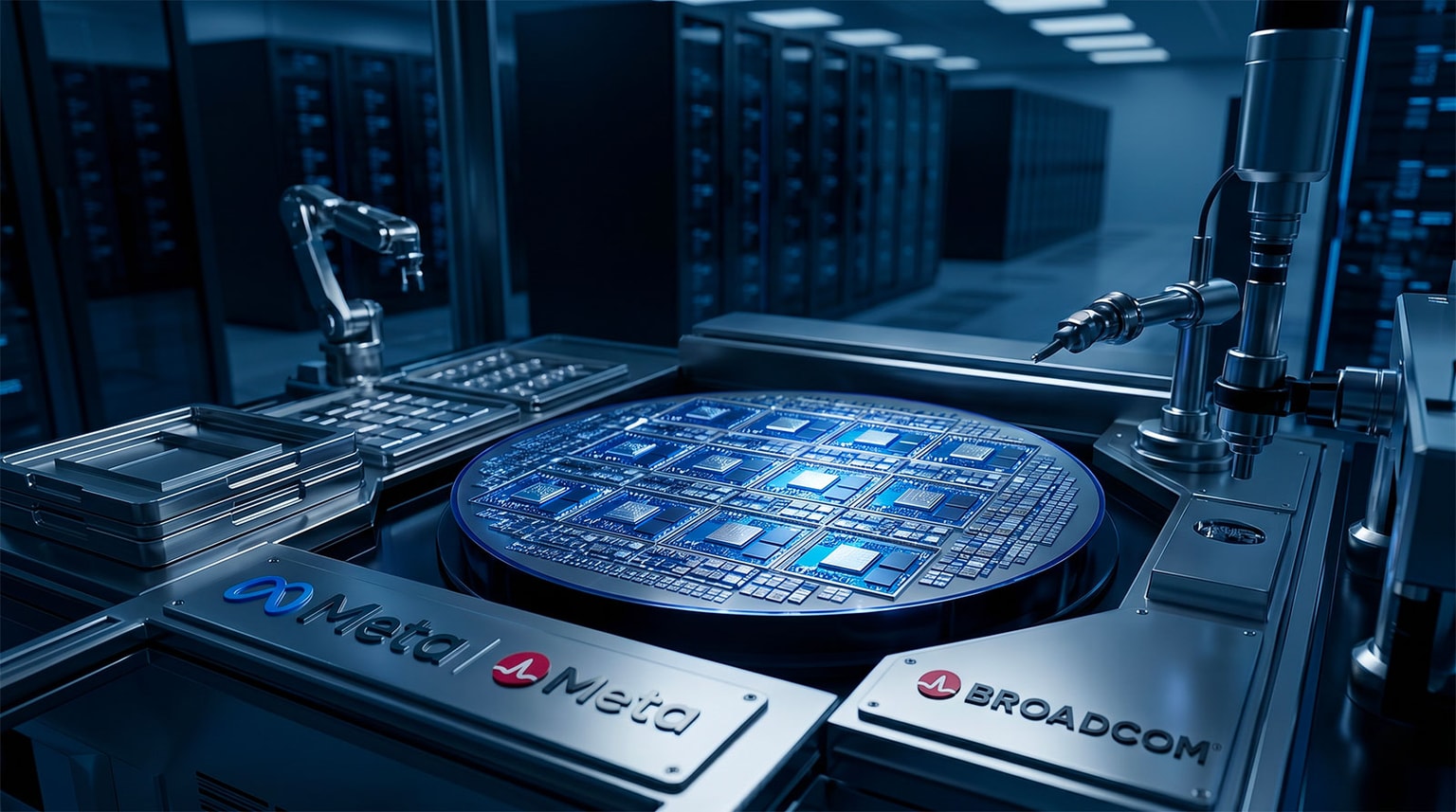
Meta has published an MTIA roadmap (Meta Training and Inference Accelerator) that changes the equation for Nvidia. Four chip generations — MTIA 300, MTIA 400, MTIA 450 and MTIA 500 — will follow each other at a cadence of one new chip every six months. MTIA 300 is already deployed in production, MTIA 400 enters data centers in mid-2026, and the Broadcom partnership structures 2 nm production reaching 1 GW of inference capacity. On the financial side, Meta confirms a 2026 capex between $115B and $135B, double the $72.2B of 2025. This is the most aggressive Meta infrastructure bet in history, and the goal is clear: kill Nvidia dependence on inference for Llama 5 and Muse Spark.
The MTIA Roadmap at a Glance
| Chip | Status | Workload target | Co-design partner |
|---|---|---|---|
| MTIA 300 | Deployed in data center (recent weeks) | Ranking inference, recommendation, ads | Broadcom (1st volume gen) |
| MTIA 400 | Tests done, H1 2026 rollout | LLM inference (Llama 5, Muse Spark) | Broadcom 2 nm |
| MTIA 450 | Roadmap, operational 2027 | Multimodal inference + partial training | Broadcom + Meta interconnect |
| MTIA 500 | Roadmap, operational 2027-2028 | Frontier-scale training | Broadcom + optical co-packaging |
A new chip every six months is unprecedented hyperscaler cadence. Google ships a new TPU every 18-24 months, AWS Trainium / Inferentia run on 24-month cycles, and Microsoft Maia hasn't yet hit volume maturity. Meta is in practice aligning with the NVIDIA Hopper → Blackwell → Rubin cadence, but internally and on its own workloads.
Why $115-135 Billion of 2026 Capex
The $115-135B 2026 capex breaks down roughly as follows (consolidated press + analyst estimates):
- ~$70-80B on Nvidia GPUs (H200, B100, B200) and associated data centers
- ~$25-30B on MTIAs and Broadcom / TSMC fabs
- ~$10-15B on power, cooling, fiber, real estate
- ~$5-10B on intra-DC networking (NVLink, Infiniband, custom interconnect)
Compared to the $72.2B of 2025, that's a +59% to +87% jump in a single year. No hyperscaler announced such an acceleration in 2026 — Microsoft is around $90-100B, Amazon $80-90B, Google $75-85B. Meta exceeds peers on raw capex, validating Mark Zuckerberg's "superintelligence labs first" thesis already visible with the Muse Spark pivot toward closed frontier.
The Real Goal: Break Nvidia's Inference Dependence
Meta operates among the largest inference fleets in the world — newsfeed, Reels, ads ranking, Instagram, WhatsApp Meta AI, and now internal Llama 5 and Muse Spark consumption. Per estimates, more than 60% of Meta's compute is now inference, not training. Yet:
- Nvidia margin on the inference layer is high (~70% gross margin on H100/B100)
- Inference workloads are predictable (model shape known, batch sizes regular), making them ideal candidates for dedicated ASICs
- Long-run operating costs justify a custom investment: over 5 years, MTIA cuts cost-per-token by roughly 35-50% per Meta's early benchmarks
This is the same logic Google used to develop TPUs starting in 2015. Meta is ~10 years late on that strategy but is closing the gap quickly. The Broadcom partnership delivers ASIC co-design plus packaging serialization expertise, without which Meta could not sustain the cadence.
The Strategic Role of Broadcom
Broadcom has become the silent ASIC co-pilot of hyperscalers. The Meta partnership joins a trajectory that already includes:
- Google: TPU v6/v7 co-design (since 2018, expanded in 2024)
- OpenAI: custom inference chip (in discussion 2025-2026)
- AWS: Trainium 3 and Inferentia 3 (announced)
- Apple: on-device AI silicon (Neural Engine, indirect)
Broadcom thus becomes the "second pick after Nvidia" for hyperscalers wanting to reduce dependence. Its market cap has surged correspondingly ($1.5T in April 2026, behind Nvidia $4.8T and Microsoft $4.2T). The Meta-Broadcom 1 GW dedicated capacity deal is the largest announced to date.
The Impact on Nvidia: No Panic, But Erosion Begins
Will Nvidia lose its hegemony? No. Frontier-scale training (1-10T parameter models) is still locked in by CUDA, NVLink and the ecosystem. The MTIA 500 chips planned for 2027-2028 will be the first real training test.
But on inference, erosion is starting:
- Today, Meta still buys 60-70% of its GPUs from Nvidia
- End of 2026, MTIA 400 will absorb 30-40% of inference load
- End of 2027, MTIA 450 + 500 may absorb 60% or more
If all hyperscalers replicate this move, Nvidia loses 15-25% of its inference TAM by 2028. Margin will hold but mix shifts. It's a parallel dynamic to what Google started with TPU v8 on Gemini Enterprise, but at greater scale.
Why Now
Several factors converge in April 2026:
- Frontier model race. GPT-5.5 (OpenAI), Opus 4.7 (Anthropic), Gemini 3 (Google), DeepSeek V5 — Meta has to serve Llama 5 and Muse Spark at scale without waiting on Nvidia allocations.
- Shareholder pressure. 2025 capex (~$72B) was debated. Transparency on the MTIA roadmap gives a rational frame for 2026's $115-135B: it's not a runaway, it's a plan.
- Geopolitics. Broadcom production runs through TSMC Taiwan and Arizona. Vendor diversification reduces US-China supply chain risk.
- Superintelligence talent. Meta Superintelligence Labs is recruiting massively (offers exceeding $50M for senior staff). The promise of "infinite compute" is worth as much as the salaries.
For Developers and Publishers: What Changes
1. Llama 5 will host cheaper internally — not necessarily cheaper as an API. Meta optimizes operating costs. That can accelerate a stronger Llama 5 release, but doesn't guarantee a public API price drop (which depends on commercial strategy, not marginal cost).
2. Hardware fragmentation accelerates. If every hyperscaler runs its own ASIC, frameworks must abstract (PyTorch + XLA + MTIA toolchain + Trainium SDK + TPU XLA + CUDA). ML tooling vendors (Modal, Replicate, Together AI) gain value by mutualizing that complexity.
3. Regional inference becomes a sales argument. With MTIAs deployed in Meta data centers (US, Europe, Asia), Meta can offer competitive regional inference SLAs. AI apps needing < 50ms latency on Llama workloads find a new vendor here.
4. Native monetization solutions thicken. If Meta runs its own models at reduced marginal cost, the ecosystem of AI app publishers (chatbots, vertical assistants, AI browsers) mechanically becomes more attractive — hence the rising importance of SDKs like Idlen for native chat AI monetization.
Uncertainty Zones
2 nm Broadcom yield. TSMC 2 nm is still ramping. A 6-month yield delay could push MTIA 450 and MTIA 500 significantly back.
Llama 5 / MTIA compatibility. Llama 5 isn't out yet. If the final architecture (mixture of experts, long-context attention) maps poorly to MTIA 400, Meta will keep buying Nvidia heavily through 2026.
Regulatory pressure. The US FTC and the European Commission monitor exclusive hyperscaler-fab deals. A 1 GW Broadcom deal could trigger an antitrust inquiry.
Bottom line:
- Meta confirms 4 custom MTIA chips (300, 400, 450, 500) over 24 months
- A new chip every 6 months — unprecedented hyperscaler cadence
- 2026 capex: $115-135B (vs $72B in 2025)
- Broadcom partnership at 1 GW, 2 nm etching
- Target: kill Nvidia dependence on inference
- MTIA 300 already shipping, MTIA 400 H1 2026, 450 and 500 in 2027-2028
- Direct implications for Llama 5 and Muse Spark
The MTIA bet is not only a cost question. It's a strategic realignment that brings Meta closer to Google's vertically-integrated TPU model and away from Microsoft's mass-Nvidia model. At $115-135B of capex, Meta can no longer afford an uncertain roadmap. If MTIA 400 reaches 80% of H200 performance on Llama 5 inference by end of 2026, the economics tip permanently. If it lands below, Meta will be forced to keep buying Nvidia in 2027 — which would justify capex sliding toward $150B+. The market will watch the first MTIA 400 vs B200 benchmark as the most consequential infrastructure event of the year.
Sources: Meta AI Blog — Four MTIA Chips in Two Years: Scaling AI Experiences for Billions, CNBC — Meta rolls out in-house AI chips weeks after massive Nvidia, AMD deals, Data Center Dynamics — Meta estimates 2026 capex to be between $115-135bn, Oplexa — Meta Broadcom AI Chip Deal 2026: 1GW MTIA, 2nm, Futurum — AI Capex 2026: The $690B Infrastructure Sprint.


