
Manus Cloud Computer: the persistent virtual machine that turns AI agents into 24/7 services
On April 30, 2026, Manus launched Cloud Computer, a dedicated, always-on Ubuntu virtual machine for AI agents. 24/7 Slack and Discord bots, scheduled scrapers, self-hosted WordPress or Metabase — all driven through natural language. A breakthrough for non-developers.
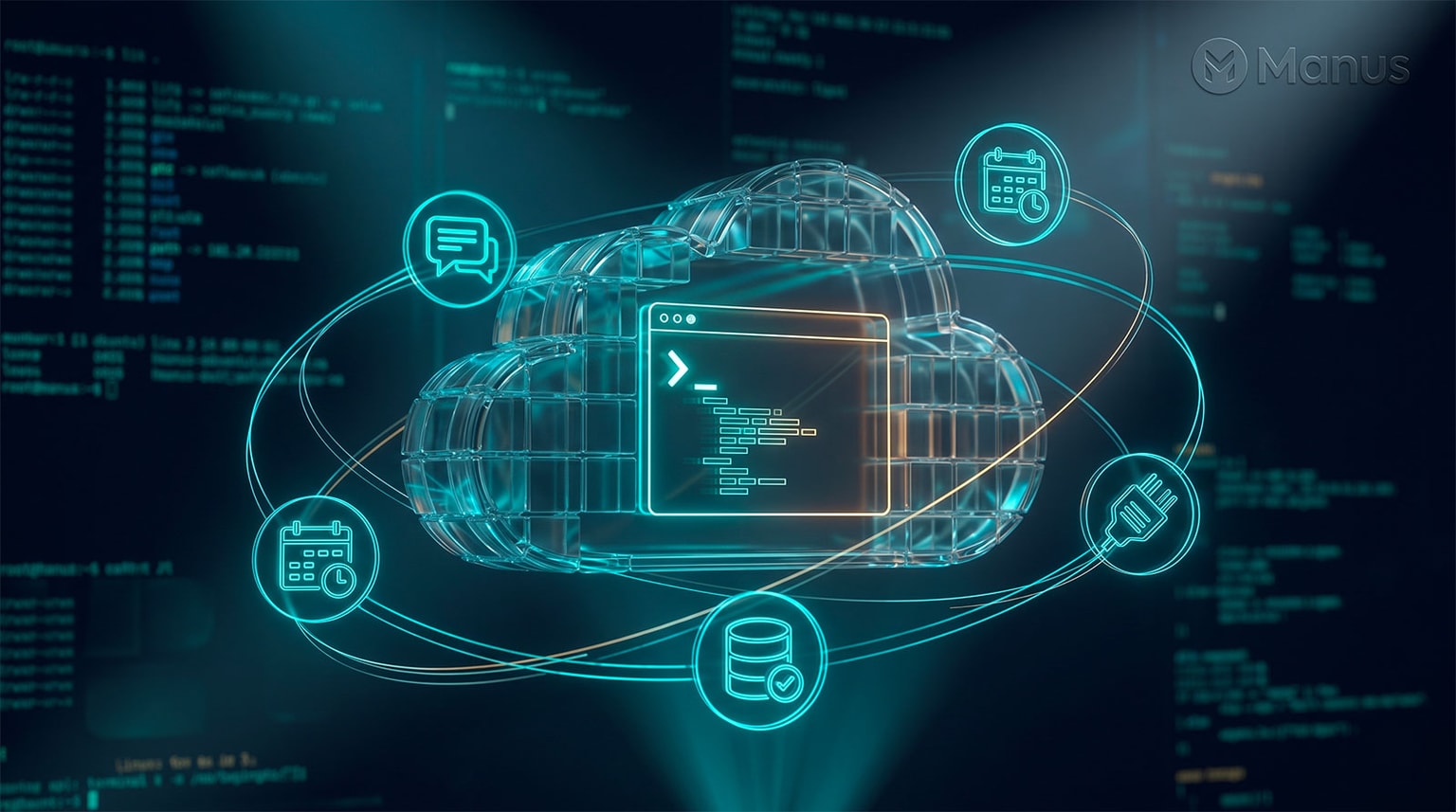
On April 30, 2026, Manus launched Cloud Computer: a dedicated Ubuntu virtual machine, hosted in the cloud, always on, and fully steerable in natural language. It's the qualitative jump that was missing from the AI agents landscape — moving from the disposable session to persistent infrastructure that non-developers can actually use without touching SSH or Docker.
From ephemeral sandbox to permanent VM
Before Cloud Computer, Manus agents ran in temporary sandboxes (the architecture is similar to the one E2B described on its technical blog in 2025): you launch a task, the agent provisions a VM, runs, returns the result, the VM disappears. Fine for one-shots, fatal for any recurring workflow.
Cloud Computer flips that. Each user can:
- Provision a dedicated Ubuntu VM from the Settings menu
- Pick a plan based on need (basic for simple scripts, advanced for databases or team usage)
- Specify geographic location and storage
- Connect via SSH or a web terminal (no graphical desktop yet)
The instance stays on, keeps state, and can be steered by the AI agent in conversational mode. It's the difference between "I'm asking you for a thing" and "I'm handing you my workstation."
The use cases Cloud Computer unlocks
Manus explicitly lists the workflows persistence makes possible:
| Use case | What it enables |
|---|---|
| 24/7 bots | Slack, Discord, Telegram bots that respond and run continuously |
| Living knowledge bases | Accumulate data over weeks (CRM, sales records, dashboards) |
| Open-source self-hosting | WordPress, Metabase, Home Assistant, Odoo without a devops team |
| Scheduled tasks | Cron scrapers, periodic reports, monitoring |
| CLI dev tools | Complex command-line tools driven in plain English |
The clearest example: a salesperson at a mid-sized company can upload weekly sales spreadsheets, the agent updates a SQLite DB hosted on the VM, generates a Metabase dashboard, and posts a Slack report every Monday at 9am. Zero lines of code written by the user. That's exactly the territory Cloudflare with emdash and MCP was eyeing, but Manus pushes the no-code claim much further.
Why it's more disruptive than it looks
At first glance, Cloud Computer looks like just another VPS. Look closer and it's a UX rupture:
- The AI becomes the sysadmin. The user doesn't configure Apache, doesn't type
apt install, doesn't manage permissions. They describe what they want, the agent provisions. The entry barrier drops from "6 months learning Linux" to "6 minutes describing your need." - Persistent state unlocks agentic compounding. Agentic workflows only get truly interesting when they can accumulate context over weeks. That's what Claude Code and Cowork on Mac initiated on the desktop side; Manus carries it into multi-tenant cloud.
- The marginal cost of a workflow drops to a few dollars/month. Where a company would have hired a freelancer to script an automation, it can now spin up a Manus VM, talk to the agent, and ship the system — for the price of a Notion subscription.
Competitive context: OpenAI, Anthropic, Replit
Manus isn't alone here. The last six months have seen a sharp acceleration on AI agents shipped with their own execution environments:
- OpenAI released its Agents SDK with Codex sandbox harness — disposable sandbox, dev-oriented
- Anthropic leans on Claude Code and Cowork on the desktop side, with cloud experiments underway
- Replit offers de-facto persistence via Repls but stays heavily code-oriented
- NVIDIA open-sourced OpenShell as a secure runtime for autonomous agents
- Cognition keeps Devin at a $25B valuation with a halfway approach
Manus' differentiator is mainstream accessibility. Cloud Computer doesn't ask you to understand Kubernetes, doesn't ask you to code in Python, doesn't ask for a corporate credit card. Manus plays the "AI agents for everyone" angle, where OpenAI and Anthropic stay anchored in the dev segment.
The vibecoding angle: the end of "you need a local dev machine"
The vibecoding movement so far rested on a hidden assumption: to vibecode, you needed a properly equipped local machine (Cursor, Lovable, Bolt). Cloud Computer flips the equation.
- A user can now vibecode a full app from a browser through the Manus VM
- The app stays hosted on the VM, so it's already deployed (no need for Vercel or Netlify on simple projects)
- Session history is persistent, so the AI remembers your project across conversations
It's exactly the pattern we describe in how to launch an app in 24 hours, without the deploy friction. For non-developers who already adopted Lovable or Bolt, Cloud Computer adds a backend execution layer those tools didn't natively offer.
The current limits to keep in mind
A few serious caveats:
- No graphical desktop. For now, Cloud Computer exposes Ubuntu in CLI only. Workflows that need GUI apps (Photoshop, Figma desktop, etc.) aren't covered.
- Enterprise security still to validate. Manus has shared little detail on tenant isolation, encryption at rest, or SOC 2 / ISO 27001 compliance. To watch for enterprise rollouts.
- Vendor lock-in. Workflows built inside Cloud Computer are portable in theory (it's plain Linux), but the agent orchestration is proprietary. Migrating to another platform would mean rebuilding the AI layer.
- Pricing to clarify. Manus announced tiered plans but didn't publish a public price grid at launch. The real economic model (per VM? per agent minute? per capacity?) remains to be observed.
- Manus dependency. If Manus hits turbulence (OpenAI has already absorbed players like Hiro for finance), hosted workflows become vulnerable.
What it opens for developers and creators
For developers building on top of the Manus stack:
- A new class of SaaS apps without traditional backend. You charge the user, you let Manus handle the infra, you focus your code on business value. Close to what we describe in our indie hacker AI, profitable projects without funding guide.
- A surface for native ad monetization. If your app runs inside Cloud Computer and chats with an AI agent, embedding an SDK like the Idlen chat SDK becomes trivial. Contextual AI ads slot naturally into the agent's conversational layer.
- The chance to package "turnkey workflows." Like Notion templates or Make scenarios, expect a marketplace of ready-to-go Manus workflows (CRM, marketing ops, personal finance, etc.).
For B2B advertisers targeting AI developers and creators, Manus becomes a relevant channel: Cloud Computer users are by definition agentic AI early adopters with high LTV. B2D marketing 2026 strategies should now factor Manus into the channel mix.
Conclusion: agentic infrastructure exits the dev kit
Cloud Computer is the most structuring Manus launch since the original release. This is the moment AI agents move from "toy for curious developers" to productive infrastructure for SMBs and creators. The market didn't need another LLM; it needed an execution layer that's persistent, accessible, and steerable in natural language. Manus delivers exactly that.
The real fight ahead is no longer about raw model quality, but about who owns the execution environment of agentic workflows. Cloud Computer puts Manus in pole position next to OpenAI Agents SDK, Anthropic Claude Code, and Cognition Devin. Consolidation will accelerate, and players without their own runtime (most of today's visible vibecoding startups) will have to choose: plug into one of the three big runtimes, or disappear.
To understand how to build monetizable AI products on these new infrastructures, see our guide how to monetize an AI app and our analysis of the agentic consolidation with Sierra and Bret Taylor.


