Trump Reopens the Pentagon Door to Anthropic — Dario Amodei at the White House, Mythos Rewrites the Deal
On April 21, 2026, Donald Trump declares that Anthropic is 'shaping up' and that a deal with the Pentagon is 'possible'. The reversal comes one week after Dario Amodei's White House visit and Anthropic's controlled launch of Claude Mythos — a model whose cybersecurity capabilities reportedly pressured the administration. After six months of blacklisting and a federal court battle, Anthropic is back in the race for the most strategic defense contract of the decade.
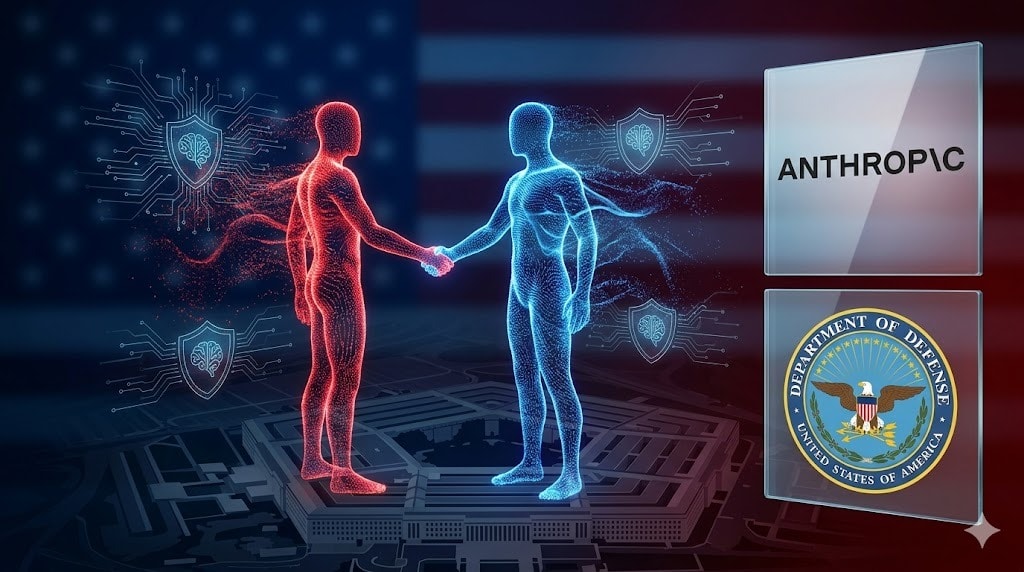
On April 21, 2026, Donald Trump declared from the Oval Office that Anthropic was "shaping up" and that a deal with the Pentagon was now "possible". The statement, delivered to CNBC and Bloomberg reporters, marks a spectacular reversal after six months of blacklisting, threatened executive orders and a federal court fight. The pivot arrives exactly one week after Dario Amodei's visit to the White House, and days after Anthropic publicly demonstrated Claude Mythos's capabilities in offensive cybersecurity. Beneath the diplomatic varnish, three structural dynamics are forcing reconciliation — and they're reshaping US AI policy.
The Sentence That Changes Everything
Asked about relations with Anthropic, Trump said: "I think we'll get along with them just fine. We want the smartest people." In presidential context, this statement is not trivial. It comes after months during which the administration had labeled Anthropic a supply chain risk to national security, blocked a $200 million contract signed in July 2025, and let OpenAI grab the military contract. Trump added: "It's possible. We want the smartest for defense."
| Phase | Dates | Key event | Anthropic impact |
|---|---|---|---|
| Tension | July 2025 | $200M Pentagon contract signed | Entry into defense ecosystem |
| Escalation | September 2025 | DOD demands unconditional model access | Public refusal from Anthropic |
| Blacklisting | March 2026 | Pentagon declares Anthropic a supply chain risk | GenAI.mil contract goes to OpenAI |
| Battle | April 2026 | Federal appeals court rejects Anthropic appeal | Maximum judicial pressure |
| Reversal | April 21, 2026 | Trump opens door to a deal | Reintegration possible |
Three Dynamics Forcing Reconciliation
1. Mythos's Capabilities Changed the Strategic Arithmetic
In April 2026, Anthropic confirmed that Claude Mythos represented a step change in cybersecurity capabilities. Experts cited by Bloomberg estimate Mythos can identify and exploit zero-day vulnerabilities at a speed and depth unprecedented among available models. In a geopolitical context where China deploys its own frontier models and where the OpenAI-Anthropic-Google alliance against Beijing takes shape, the Pentagon cannot ignore Mythos without accepting a strategic lag.
The DOD's calculus becomes binary. Either Mythos is integrated into the GenAI.mil ecosystem with guardrails, or it is used exclusively by defense teams in allied third countries — via partnership or license. The first option preserves US leadership; the second degrades it. Trump, who reads every decision through an America First lens, doesn't have the luxury of maintaining the ban.
2. Amodei's Visit Produced a Negotiable Compromise
Amodei visited the White House on Monday April 14. The White House described the meeting as productive and constructive. The exact terms of the compromise discussed aren't public, but leaks suggest a three-part framework:
- Conditional access to models — Anthropic agrees to provide Claude and Mythos to the DOD, with technical guardrails: no use for fully autonomous weapons, no mass domestic surveillance.
- Government audit — NSA and DOD teams gain audit rights on Anthropic's frontier releases, particularly on jailbreaks and cyber capabilities.
- Pricing and partial exclusivity — Anthropic renegotiates a multi-hundred-million contract, with vertical exclusivity on select defense use cases (e.g., threat intelligence).
This framework looks similar to what Anthropic has accepted before for sensitive enterprise partnerships, while preserving the red line of its public Usage Policy. For the administration, it's a political win without compromising the no-woke-AI doctrine.
3. Investors and IPO Targets Apply Their Own Pressure
Anthropic just closed preemptive rounds and refused an $800B valuation, while crossing $30B in run-rate. A significant share of revenue comes from potential federal contracts. Maintaining the ban was costing Anthropic not only a government contract but a meaningful multiple discount on its next round.
On Trump's side, maintaining the ban meant OpenAI captured a historic contract without competition. Sam Altman, close to the current administration, enjoyed a near-monopoly position on US defense AI. The White House, on principle, doesn't want a private monopoly on a strategic market — and congressional Republicans were starting to grumble about single-vendor lock-in.
What Reconciliation Changes for the AI Ecosystem
For Other Frontier Labs
Lifting the Anthropic ban sets a precedent: safety commitments are no longer incompatible with US defense market access. It's excellent news for labs maintaining strict usage policies (Anthropic, Google, Cohere) and less welcome for those who bet on an unabashed hard-sell line (OpenAI, Palantir). The market will reshape over 12 months.
For the Supply Chain and Integrators
Defense integrators (Lockheed, Northrop, L3Harris, Booz Allen) who had to switch to OpenAI stacks will be able to reintegrate Claude and Mythos into their GenAI.mil systems. That creates work for government MLOps teams and a surge of demand for integrators capable of plugging multiple frontier models into a single command-and-control interface.
For the Political Narrative
Trump bent Anthropic without needing an executive order. Politically, it's a strategic win: he displays America First pragmatism rather than ideological warfare. Commentators who had read the Anthropic ban as an attempt to reshape the AI landscape via California law and executive orders have to rewrite their analysis. The truth looks simpler: the administration uses regulatory pressure as a negotiating lever, not an end goal.
The Open Questions
The contract isn't signed. Trump said "possible", not "closed". Between an oral statement and a signature in presence of the Secretary of Defense, months can elapse. The Joint Chiefs and Pentagon General Counsel must validate the technical guardrails Anthropic proposes.
Competitors will push back. OpenAI built its defense position on Anthropic's eviction. Sam Altman won't let his GenAI.mil exclusivity erode without reacting. Aggressive pricing, cyber capability demos or industrial defense partnerships are likely over the next six months.
Internal Anthropic opinion. Part of Anthropic's research team opposes military use, even bounded. Dario Amodei will have to manage resignations or leaks if the deal is judged too permissive. Internal communications will be scrutinized by the press and by employees themselves.
China is watching. Beijing will analyze the Trump-Anthropic compromise as a precedent. If Mythos is deployed on GenAI.mil, Chinese services (MSS, PLA) will intensify industrial espionage and recruitment of US researchers. It's the normal game between major AI powers, but pressure ticks up a notch.
For AI Product Teams
Beyond politics, the Trump-Anthropic reconciliation offers three operational lessons:
1. Public usage policies are becoming a strategic asset. Anthropic held its ethical position for six months despite losing a major contract. That consistency is now valued by Wall Street and the market: enterprises wanting a predictable AI provider are choosing Anthropic over competitors that change their rules under political pressure.
2. Defense is becoming the largest B2B AI vertical globally. Between DOD, NATO, European defense ministries and Asian allies, we're talking $50-100B annual markets by 2028. All frontier labs and enterprise orchestrators will position offers, including developer SDKs. Shield AI at $2B in Series G is the most recent example.
3. Compliance isn't a brake, it's a moat. The technical guardrails Anthropic will deploy to satisfy the DOD (audit trails, capability containment, sandboxing) will become standard features for civilian enterprise buyers. Competitors who haven't invested in these layers will lag. For publishers building on frontier APIs, the signal is worth taking seriously.
TL;DR:
- April 21, 2026: Trump declares an Anthropic-Pentagon deal "possible"
- Major reversal after 6 months of blacklisting and court battle
- Dario Amodei met the White House on April 14 — meeting called "productive"
- Claude Mythos and its cyber capabilities changed the strategic arithmetic
- Likely compromise: conditional access + guardrails + government audit
- For OpenAI: end of US defense monopoly; for Anthropic: back in the race
- Precedent: safety commitments no longer block federal market access
The Trump-Anthropic reconciliation marks the end of the hardest phase of the US political conflict over frontier AI. It doesn't erase tensions — it normalizes them. The Trump administration accepts that a strategic supplier can impose ethical limits as long as those limits don't forbid the main defense use. Anthropic accepts reentering a federal framework as long as that framework preserves its public red line.
For product teams, the final lesson is that 2026 AI policy no longer pits safety against business — it demands both simultaneously. Labs, orchestrators and SaaS platforms that can hold this line will win. Those who sacrifice it will lose — in the short term on regulated enterprise accounts, in the long term on developer trust itself. It's the same logic driving Idlen to publish its SDK with a transparent ad policy and zero user data: high standards are the most valuable asset in an era where every winning model is watched by governments, partners and users alike.
Sources: CNBC — Trump says Anthropic is shaping up and a deal is possible, Bloomberg — Trump Says US Will Get Along With Anthropic After Pentagon Spat, The Defense Post — Trump Hints at Thaw With AI Firm Anthropic, Washington Examiner — Trump: Deal with Anthropic still possible for military use.