Developer Relations vs Developer Advertising: Which Strategy to Choose in 2026?
DevRel vs Developer Advertising: a comprehensive comparison of costs, ROI, scalability, and timelines. Learn which strategy works best for your developer tool in 2026 and how to combine both.
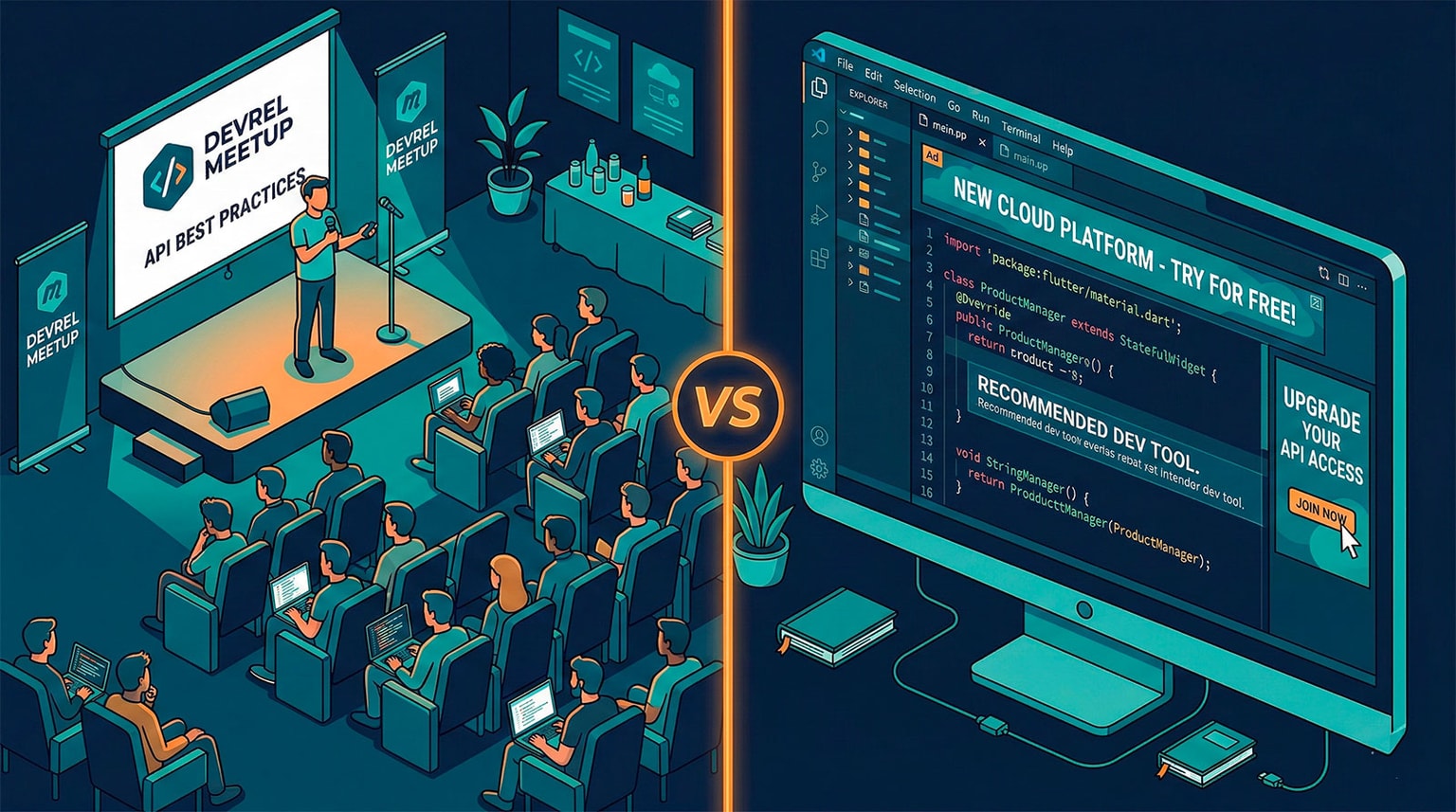
Developer Relations vs Developer Advertising: Which Strategy to Choose in 2026?
Every developer tool company faces the same question: should we invest in Developer Relations or developer advertising? Or both? This is one of the most critical decisions in B2D marketing.
The answer used to be simple. DevRel was the "right" way to reach developers, and advertising was considered ineffective or even harmful with technical audiences. But the landscape has changed dramatically. New advertising channels have emerged that developers actually engage with, while DevRel costs have skyrocketed and hiring experienced developer advocates has become fiercely competitive.
In 2026, the real question is not DevRel vs. advertising -- it is how to combine them effectively for your specific stage, budget, and growth targets.
This guide breaks down both strategies honestly, compares them on the metrics that matter, and gives you a framework for allocating your budget.
What Is Developer Relations (DevRel)?
Developer Relations is the practice of building relationships with developers to drive adoption, satisfaction, and advocacy for your product. It sits at the intersection of marketing, engineering, and product.
Core DevRel Activities
- Community Management: Running Discord servers, GitHub Discussions, forums
- Content Creation: Writing tutorials, guides, blog posts, documentation
- Conference Speaking: Presenting at events, meetups, hackathons
- Developer Advocacy: Being the voice of developers inside the company
- SDK/API Support: Helping developers build with your product
- Open Source Contributions: Building and maintaining open source projects
- Feedback Loops: Channeling developer feedback to product teams
The DevRel Value Proposition
DevRel builds something advertising cannot buy: trust. When a developer advocate genuinely helps someone debug an integration at 2 AM on Discord, that creates a relationship no ad impression can replicate.
The best DevRel programs produce:
- Authentic word-of-mouth growth
- High-quality product feedback
- Community-driven content (users writing tutorials)
- Strong brand loyalty and low churn
- Developer champions inside target companies
What Is Developer Advertising?
Developer advertising is using paid channels to reach software developers with targeted messages. Unlike generic B2B advertising, developer advertising requires specialized channels, messaging, and creative approaches.
Core Developer Advertising Channels
- In-IDE Advertising: Ads displayed inside development environments (Idlen) -- one of the best dev tool advertising platforms
- Social Media Ads: LinkedIn, X/Twitter, Reddit campaigns
- Content Sponsorships: Newsletter and publication sponsorships
- Search Ads: Google Ads targeting developer queries
- Display Advertising: Banner ads on developer websites
- Podcast Sponsorships: Audio ads on developer podcasts
- Programmatic: Automated media buying on developer properties
The Developer Advertising Value Proposition
Advertising delivers what DevRel cannot: scale and speed. You can reach 100,000 developers in a week. You can test messaging and iterate in real-time. You can measure results with precision. And you can turn spend up or down based on performance.
The best developer advertising programs deliver:
- Immediate reach and awareness
- Measurable, attributable results
- Rapid testing of positioning and messaging
- Scalable pipeline generation
- Predictable cost per acquisition
The Honest Comparison
Cost Comparison
Let us compare what it actually costs to run each strategy.
DevRel Costs (Annual)
| Item | Low End | High End |
|---|---|---|
| Developer Advocate salary (1 hire) | $130,000 | $220,000 |
| Benefits & overhead (30%) | $39,000 | $66,000 |
| Travel (conferences, meetups) | $15,000 | $40,000 |
| Content production | $10,000 | $30,000 |
| Swag and community perks | $5,000 | $20,000 |
| Tools (community platforms, CMS) | $5,000 | $15,000 |
| Total (1 person) | $204,000 | $391,000 |
| Total (3-person team) | $550,000 | $1,000,000 |
Developer Advertising Costs (Annual)
| Item | Low End | High End |
|---|---|---|
| Ad spend | $30,000 | $300,000 |
| Creative production | $5,000 | $30,000 |
| Tools (analytics, attribution) | $3,000 | $20,000 |
| Agency or in-house management | $0 (self-managed) | $60,000 |
| Total | $38,000 | $410,000 |
ROI Comparison
| Dimension | DevRel | Developer Advertising |
|---|---|---|
| Time to first results | 3-6 months | 1-2 weeks |
| Time to meaningful ROI | 12-24 months | 2-3 months |
| Measurability | Difficult (proxy metrics) | High (direct attribution) |
| Cost per lead (typical) | $100-500 (estimated) | $20-200 (measured) |
| Conversion quality | Higher (trust-based) | Varies by channel |
| Scalability ceiling | Low-medium (people-dependent) | High (budget-dependent) |
| Defensibility | High (relationships are hard to copy) | Low (anyone can buy ads) |
Time to Impact
This is where the strategies differ most dramatically.
DevRel timeline:
- Month 1-3: Hire, onboard, start community building
- Month 3-6: First content, initial community traction
- Month 6-12: Growing community, first measurable impact on pipeline
- Month 12-18: Compounding returns begin
- Month 18-24: Full flywheel effect
Advertising timeline:
- Week 1: Launch campaigns
- Week 2-4: Initial data, first optimizations
- Month 1-2: Statistical significance on creative and targeting
- Month 2-3: Optimized campaigns with predictable unit economics
- Month 3-6: Scale what works
If you need pipeline in 90 days, advertising is the only realistic option. If you are building for the long term and can wait 12-18 months, DevRel builds a durable competitive advantage.
Scalability
DevRel scales linearly. Adding one more developer advocate adds roughly one more person's worth of output. A team of 5 does roughly 5x what a team of 1 does. Eventually, you hit diminishing returns because there are only so many conferences, so many Discord channels, so much content one team can produce.
Advertising scales exponentially (up to a point). You can double your ad spend and roughly double your reach. The constraint is audience size -- once you have saturated your developer segment on a given channel, additional spend yields diminishing returns. But you can add new channels to extend reach.
| Growth Need | DevRel Answer | Advertising Answer |
|---|---|---|
| 10x more awareness | Hire 3 more advocates ($600K+) | Increase budget 5x ($15K/month more) |
| New market segment | Hire specialist advocate ($200K+) | Adjust targeting (same budget) |
| New geography | Hire local advocate ($200K+) | Add geo-targeting ($5K/month) |
| Product launch | Coordinate team effort (weeks) | Launch campaign (days) |
Measurability
This is advertising's biggest advantage over DevRel.
What you can easily measure with advertising:
- Impressions, clicks, conversions
- Cost per click, cost per acquisition
- Return on ad spend
- A/B test results (creative, messaging, targeting)
- Full-funnel attribution
What you can measure with DevRel (sort of):
- Community member count (vanity metric)
- Content views and engagement (correlation, not causation)
- Conference leads (lagging indicator)
- NPS scores (satisfaction, not acquisition)
- "Developer-sourced pipeline" (fuzzy attribution)
Most DevRel teams struggle to prove their ROI in terms the CFO cares about. For practical guidance on this, see our guide on measuring developer advertising ROI. This does not mean DevRel is less valuable -- it means its value is harder to quantify. The best DevRel leaders use proxy metrics and cohort analysis to demonstrate impact, but it remains an imperfect science.
When to Choose DevRel
DevRel is the right primary strategy when:
1. Your Product Has a Complex Integration
If developers need days or weeks to integrate your product, they need support that advertising cannot provide. DevRel advocates who can pair-program, debug issues, and create integration guides are essential.
Examples: Infrastructure platforms, database engines, complex SDKs
2. You Sell to Enterprise Through Bottom-Up Adoption
When individual developers adopt your tool and then champion it internally, DevRel builds the relationships that create those champions.
Examples: Datadog, HashiCorp, MongoDB
3. Your Community Is Your Moat
For products where community is the product or a core differentiator, DevRel is the engine that builds and maintains that community. This aligns closely with community-led growth strategies.
Examples: Open source projects, developer platforms, framework ecosystems
4. You Have Long Sales Cycles
If your average deal takes 6-12 months, the trust built through DevRel relationships pays off during the evaluation and procurement phases.
5. You Can Afford to Wait
DevRel is a long-term investment. If you have runway and patience, it builds a compounding advantage that advertising cannot replicate.
When to Choose Developer Advertising
Advertising is the right primary strategy when:
1. You Need Results Fast
Product launch in 30 days? Revenue target this quarter? Board meeting next month? Advertising delivers measurable results in weeks, not months.
2. Your Product Is Easy to Try
Self-serve signups, generous free tiers, and quick time-to-value mean you can convert ad traffic directly. The shorter the path from click to "aha moment," the better advertising works.
Examples: API services, developer productivity tools, cloud services
3. You Have a Small Team
A 5-person startup cannot afford a $200K DevRel hire. But they can spend $3,000-5,000/month on targeted in-IDE advertising through Idlen and reach thousands of relevant developers.
4. You Want to Test Positioning
Advertising lets you test different value propositions, messaging angles, and audience segments in real-time. Run 5 different headlines and know in 2 weeks which resonates. DevRel offers no equivalent feedback loop.
5. You Have Proven Product-Market Fit
Once you know your product works and who it is for, advertising lets you pour fuel on the fire. Scale predictably with known unit economics.
The Hybrid Approach: DevRel + Advertising
The most successful developer tool companies in 2026 are not choosing one or the other. They are combining both strategies so each amplifies the other.
How DevRel Makes Advertising Better
- Credibility: When developers see your ad, they also see your team active on Discord and GitHub. The ad converts better because of pre-existing trust.
- Content: DevRel produces tutorials, talks, and guides that become advertising content. A conference talk can become 10 ad creatives.
- Community proof: Ads that reference community size or GitHub stars convert better than generic value propositions.
- Product feedback: DevRel surfaces what developers care about, which informs ad messaging and targeting.
How Advertising Makes DevRel Better
- Reach: Even the best DevRel team can only talk to so many developers. Advertising extends their reach to developers who would never attend a conference or join a Discord.
- Speed: Advertising creates instant awareness that gives DevRel a warm audience to engage.
- Measurement: Attribution data from advertising helps prove the impact of DevRel-sourced content and positioning.
- Content amplification: DevRel writes a great tutorial. Advertising puts it in front of 50,000 developers via content promotion.
The Flywheel Effect
DevRel creates trust and content
    --> Advertising amplifies content to reach new developers
        --> New developers try the product
            --> Some join the community
                --> Community grows, producing more content and social proof
                    --> Advertising becomes more effective (higher CTR, lower CPC)
                        --> Cycle repeats with compounding returns
Budget Allocation Framework
By Company Stage
Pre-Seed / Seed ($5K-15K/month marketing budget)
| Strategy | Allocation | Activities |
|---|---|---|
| Founder-led DevRel | 40% ($2K-6K) | Founder engagement on Twitter, Discord, GitHub |
| Developer Advertising | 50% ($2.5K-7.5K) | Idlen in-IDE ads, targeted social |
| Tools & Content | 10% ($500-1.5K) | Analytics, basic content |
At this stage, the founder IS the DevRel team. Supplement with targeted advertising for immediate pipeline.
Series A ($20K-50K/month marketing budget)
| Strategy | Allocation | Activities |
|---|---|---|
| DevRel (1-2 hires) | 45% ($9K-22.5K) | Community, content, events |
| Developer Advertising | 35% ($7K-17.5K) | In-IDE (Idlen), social, sponsorships |
| Content & SEO | 15% ($3K-7.5K) | Technical writing, SEO |
| Tools | 5% ($1K-2.5K) | Analytics, CRM, attribution |
Start building a real DevRel function while maintaining advertising momentum.
Series B+ ($50K-200K/month marketing budget)
| Strategy | Allocation | Activities |
|---|---|---|
| DevRel (3-5 hires) | 35% ($17.5K-70K) | Full program: community, events, content, advocacy |
| Developer Advertising | 30% ($15K-60K) | Multi-channel, in-IDE, retargeting, sponsorships |
| Content & SEO | 20% ($10K-40K) | Content team, SEO, thought leadership |
| Brand & Events | 10% ($5K-20K) | Conferences, flagship events |
| Tools & Infrastructure | 5% ($2.5K-10K) | Full marketing stack |
At scale, both strategies should be running in parallel with clear coordination.
Real-World Comparison: Two Approaches to Launch
Company A: DevRel-First Launch
A database startup hires 2 developer advocates 6 months before launch.
Activities: Build Discord community, write 20 tutorials, speak at 5 conferences, engage on Twitter daily.
Results after 6 months:
- 2,500 Discord members
- 45,000 unique content views
- 800 GitHub stars
- 350 free tier signups
- 45 paid customers
- Estimated CAC: $1,200 (salary + activities / customers)
Strengths: Loyal early adopters, quality feedback, strong brand perception.
Weaknesses: Slow growth, high CAC, hard to scale without more hires.
Company B: Advertising-First Launch
A similar database startup allocates $30,000 to developer advertising for 3 months.
Activities: In-IDE ads via Idlen targeting database-related technologies, LinkedIn ads to backend developers, newsletter sponsorships.
Results after 3 months:
- 500,000 impressions
- 12,000 clicks
- 1,200 free tier signups
- 120 paid customers
- Measured CAC: $250 (ad spend / customers)
Strengths: Fast growth, measurable results, lower CAC, easy to scale.
Weaknesses: Less community engagement, lower retention without community support, less organic growth.
Company C: Hybrid Launch (The Winner)
The smartest company combines both with a $45,000 budget over 6 months.
Activities: Founder-led community ($5K), 1 part-time advocate ($10K), Idlen in-IDE ads ($15K), newsletter sponsorships ($10K), content production ($5K).
Results after 6 months:
- 1,200 Discord members
- 750,000 impressions
- 18,000 clicks
- 1,800 free tier signups
- 200 paid customers (with higher retention than Company B)
- Blended CAC: $225
Strengths: Fast growth AND community. Measurable AND defensible. Efficient AND sustainable.
How to Measure Both Strategies
DevRel Metrics
Track these quarterly, not monthly. DevRel is too slow for monthly measurement to be meaningful.
| Category | Metric | Target |
|---|---|---|
| Community | Active members (not total) | 20% MoM growth |
| Content | Unique readers from DevRel content | 30% QoQ growth |
| Product | DevRel-attributed signups | 15% of total |
| Support | Developer satisfaction (CSAT) | 4.5+ / 5 |
| Advocacy | Community-created content | 5+ pieces/quarter |
| Pipeline | Developer champions in deals | Track, not target |
Advertising Metrics
Track these weekly to monthly depending on volume.
| Category | Metric | Target |
|---|---|---|
| Efficiency | CAC by channel | Below LTV/3 |
| Engagement | CTR by channel | Above channel benchmark |
| Conversion | Signup-to-activation rate | 30%+ |
| Revenue | ROAS | 3x+ |
| Scale | Spend efficiency at scale | Maintain CAC within 20% as spend grows |
The 2026 Landscape: What Has Changed
DevRel Has Gotten More Expensive
- Senior DevRel salaries have increased 25% since 2023
- Conference sponsorships have doubled
- Competition for top advocates is fierce
- Remote-first means less in-person impact
Developer Advertising Has Gotten Better
- In-IDE advertising (Idlen) delivers 2-3.5% CTR, proving developers will engage with relevant ads
- Better targeting based on technology stack and actual behavior
- Native formats that respect developer psychology
- Real-time measurement and optimization
- Lower entry costs ($3,000/month minimum viable campaigns)
The Developer Audience Has Evolved
- 27+ million developers worldwide
- Developers are more receptive to helpful, well-targeted advertising
- Community fragmentation means DevRel has to be in more places
- AI tools have changed how developers discover and evaluate products
Frequently Asked Questions
What is the difference between DevRel and developer advertising?
DevRel (Developer Relations) builds long-term trust through community engagement, content, events, and advocacy. Developer advertising uses paid channels to reach developers at scale. DevRel is relationship-driven and slow; advertising is transaction-driven and fast. Most successful companies combine both.
How much does a DevRel program cost?
A single DevRel hire costs $150,000-250,000 annually (salary + benefits + travel + content). A small DevRel team of 3 costs $500,000-800,000 per year. Results typically take 6-12 months to materialize, making the upfront investment significant.
Is developer advertising worth it?
Yes, when done correctly. In-IDE advertising platforms like Idlen deliver 2-3.5% CTR and measurable ROI within weeks. Developer advertising is especially valuable for product launches, scaling beyond organic reach, and complementing DevRel efforts.
Can you do DevRel and developer advertising at the same time?
Yes, and you should. The best developer marketing strategies combine DevRel for trust-building and community with advertising for scale and speed. DevRel creates the credibility that makes advertising more effective, while advertising amplifies DevRel content and reach.
When should a startup invest in DevRel vs advertising?
Pre-seed and seed startups should prioritize lightweight DevRel (founder-led community engagement) and targeted advertising for fast feedback. Series A and beyond should build a dedicated DevRel function while scaling advertising spend. The optimal mix depends on sales cycle length and product complexity.
The Bottom Line
DevRel and developer advertising are not competing strategies. They are complementary forces that, when combined, create a growth engine that neither can achieve alone.
- DevRel builds trust. Advertising builds reach.
- DevRel creates content. Advertising amplifies it.
- DevRel is your foundation. Advertising is your accelerator.
If you are forced to choose one, choose based on your timeline and budget. Need results in 90 days with a lean budget? Start with advertising. Have 12+ months of runway and capital for a hire? Start with DevRel. But plan to add the other as soon as you can.
For the advertising side of the equation, Idlen makes it easy to reach developers where they work with in-IDE ads that achieve 2-3.5% CTR. It is the ideal complement to any DevRel program -- amplifying your reach while your community builds the trust that drives long-term retention.
Start reaching developers with Idlen and give your DevRel team the scale they need.
Reach developers where they work
Advertise directly inside developer tools. Native ads, real engagement, zero wasted impressions.