Google Cloud Next 2026: Gemini Enterprise, A2A at 150 Companies, and TPU 8 — Google's Full-Stack Agentic Bet Takes Shape
On April 22, 2026 in Las Vegas, Google Cloud unveiled the Gemini Enterprise Agent Platform, TPU 8 silicon built for the agentic era, a $750M partner fund, and the expansion of the A2A protocol, now in production across 150 organizations including ServiceNow, Salesforce, Atlassian, and SAP.
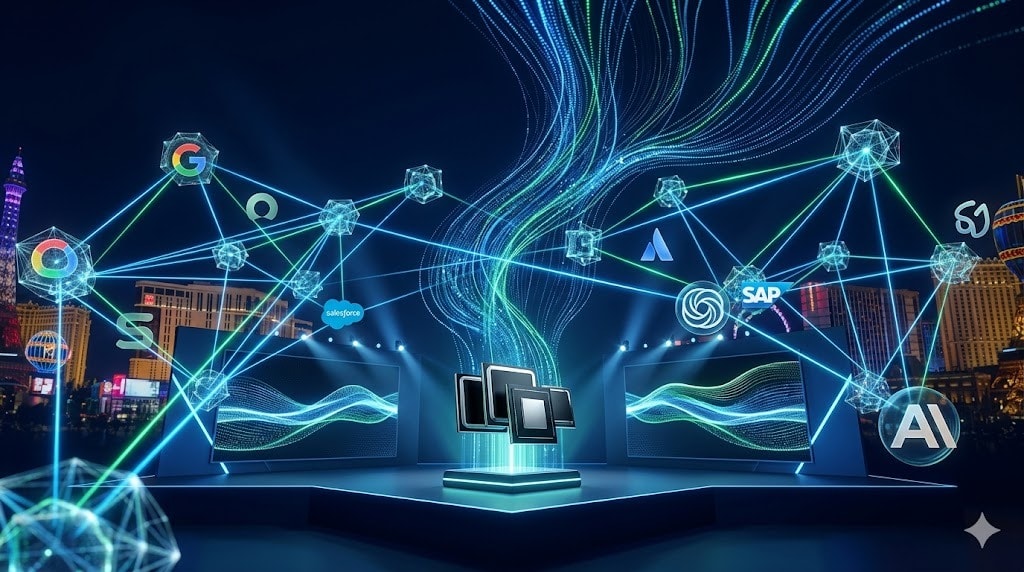
Google Cloud stopped showing AI agent demos. On April 22, 2026 in Las Vegas, during the opening keynote of Google Cloud Next 2026, Sundar Pichai and Thomas Kurian made a different bet: stack the whole tower — from silicon to interoperability protocol — and sign every layer with the same name. Vertex AI is gone — the platform is now called the Gemini Enterprise Agent Platform. TPU 8 ships with two variants built for the agentic era. And the Agent2Agent (A2A) protocol, launched a year ago as an open-source proposal, is now in production at 150 organizations with native integrations in ServiceNow, Salesforce, Atlassian, and SAP. The demo cover band gave way to the enterprise product.
Vertex AI becomes the Gemini Enterprise Agent Platform
The first signal is semantic, but it matters. Google has consolidated Vertex AI, Agent Builder, and its Gemini models under a single brand: Gemini Enterprise Agent Platform. The idea is that the coupling between model, agent tooling, and enterprise runtime becomes the product — not three products to snap together.
The platform spans the full lifecycle of an agent: build, test, deploy, optimize. Key additions:
- Agent registries — an enterprise-level catalog of agents, with versioning and access policies
- Shared context — a memory layer shared across agents within the same tenant
- Runtime engines — an isolated, governed execution environment designed for long-running workloads
- Developer platform — 200+ models available, including third-party models like Anthropic's Claude
- No-code agent builder — an agent builder for Google Workspace, running on the same primitives
The implicit message matters: Google accepts that its enterprise customers will also use Claude, Llama, or other frontier models. The lock-in is no longer the model — it's the orchestration platform around it. That's the same bet Amazon placed with its $25 billion investment in Anthropic and the Trainium expansion — infrastructure beats model exclusivity.
A2A crosses 150 organizations in production
The most revealing piece of the keynote wasn't a launch. It was a number. The Agent2Agent protocol — an open standard for agents from different vendors to discover each other, collaborate, and delegate tasks — is now in production at 150 organizations. And the list of native integrations paints a precise portrait of the 2026 enterprise market:
- ServiceNow — IT ops and ITSM agents
- Salesforce — Agentforce across CRM, service, marketing
- Atlassian — Jira, Confluence, tickets and issues
- SAP — ERP, finance, supply chain
Native A2A support ships in the most-used agent frameworks: Google Agent Development Kit, LangGraph, CrewAI, LlamaIndex Agents, Semantic Kernel (Microsoft), and AutoGen. In other words, A2A no longer just exists — it is becoming the default plumbing of enterprise agentic software, independent of cloud or framework.
The canonical use case Google described: a Salesforce Agentforce agent detects churn risk on an account, delegates retention planning to a Vertex AI agent, which queries a ServiceNow agent about recent support tickets, then hands the recommendation back to Agentforce. None of the three needs to understand the others' internal architecture. That's exactly the interoperability pattern Stripe previewed on the payments side with the MPP (Machine Payments Protocol) — a pass-through protocol each party adopts because the cost of not adopting is falling outside the graph.
TPU 8: one chip for agentic inference, one for training
On silicon, Google unveiled its eighth-generation Tensor Processing Units, designed for the specific workloads of the agentic era.
| Variant | Target | Optimization |
|---|---|---|
| TPU 8t | Training | Frontier models at very large scale |
| TPU 8i | Inference | Agentic workloads — long sessions, multi-turn, high concurrency |
The hardware split between training and inference is the most interesting piece. Agents no longer look like traditional inference workloads. A production agent can run for minutes or hours, accumulate context, call tools, and wait on external responses. The compute profile is very different from batch one-shot inference. The TPU 8i is the first mainstream silicon explicitly designed for that profile — a positioning Nvidia is pushing with Vera Rubin and Groq 3 LPX.
The underlying thesis is the same one carried by NeoCognition with its $40M seed for self-learning agents: reliable agents aren't calls to a bigger model — they're systems that run long and learn from their environment. That changes the silicon you need.
$750 million to train the partner ecosystem
In parallel, Google Cloud announced a $750 million fund for its 120,000-member partner network — global consulting firms, system integrators, ISVs, and channel partners. The envelope covers five workstreams:
- Agentic value identification across client portfolios
- Prototyping custom agents
- Building and deploying in production
- Upskilling partner teams
- Google forward-deployed engineers embedded with integrators
This is the signal that was missing to read the playbook. Google isn't betting on a direct motion to the Fortune 500 — it's betting that agents arrive at the customer via Accenture, Deloitte, Capgemini, and the hundreds of regional integrators. Partner upskilling is the distribution layer. That's exactly the playbook Databricks built — and it's no coincidence Ion Stoica, Databricks co-founder, angel-invested in NeoCognition.
Project Mariner, managed MCP, Workspace Studio
Three more announcements deserve to be called out, because they complete the full stack.
Project Mariner — A web-browsing agent, presented as production-ready, able to run multi-step workflows in web interfaces that weren't designed for automation. That's the direct counter-play to Anthropic's Computer Use and OpenAI's Codex Desktop mode. Everyone wants to be the action layer that clicks in place of the user.
Managed MCP — Model Context Protocol, launched by Anthropic in 2024 and now the de facto standard, is offered as a managed version across all Google Cloud services. Every GCP service automatically exposes its MCP endpoint. That's the enterprise mirror of what we've seen emerging with Figma's Canvas Agents MCP.
Workspace Studio — An agentic IDE for building custom workflows on Gmail, Docs, Sheets, Drive, and Meet. The positioning is to do to Google Workspace what app builders like Lovable or Kilo Code do to the web: vibe coding for business workflows.
ServiceNow promoted to strategic partner of the year
Same day, ServiceNow was named Google Cloud Partner of the Year 2026 across four categories: Global Business Applications, Agentic AI Innovation, Financial Services & Insurance, and Workspace Platform. The two companies jointly announced a suite of solutions including:
- 5G Autonomous Network Operations — anomaly detection and remediation on telco networks
- Retail Operations — agents managing demand, pricing, and inventory
- IT Autonomous Ops — incident triage, diagnosis, and remediation
Under the hood: Gemini Enterprise + ServiceNow AI Platform + ServiceNow AI Control Tower + Workflow Data Fabric + BigQuery. What makes it interesting is that ServiceNow and Google Cloud aren't reselling the same layer — each keeps its own surface, but A2A bridges them. It's the demonstration that the protocol isn't a marketing stunt: it's the interface contract that lets two front-end competitors agree to interoperate.
The positioning vs OpenAI and Anthropic
Google Cloud Next 2026 is the first major keynote since OpenAI's record $122 billion close at a $852 billion valuation and Anthropic's release of Claude Opus 4.7 at 87% on SWE-Bench. Google's bet is explicitly the opposite.
| Axis | OpenAI / Anthropic | Google Cloud |
|---|---|---|
| Model | One frontier model, closed, sold via API | Gemini + Claude + Llama + 200 others |
| GTM | Self-serve + ChatGPT / Claude Enterprise | Integrators + Fortune 500 partners |
| Protocol | MCP (Anthropic) — tools | A2A (Google) — agent-to-agent |
| Silicon | Nvidia GPU / Trainium clusters | Vertically integrated TPU 8 |
| Position | The brain | The central nervous system |
Put another way: OpenAI and Anthropic want to be the single brain everyone plugs their apps into. Google accepts multiple brains, but wants to be the nervous system that makes them talk and provides the substrate. It's a bet closer to the history of the cloud than to the history of LLMs.
What this means for the ecosystem
Three strategic readings follow the keynote.
A2A just won. Agent interoperability is no longer a debate. 150 organizations in production, ServiceNow / Salesforce / Atlassian / SAP native, every major open-source agent framework — the protocol has crossed the threshold where not supporting it is a competitive disadvantage. Agent startups that ship now without an A2A plan will get downgraded in enterprise RFPs before the demo even starts.
Agentic inference prices are going lower. TPU 8i plus a bigger share of the workload staying inside a Google tenant instead of leaving for external APIs equals the unit cost of an agentic token collapsing. For platforms selling agent consumption (Factory, Cursor, Emergent), it's both margin pressure and a chance to scale without imploding.
The Idlen principle hits the core question. An agent running for thirty seconds on a well-prompted task is institutionalized idle model — compute paid for that doesn't compound. A2A + shared context + runtime engines convert that idle capacity into compounding effect: each agent in a chain enriches the context of the next. For developers building on the @idlen/chat-sdk or monetizing their AI apps, this direction confirms the thesis: agents that live in your environment long enough to get good win — and they win by collaborating.
Bottom line:
- Google Cloud Next 2026 opened in Las Vegas on April 22, 2026, with a keynote by Sundar Pichai and Thomas Kurian.
- Vertex AI is rebranded Gemini Enterprise Agent Platform — a unified platform to build, deploy, govern, and optimize agents.
- The A2A protocol is in production at 150 organizations, with native support in ServiceNow, Salesforce, Atlassian, SAP, LangGraph, CrewAI, LlamaIndex, Semantic Kernel, and AutoGen.
- The TPU 8 series ships with an 8t (training) and 8i (agentic inference) variant.
- A $750M fund for upskilling the 120,000-member Google Cloud partner ecosystem.
- ServiceNow named Partner of the Year 2026 across four categories, with a co-developed 5G, retail, and IT ops agent suite.
- Project Mariner, managed MCP, and Workspace Studio complete the full stack.
The opening keynote of Google Cloud Next 2026 won't have produced a smarter model than OpenAI's or Anthropic's. That's not the bet. The bet is that, as tens of thousands of enterprises move to production in the next eighteen months, they'll pick the vendor that gives them silicon, platform, interoperability protocol, and an integrator network to land all of it in one place. Google put the four pieces on the same table. It remains to be seen how many enterprises sit down.
Sources:
- Introducing Gemini Enterprise Agent Platform — Google Cloud Blog
- Google Cloud Next 2026: News and updates — Google Blog
- Google Cloud Commits $750 Million to Accelerate Partners' Agentic AI Development
- Agent2Agent protocol (A2A) is getting an upgrade — Google Cloud Blog
- ServiceNow and Google Cloud Unite AI Agents for Autonomous Enterprise Operations
- Google Cloud Next 2026: the full-stack bet against OpenAI and Anthropic — TNW