Open Source vs Proprietary AI: What's the Future for Developer Tools?
Open source AI (Llama, Mistral, DeepSeek) vs proprietary AI (GPT-4, Claude, Gemini): compare cost, privacy, performance, and self-hosting options. A complete guide for developers choosing AI-powered tools in 2026.
Open Source vs Proprietary AI: What's the Future for Developer Tools?
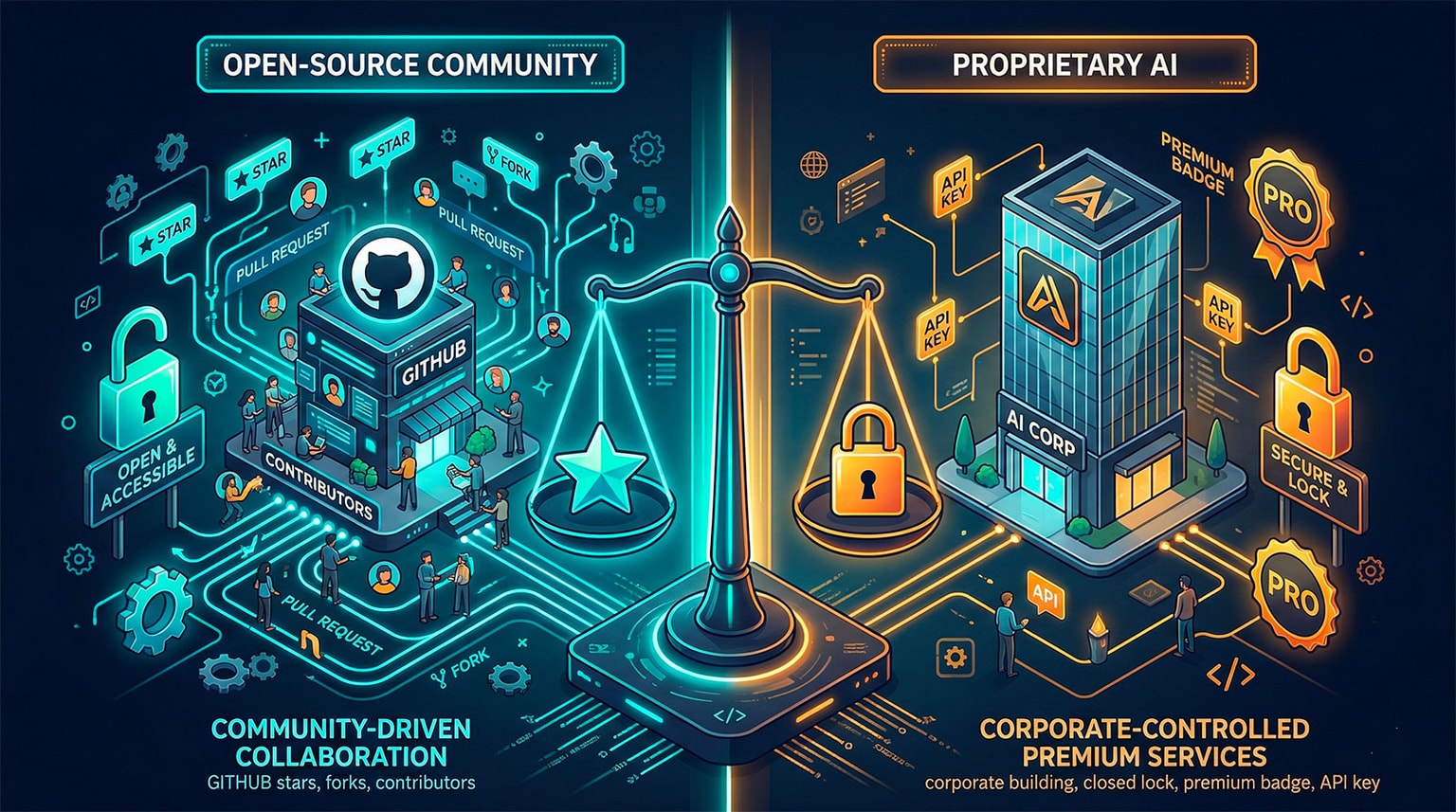
The developer tools landscape is undergoing its most dramatic shift in decades. On one side, proprietary AI giants like OpenAI (GPT-4), Anthropic (Claude), and Google (Gemini) deliver polished, high-performance models through paid APIs. On the other, an open source revolution led by Meta (Llama), Mistral AI, and DeepSeek is rapidly closing the gap, offering developers unprecedented control over their AI infrastructure.
For developers and engineering teams, this is not an abstract debate. As one of the defining tech trends transforming development in 2026, the choice between open source and proprietary AI affects your costs, data privacy, product architecture, and long-term vendor independence. Get it wrong, and you lock yourself into expensive APIs or spend months managing infrastructure you did not need.
This guide breaks down everything you need to know to make the right decision in 2026.
The Current Landscape: Key Players
Proprietary AI Models
These models are developed by companies that keep their weights, training data, and architecture closed. You access them exclusively through paid APIs or platform subscriptions.
| Model | Company | Strengths | Pricing (per 1M tokens) |
|---|---|---|---|
| GPT-4o | OpenAI | Multimodal, fast, strong reasoning | $5 input / $15 output |
| Claude 3.5 Sonnet | Anthropic | Superior coding, 200K context, safety | $3 input / $15 output |
| Claude Opus 4 | Anthropic | Best-in-class complex reasoning | $15 input / $75 output |
| Gemini 1.5 Pro | 1M token context, multimodal | $3.50 input / $10.50 output | |
| GPT-4o mini | OpenAI | Cost-effective, good performance | $0.15 input / $0.60 output |
Open Source AI Models
These models release their weights publicly, allowing anyone to download, run, modify, and deploy them.
| Model | Organization | Strengths | License |
|---|---|---|---|
| Llama 3.1 405B | Meta | Largest open model, strong reasoning | Llama Community |
| Llama 3.1 70B | Meta | Best balance of size and performance | Llama Community |
| Mistral Large 2 | Mistral AI | Multilingual, strong coding | Apache 2.0 |
| DeepSeek V3 | DeepSeek | Coding benchmark leader, MoE architecture | MIT |
| Qwen 2.5 72B | Alibaba | Multilingual, math, coding | Apache 2.0 |
| Gemma 2 27B | Small but powerful, on-device | Gemma License | |
| Phi-3 Medium | Microsoft | Compact, surprisingly capable | MIT |
Head-to-Head Comparison: 7 Critical Dimensions
1. Performance and Quality
The performance gap between open source and proprietary models has narrowed dramatically, but differences remain.
Where proprietary models still lead:
- Complex multi-step reasoning (Claude Opus 4 and GPT-4o dominate agentic benchmarks)
- Very long context comprehension (Claude's 200K window is better calibrated than open source alternatives)
- Nuanced instruction following and safety alignment
- Multi-turn conversation coherence across extended sessions
Where open source models have caught up or surpassed:
- Standard code generation (DeepSeek V3 matches GPT-4o on HumanEval and MBPP)
- Translation and multilingual tasks (Mistral Large 2 and Qwen 2.5 excel here)
- Domain-specific tasks after fine-tuning (open models can be specialized)
- Structured output generation (JSON, XML, SQL)
Benchmark comparison (early 2026):
| Benchmark | GPT-4o | Claude 3.5 Sonnet | Llama 3.1 405B | DeepSeek V3 | Mistral Large 2 |
|---|---|---|---|---|---|
| HumanEval (code) | 90.2% | 92.0% | 89.0% | 91.5% | 88.7% |
| MMLU (knowledge) | 88.7% | 88.3% | 87.3% | 87.1% | 84.0% |
| MATH (reasoning) | 76.6% | 78.3% | 73.8% | 78.0% | 70.5% |
| MT-Bench (conversation) | 9.3 | 9.1 | 8.9 | 8.8 | 8.7 |
Verdict: For general-purpose development tasks, open source models are now competitive. For complex architecture decisions, deep debugging, and agentic workflows, proprietary models maintain an edge worth paying for.
2. Cost: API vs Self-Hosting
Cost is often the deciding factor. Here is a realistic breakdown.
API-based proprietary models (pay-per-token):
- Low volume (< 1M tokens/day): $50-200/month
- Medium volume (1-10M tokens/day): $200-2,000/month
- High volume (10-100M tokens/day): $2,000-20,000/month
- Very high volume (100M+ tokens/day): $20,000+/month
Self-hosted open source models:
- Single GPU (RTX 4090, runs 7B-13B models): $1,500 one-time + $50/month electricity
- Small cluster (2x A100, runs 70B models): $3,000-5,000/month cloud rental
- Large cluster (8x A100/H100, runs 405B models): $10,000-25,000/month cloud rental
- Managed inference (Together AI, Replicate, Anyscale): $0.20-2.00 per 1M tokens
The crossover point:
| Monthly Token Volume | Cheaper Option | Estimated Savings |
|---|---|---|
| < 500K tokens/day | Proprietary API | N/A (baseline) |
| 500K - 5M tokens/day | Depends on use case | Minimal difference |
| 5M - 50M tokens/day | Self-hosted open source | 40-60% savings |
| 50M+ tokens/day | Self-hosted open source | 70-90% savings |
Verdict: For startups and small teams, proprietary APIs are usually cheaper and simpler. For scale-ups processing millions of requests, self-hosting open source models delivers massive cost savings.
3. Privacy and Data Control
This dimension matters more than most teams realize until it is too late.
Proprietary APIs:
- Your prompts and data are sent to third-party servers
- Most providers offer data processing agreements (DPAs)
- OpenAI and Anthropic state they do not train on API data (but policies can change)
- Enterprise tiers (Azure OpenAI, AWS Bedrock) offer better data isolation
- You cannot audit what happens to your data
Open source self-hosted:
- Data never leaves your infrastructure
- Full audit trail of every request and response
- Compliant with GDPR, HIPAA, SOC 2 by design
- No dependency on third-party privacy policies
- You control data retention and deletion
Hybrid approach (increasingly popular):
- Route sensitive data (customer PII, proprietary code, financial data) to self-hosted models
- Use proprietary APIs for non-sensitive tasks (documentation, boilerplate generation)
- Implement a routing layer that classifies request sensitivity automatically
Verdict: If you handle regulated data, healthcare records, financial information, or sensitive IP, open source self-hosting is the safest path. For general development work, proprietary APIs with enterprise agreements are usually sufficient.
4. Customization and Fine-Tuning
One of the most compelling advantages of open source models is the ability to adapt them to your specific needs.
What you can do with open source models:
- Full fine-tuning: Retrain the entire model on your domain data (expensive but powerful)
- LoRA/QLoRA: Efficient fine-tuning that modifies only a small fraction of parameters (cost-effective)
- RAG integration: Combine the model with your private knowledge base
- Custom tokenizers: Optimize for your specific programming languages or domain terminology
- Distillation: Train a smaller, faster model from a larger one for production use
- Quantization: Reduce model size (e.g., from 16-bit to 4-bit) to run on cheaper hardware
What you can do with proprietary models:
- Fine-tuning (limited): OpenAI offers fine-tuning for GPT-4o mini; Anthropic and Google have similar offerings
- System prompts: Customize behavior through instructions (no weight changes)
- RAG integration: Works well with external knowledge retrieval
- No architecture modifications: You cannot change the model structure
- No distillation: You cannot create smaller versions
Real-world example: A fintech company fine-tuned Llama 3.1 70B on 500,000 code review examples from their codebase. The result outperformed Claude 3.5 Sonnet on their internal code review benchmarks by 15%, at one-tenth the inference cost.
Verdict: If your use case is specialized (specific programming language, domain jargon, company-specific patterns), open source fine-tuning delivers a significant advantage. For general-purpose use, proprietary models are excellent out of the box.
5. Developer Experience and Ecosystem
The tools, libraries, and community surrounding each approach affect day-to-day productivity.
Proprietary ecosystem:
- Polished SDKs and documentation
- Managed infrastructure (zero DevOps burden)
- Consistent performance and uptime SLAs
- Easy integration with Cursor, VS Code, and other IDEs
- Rapid iteration on new features and capabilities
Open source ecosystem:
- Hugging Face as a central hub for models, datasets, and tools
- vLLM, TGI, and Ollama for efficient inference serving
- LangChain, LlamaIndex for application frameworks
- Active community contributing improvements, benchmarks, and adapters
- GGUF/GGML formats for running models on consumer hardware
Key open source tools for developers:
| Tool | Purpose | Maturity |
|---|---|---|
| Ollama | Run models locally with one command | Production-ready |
| vLLM | High-throughput serving with PagedAttention | Production-ready |
| Text Generation Inference (TGI) | Hugging Face's optimized serving | Production-ready |
| LM Studio | Desktop app for running local models | Stable |
| llama.cpp | Run models on CPU/consumer GPU | Stable |
| Open WebUI | Self-hosted ChatGPT-like interface | Mature |
Verdict: Proprietary models offer a smoother getting-started experience. Open source requires more setup but provides greater flexibility. The open source ecosystem has matured significantly, and tools like Ollama make local development nearly as simple as calling an API.
6. Reliability and Support
When your production system depends on AI, reliability matters.
Proprietary models:
- 99.9%+ uptime SLAs (enterprise tiers)
- Professional support teams
- Automatic scaling under load
- Model deprecation with migration paths (though sometimes short notice)
- Risk: Provider outages affect all customers simultaneously
Self-hosted open source:
- Uptime depends on your infrastructure and team
- Community support (forums, Discord, GitHub issues)
- Scaling is your responsibility
- Models never get deprecated or changed without your consent
- Risk: Infrastructure management burden falls on you
A common hybrid pattern: Use a proprietary API as your primary provider with a self-hosted open source model as a fallback. If OpenAI or Anthropic experiences an outage, your system automatically routes to the local model. This pattern costs slightly more but delivers near-100% uptime.
Verdict: For teams without dedicated MLOps engineers, proprietary APIs are more reliable. For teams with infrastructure expertise, self-hosting offers more control but requires operational investment.
7. Long-Term Strategic Risk
This is where the decision gets philosophical but also deeply practical.
Risks of proprietary dependence:
- Price increases: OpenAI has raised prices before; nothing prevents it from happening again
- API changes: Breaking changes can require significant refactoring
- Rate limiting: Your growth can be throttled by provider capacity
- Geopolitical risk: API access can be restricted by country or regulation
- Competitive risk: Your provider might launch a competing product using insights from API usage patterns
Risks of open source commitment:
- Talent scarcity: MLOps engineers who can manage AI infrastructure are expensive and rare
- Keeping up: New model releases happen monthly; staying current requires effort
- Security burden: You are responsible for patching vulnerabilities
- Performance ceiling: The best proprietary models may always be slightly ahead
- Hidden costs: Infrastructure, monitoring, maintenance add up
Verdict: Diversification is the safest long-term strategy. Avoid deep coupling to any single model or provider, whether open source or proprietary.
The Impact on Developer Tools
The open source vs. proprietary debate is reshaping every category of developer tools.
Code Editors and IDEs
- Cursor and Windsurf use proprietary models (Claude, GPT-4) for their AI features — see our comparison of Claude Code vs Copilot Workspace vs Cursor Composer
- Continue.dev is an open source IDE extension that supports both local and API models
- Tabby provides self-hosted code completion using open source models
- Void is building an open source alternative to Cursor with local model support
CI/CD and DevOps
- AI-powered code review tools increasingly offer self-hosted options
- Open source models enable private code analysis without sending code to third parties
- Automated testing generation works well with both open and proprietary models
Documentation and Knowledge Management
- RAG-based documentation tools benefit from open source models (no data leaves your servers)
- Internal knowledge bases can use fine-tuned open models for better domain understanding
- Proprietary models often produce higher-quality prose for public-facing documentation
Vibe Coding Platforms
- Lovable, Bolt, and similar platforms rely heavily on proprietary models for their AI capabilities
- Future platforms may offer a "bring your own model" option as open source models improve, further fueling the rise of AI-native applications
- The trend toward vibe coding creates an interesting tension: users want simplicity (proprietary APIs) but also ownership (open source values)
Decision Framework: Which Approach Is Right for You?
Choose Proprietary APIs If:
- You are a small team (< 10 developers) without dedicated MLOps
- Your token volume is under 5 million per day
- You need the absolute best performance for complex reasoning tasks
- You want to ship quickly without infrastructure overhead
- Your data sensitivity is moderate (standard SaaS, no regulated data)
- You are building consumer-facing products where quality matters most
Choose Self-Hosted Open Source If:
- You process high token volumes (5M+ per day)
- Data privacy is non-negotiable (healthcare, finance, defense)
- You need to fine-tune models on proprietary data
- You have MLOps expertise on your team
- Long-term cost optimization is a priority
- You want to avoid vendor lock-in entirely
Choose a Hybrid Approach If:
- You want the best of both worlds
- Different parts of your system have different requirements
- You want a fallback strategy for outages
- You are transitioning from proprietary to open source gradually
- You need to comply with regulations in some areas but not others
Recommended hybrid architecture:
[User Request] --> [Router/Classifier]
                        |
            +-----------+-----------+
            |                       |
    [Sensitive Data]         [General Tasks]
            |                       |
    [Self-hosted Llama 3]    [Claude API]
            |                       |
    [Internal DB only]       [Standard logging]
What the Future Holds
Predictions for 2026-2027
- Open source models will match proprietary quality for 90% of coding tasks. The remaining 10% (complex architecture, multi-file refactoring, agentic workflows) will take longer to close.
- Hybrid architectures will become the default. Most serious engineering teams will use both open source and proprietary models, routed intelligently based on task requirements.
- "Open source" licensing will get more nuanced. Expect new licenses that allow commercial use but restrict certain large-scale deployments. The definition of "open" will remain contested.
- Inference costs will drop 5-10x. Hardware improvements (NVIDIA Blackwell, AMD MI400, custom silicon) and software optimization (quantization, speculative decoding) will make self-hosting dramatically cheaper.
- Small models will surprise everyone. Models under 10 billion parameters, running on laptops and phones, will handle most routine coding tasks competently.
- Developer tool companies will offer model-agnostic platforms. Rather than betting on one model, tools will let developers choose (or automatically select) the best model for each task — a key competency for the emerging AI full-stack developer role.
Supplementing Your AI Tool Costs with Idlen
Whether you choose open source, proprietary, or a hybrid approach, AI tools represent a real cost for developers. Subscriptions for Cursor, Claude Pro, GitHub Copilot, and cloud GPU rentals add up quickly.
Idlen helps offset those costs with zero additional effort:
- Install the Idlen extension on your AI coding tools (Cursor, VS Code, ChatGPT, Claude)
- Earn $40-100/month from non-intrusive, developer-focused ads
- Revenue flows in while you code normally -- no extra work required
- Use the earnings to fund your API costs, GPU rentals, or tool subscriptions
Think of it as making your AI tools partially pay for themselves. The $50-100/month from Idlen can cover a Cursor Pro subscription or a significant portion of your API bill.
Start earning with Idlen -- offset your AI tool costs ->
Frequently Asked Questions
Is open source AI good enough to replace proprietary models like GPT-4 or Claude?
For many tasks, yes. Models like Llama 3, Mistral Large, and DeepSeek V3 now match or exceed proprietary models on standard coding benchmarks. However, proprietary models still lead on complex reasoning, long-context tasks, and multi-step agentic workflows. The best strategy for most teams is a hybrid approach. Explore our guide to the best AI coding assistants in 2026 to compare the tools built on these models.
Is it cheaper to self-host open source AI models?
It depends on your scale. Self-hosting requires GPU infrastructure costing $2,000-10,000+ per month. At low volumes, API-based proprietary models are cheaper. At high volumes (millions of tokens per day), self-hosting open source models becomes significantly more cost-effective, with savings of 40-90%.
Which open source AI model is best for coding in 2026?
DeepSeek Coder V3 and Code Llama 3 lead for code generation. Mistral Large excels at code review and multi-language tasks. For on-device coding assistance, Phi-3 and Gemma 2 offer strong performance at small model sizes. The best choice depends on your hardware, language requirements, and whether you need general intelligence or specialized coding ability.
Can I use open source AI models for commercial projects?
Most open source AI models allow commercial use, but licenses vary. Llama 3 uses a permissive community license (commercial use allowed for companies with < 700M monthly active users). Mistral models are Apache 2.0 (fully permissive). DeepSeek uses an MIT-style license. Always read the specific license before deploying.
How do I get started with self-hosting AI models?
The simplest path: install Ollama on your machine (curl -fsSL https://ollama.com/install.sh | sh), then run ollama run llama3.1 to start chatting with a local model. For production serving, look into vLLM or TGI deployed on cloud GPU instances. Start with a 7B-parameter model and scale up as your needs grow.
What about the environmental impact of self-hosting vs. API usage?
Proprietary API providers typically achieve better GPU utilization because they batch requests from many customers. Self-hosted models may waste GPU cycles during low-traffic periods. However, you can mitigate this by using spot instances, auto-scaling, or sharing GPU resources across multiple models.
Related Articles
- Best AI Coding Assistants in 2026: Claude vs Copilot vs Cursor -- Compare the tools that use these models
- Vibe Coding: How AI Is Changing Developer Work -- The new paradigm
- Secure AI-Generated Code: A Developer's Guide -- Security considerations for AI-assisted development
- Tech Trends Transforming Development in 2026 -- The broader landscape
- 15 AI Tools That Actually Improve Developer Workflow -- Tools that work with both open source and proprietary models
Earn passive income while you code
Install Idlen and earn money from your idle browser time. Zero extra work, 100% privacy.