SpaceX Grabs a $60 Billion Option on Cursor — Musk Pulls Tesla, xAI, and Vibe Coding Into the Same Orbit
On April 21, 2026, SpaceX revealed a partnership with Cursor carrying a $60 billion option to acquire the company before the end of 2026. If the option isn't exercised, SpaceX pays $10 billion for joint work. The deal pulls vibe coding into the Musk orbit following the xAI acquisition.
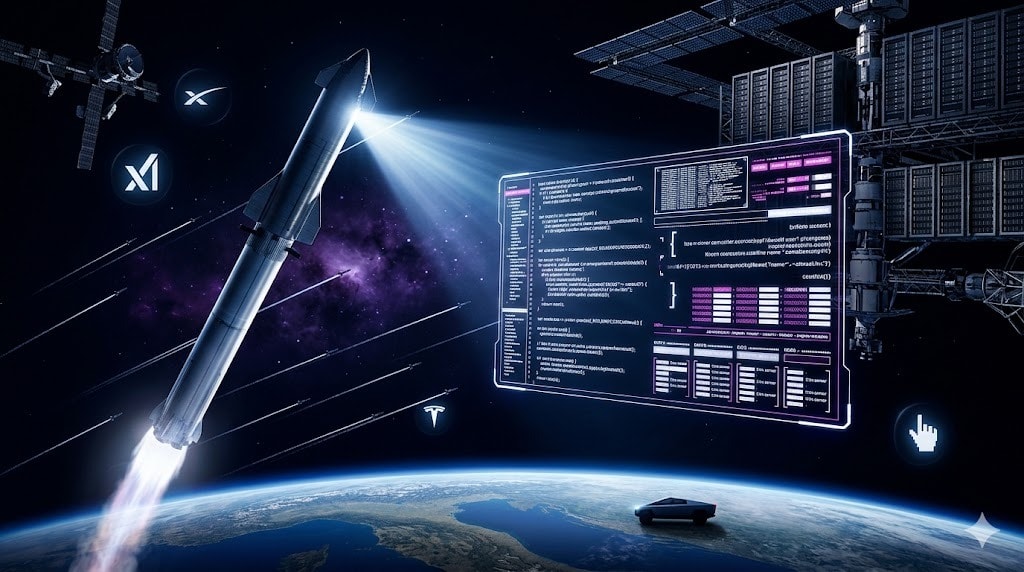
The buyer isn't who anyone expected. On April 21, 2026, SpaceX — Elon Musk's rocket company, not xAI, not Tesla — revealed a strategic partnership with Cursor (Anysphere) carrying a $60 billion option to acquire the startup, exercisable before the end of 2026. If the option isn't taken, SpaceX will pay $10 billion for "our work together." The deal lands two months after SpaceX absorbed xAI as part of Musk's restructuring, and days after Cursor opened talks for a $2 billion round at a $50 billion valuation with a16z and Nvidia. Vibe coding just entered the Musk orbit — with a 20% premium on Cursor's last market valuation.
Deal structure — $10 billion without the option, $60 billion with it
The partnership SpaceX announced covers three distinct components:
| Component | Amount | Condition |
|---|---|---|
| R&D partnership | $10 billion | Firm payment if the acquisition option isn't exercised |
| Acquisition option | $60 billion | Exercisable through December 31, 2026 |
| AI collaboration | Shared compute and Starlink satellite access | Partial exclusivity framework |
The underlying economics are interesting. Cursor just crossed $2 billion in ARR — the fastest B2B company in history to hit that bar, in roughly three years. The implied multiple at $60 billion is 30x ARR — not far from the $50 billion multiple the company was targeting with a16z and Nvidia two weeks earlier. But the option mechanic changes the story: SpaceX locks in the right to buy at $60 billion even if Cursor's public valuation runs away, while capping its downside at $10 billion if the combination doesn't work.
For existing Anysphere shareholders — including founders Michael Truell, Sualeh Asif, Arvid Lunnemark, and Aman Sanger, and early investors Thrive Capital, Andreessen Horowitz, and the OpenAI Startup Fund — it's a guaranteed floor above the last market clearing price. For SpaceX, it's a fixed-price call option on one of the two most strategic assets in vibe coding (the other being GitHub Copilot, inside the Microsoft orbit).
Why SpaceX, not xAI — and why it changes everything
The most important detail is who the buyer is. Musk announced in February 2026 that SpaceX would acquire xAI, consolidating the three Musk entities (Tesla, SpaceX, xAI) around a coherent plan: solar-powered data centers, deployed in orbit via Starlink constellations, training and serving the next generation of AI models. The Cursor deal isn't led by xAI. It's led by SpaceX — that is, by the entity that will go public in the coming quarters and that now owns xAI internally.
The signal is clean: Musk doesn't want Grok to stand alone as an asset priced in isolation. He wants to park every AI capability (models, agents, coding tools, inference) on SpaceX's balance sheet to arrive at the IPO with a full-stack story — rocket to data center to model to developer. Cursor is the developer layer of that story.
The numbers back up the positioning. SpaceX today sits around $400 billion in secondary valuation. Adding Cursor at $60 billion is meaningful but not indigestible on that balance sheet. Doing the same at the xAI level — where the valuation is blurrier — would have been much harder to justify publicly.
The direct counter-play to Google, OpenAI, and Anthropic
The announcement lands a week from Google Cloud Next 2026 and its full-stack bet on the Gemini Enterprise Agent Platform, TPU 8, and the A2A protocol. Each of the three major labs is now locking down its developer layer:
| Lab | Developer layer | Model |
|---|---|---|
| OpenAI | Codex Desktop + Agents SDK | GPT-5.4, GPT-6 Spud |
| Anthropic | Claude Code + native App Builder | Claude Opus 4.7 |
| Workspace Studio + ADK | Gemini 3.1 Pro | |
| SpaceX / xAI | Cursor ($60B option) | Grok 4.20 → Grok 5 |
What changes with the Cursor deal is that Musk is no longer building his own developer surface. He's buying the biggest one. Cursor today counts millions of paying developers, with enterprise penetration that has 4x'd since Q4 2025. Integrating xAI into Cursor would give Grok an instant distribution channel that neither Codex nor Claude Code had at launch — and that OpenAI is desperately rebuilding through Codex Desktop.
The strategic read is simple: Cursor becomes the developer front-end of the full SpaceX / xAI stack. Starlink provides the network backbone. SpaceX provides orbital compute. xAI provides the model (Grok, Grok 5). Cursor provides the interface. Tesla, eventually, provides the physical application layer (cars, Optimus robots).
The tensions an acquisition would force on Cursor
If the option is exercised, three tensions will need to resolve.
Model mix. Cursor built its reputation on neutrality — developers pick Claude, GPT-5, Gemini, or Grok depending on the task. Usage measured on Cursor Composer 2 and Kimi K2 showed developers refuse to be locked in. Acquisition by SpaceX / xAI puts that neutrality under pressure. Would Grok become the default? How long before Anthropic pulls its privileged access to Claude Opus 4.7 in a product now owned by a direct Claude competitor?
Team culture. Anysphere's founders are four MIT engineers known for disciplined craft and an academic-engineering culture. SpaceX runs hard physical engineering with Musk's direct management style. Bridges between those kinds of cultures have gone both ways — Zappos-Amazon held, Twitter-Musk didn't.
Regulation. An acquirer that already owns a dominant satellite network (Starlink), a vehicle platform (Tesla, with its data stack), a social network (X), and that adds the most-deployed coding tool in the world… will attract FTC and European Commission attention. Recent inquiries on digital sovereignty in France and AI consolidation suggest the deal will make more regulatory noise than technical noise.
What this means for the vibe coding ecosystem
Three second-order effects are worth tracking.
The independence window is closing for app builders. Lovable at $400M ARR, v0 from Vercel, Bolt via StackBlitz, Kilo Code, and Emergent in India at $100M raised all come under pressure to either get acquired, align with a major lab, or find a marketable neutrality angle. Cursor's precedent shows that even the category leader didn't try to hold out to IPO.
Parallel agents become the new normal. Cursor 3 shipped the Agent Window and parallel agents, Emergent Wingman and Factory Droids followed. With Cursor in the Musk orbit, the "autonomous agent orchestration" pattern becomes the standard — not a differentiator.
The Idlen principle hits the real underlying pressure. A developer running three agents in parallel on Cursor 3 is monetizing their orchestration skill. Cursor monetizes the session; the models behind it monetize the token. The economy at stake in the SpaceX / Cursor deal is about who captures the rent as tokens become nearly free and value migrates to the agentic layer. For developers publishing via the @idlen/chat-sdk, that's exactly the structural question: who pays whom, and where in the chain the value anchors.
Bottom line:
- SpaceX announced on April 21, 2026 a partnership with Cursor (Anysphere) carrying a $60 billion acquisition option exercisable through the end of 2026.
- If the option isn't exercised, SpaceX pays $10 billion for the joint R&D partnership.
- The deal lands two months after SpaceX's acquisition of xAI and less than two weeks after Cursor opened talks for a $50B round with a16z and Nvidia.
- Implied multiple: roughly 30x ARR ($2B reached in Q1 2026).
- Musk's bet: consolidate Grok, Starlink, SpaceX, Tesla, and Cursor under one balance sheet ahead of SpaceX's IPO.
- Historic reference point: FTX sold its Cursor stake in 2023 for $200,000 — that same stake would be worth $3 billion today.
The $60 billion option on Cursor isn't just a record. It's the confirmation that AI developer tools are now strategic assets at the same level as semiconductor foundries and satellite constellations. Musk saw earlier than others that vibe coding isn't a software category — it's the interface layer between AI agents and the world's 50 million developers. The question now isn't whether Cursor will be acquired, but whether the FTC will let a company that owns Starlink, Tesla, Grok, and Cursor exist inside the same legal entity before year-end 2026.
Sources:
- SpaceX says it can buy Cursor later this year for $60 billion or pay $10 billion for 'our work together' — CNBC
- SpaceX is working with Cursor and has an option to buy the startup for $60B — TechCrunch
- SpaceX partners with Cursor on AI training, floats potential $60B acquisition — SiliconANGLE
- SpaceX partners with AI startup Cursor, may buy it for $60 bn — Phys.org
- Bankman-Fried's FTX sold its Cursor stake for $200,000 in 2023. It would be worth $3 billion today — CoinDesk